Flux Core Welders Compared by Amperage and Duty Cycle
The Forney Easy Weld 299 earns the best overall pick, balancing a 40 to 125 amp range with a 19 pound frame. Home garage builders get more reach from the Hobart Handler 140, and tight budgets are served well by the YESWELDER FLUX-125.
Gasless welding solves a specific problem: outdoor repairs where wind scatters shielding gas before it protects the weld. Seven flux core welders were lined up here on amperage range, duty cycle, and wire feed control. Balanced power and portability push the Forney Easy Weld 299 to the top, with the Hobart Handler 140 close behind for bigger garage jobs.
Input voltage, duty cycle, and wire diameter start to conflict once a project gets specific, and that is where most buyers stall. Manufacturer specifications and owner feedback were cross-checked, then matched against common use cases: auto body panels, fence repair, and garage fabrication.
The shortlist, ranked
Forney Easy Weld 299 (125 FC-i)
This 120V flux-core-only welder outputs 40 to 125 amps, covering most mild steel repairs up to 1/8 inch thick. Setup skips the gas tank and regulator entirely, which speeds up a first-time build. Weight stays at 19 pounds, light enough to move between a workbench and a job site.
Pros
- No gas cylinder required for setup
- Output range covers common repair and hobby projects
- Lightweight at 19 pounds for job-site portability
Cons
- Flux-core only, no gas-shielded MIG mode
- 30% duty cycle limits continuous welding at full amperage

Hobart Handler 140
Flux-core and gas-shielded MIG modes both live in this machine, and it handles steel up to 5/16 inch thick in a single pass. A 25 to 140 amp output range stretches from thin patch panels to trailer frame repairs. At 57 pounds, a cart or bench suits it better than repeated trips to a remote site.
Pros
- Handles thicker steel up to 5/16 inch
- Switches to gas-shielded MIG for cleaner welds
- Wide 25-140A range covers light and heavy jobs
Cons
- 57 pounds makes it less portable than lighter models
- Gas-shielded mode requires a separate cylinder purchase

YESWELDER FLUX-125
Gas never enters the equation here; flux-cored wire alone drives outputs between 50 and 120 amps. Buyers who want a straightforward gasless welder without paying for MIG-mode hardware land squarely in its target range. At 14 pounds, it ranks among the lightest units in this lineup.
Pros
- Lowest weight in this comparison at 14 pounds
- Simple flux-core-only design with no gas mode to configure
- Output range suits light-gauge repairs down near 50A
Cons
- 10% duty cycle at max amperage limits long welds
- No gas-shielded MIG option if cleaner beads are needed later

Lincoln Electric Handy MIG
Two knobs handle voltage and wire speed on this flux-core and gas-shielded MIG combo, keeping the learning curve short. Output tops out at 88 amps, a range suited to thinner material like 24 gauge sheet metal up to 1/8 inch steel. Weight lands at 46 pounds, roughly the middle of this group.
Pros
- Simple two-knob interface for new welders
- Both flux-core and gas-shielded MIG capability
- Well-documented setup from a widely recognized welding brand
Cons
- 88A maximum output limits use on steel thicker than 1/8 inch
- 20% duty cycle at 70A slows down longer weld sessions

YESWELDER MIG-205DS PRO
MIG, flux-core, and lift TIG all run through this multi-process machine, which auto-switches between 110V and 220V input. Output climbs to 205 amps on 240V power, enough for steel thicker than most garage welders reach. Voltage and wire speed settings show up on a front-panel digital display.
Pros
- Dual voltage input adds flexibility between outlets
- 205A maximum output handles thicker steel than 120V-only models
- Multi-process design adds lift TIG beyond MIG and flux-core
Cons
- Higher amperage settings require a dedicated 240V outlet
- More setup steps than single-process flux-core-only welders
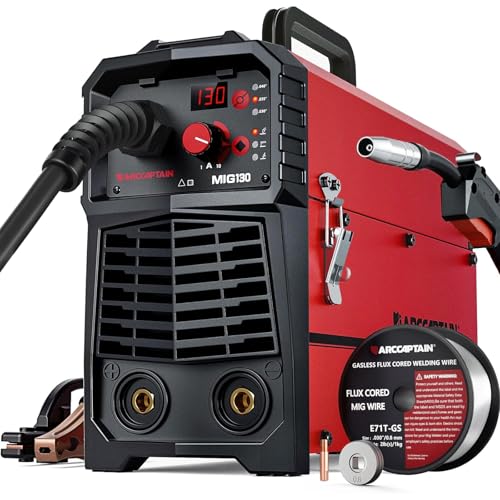
Goplus MIG130 Flux Core Welder
Light repairs and hobby projects fit this flux-core-only unit, with output ranging from 55 to 130 amps. A small case swallows all 18 pounds of it for storage or transport. Skipping gas cylinder setup means welding can start shortly after unboxing.
Pros
- Compact size fits in small storage spaces
- Ready to weld without gas cylinder setup
- 130A maximum output covers most hobby-scale repairs
Cons
- 10% duty cycle at 130A limits continuous use
- Flux-core only, with no gas-shielded MIG upgrade path
Reboot MIG130 Flux Core Welder
A 30 amp minimum output gives this welder finer control on thin material like 20 gauge auto body panels. Adjustable wire speed helps hold back burn-through on light-gauge steel. Weighing 15.5 pounds, it repositions easily around a vehicle during panel repairs.
Pros
- 30A minimum output suits thin sheet metal work
- Adjustable wire speed helps control heat input
- Light 15.5 pound build for repositioning around a vehicle
Cons
- 120A maximum output limits use on thicker structural steel
- Flux-core only, so no gas-shielded MIG mode for cleaner beads
The lineup, side by side
| # | Model | Input Voltage | Best for | Score | Price |
|---|---|---|---|---|---|
| 1 | Forney Easy Weld 299 (125 FC-i) | 120V | Best overall | 9.4 | Check price |
| 2 | Hobart Handler 140 | 120V | Best for home garage projects | 9.1 | Check price |
| 3 | YESWELDER FLUX-125 | 120V | Best budget pick | 8.8 | Check price |
| 4 | Lincoln Electric Handy MIG | 120V | Best for first-time welders | 8.6 | Check price |
| 5 | YESWELDER MIG-205DS PRO | 110V/220V | Best for dual voltage and thicker metal | 8.4 | Check price |
| 6 | Goplus MIG130 Flux Core Welder | 120V | Best for portability | 8.2 | Check price |
| 7 | Reboot MIG130 Flux Core Welder | 120V | Best for thin sheet metal | 8.0 | Check price |
How to pick the right one
What to look for in a flux core welder Duty cycle sets how many minutes out of ten a welder runs at rated amperage before it needs to cool down. A machine rated 20% at 90 amps overheats sooner on thick material than one rated 60% at 130 amps. Input voltage splits into two camps: 120V units plug into a standard household outlet, while 120V/240V dual-voltage machines add headroom for thicker metal. Wire diameter compatibility, usually 0.030 to 0.035 inch flux-cored wire, shapes both penetration depth and cost per spool.
Flux core vs MIG: when gasless welding makes sense No gas tank is needed for flux core welding, since the wire’s own flux core burns to create a shielding gas as it melts. Outdoor jobs and windy garages favor this setup, because gas-shielded MIG welding loses its gas cloud in a breeze and leaves porous welds behind. Cleaner beads with less spatter come from gas-shielded MIG instead, which matters on visible auto body panels. Polarity changes let several models here, including the Hobart Handler 140 and Lincoln Electric Handy MIG, switch between the two processes.
Best flux core welders for home garage projects Trailer frames, gates, and structural steel repairs make up the bulk of garage welding work, and that stock runs thicker than sheet metal. Longer welds on 1/4 inch steel or heavier need a higher duty cycle to avoid interruptions. Up to 5/16 inch steel goes through in a single pass on the Hobart Handler 140, covering most garage fabrication needs. Weight carries less weight in this decision, since these machines typically stay parked on a bench or cart.
Choosing a flux core welder for thin sheet metal or auto body work Burn-through happens fast on thin sheet metal, like 20 gauge auto body panels, when amperage runs too high. A lower minimum output, ideally starting near 30 amps, gives finer control on these thinner materials. Patch panels and light-gauge repairs suit the Reboot MIG130 and YESWELDER FLUX-125, both of which offer low-end amperage settings. Scrap material is worth practicing on first, to dial in wire speed before touching a visible panel.
Common questions
What is the best flux core welder for beginners?
The Lincoln Electric Handy MIG suits beginners well, with a simple two-knob voltage and wire-speed control. Its lower maximum output, 88 amps, also reduces the risk of burning through practice material while learning.
Can flux core welders weld thin sheet metal?
Yes, though amperage control matters. Welders like the Reboot MIG130 and YESWELDER FLUX-125 offer lower minimum output settings around 30 to 50 amps, which helps prevent burn-through on gauges as thin as 20 gauge steel.
Is flux core welding as strong as MIG welding?
Flux core welds can match MIG weld strength when done correctly, since both processes fuse base metal with filler wire. More spatter and slag typically follow flux core, requiring extra chipping, though penetration on thicker steel can run deeper.
How many amps do I need for a flux core welder?
Most home projects on 1/8 to 1/4 inch steel need 90 to 140 amps of output. Thinner sheet metal, under 20 gauge, works better with a welder capable of dropping below 50 amps.
Which flux core welder works best in a home garage?
The Hobart Handler 140 fits most home garages, handling up to 5/16 inch steel with a 140 amp maximum output. A standard household outlet powers its 120V plug, so no dedicated 240V line is required.
Flux core vs MIG welding: which is easier to learn?
Flux core welding is generally easier to learn since there is no gas flow rate to adjust and no wind sensitivity outdoors. Once gas flow is set correctly, MIG welding produces cleaner beads with less post-weld cleanup.
Do flux core welders need shielding gas?
No. Flux core wire carries its own flux compound, which burns and forms a shielding gas as the arc melts the wire. That is why flux core welders skip the gas tank and regulator that gas-shielded MIG setups require.
Is a 120V flux core welder powerful enough for home use?
For most home repairs, garage fabrication, and trailer work, a 120V flux core welder rated 125 to 140 amps covers steel up to 1/4 inch thick. Heavier structural work benefits from a dual-voltage machine like the YESWELDER MIG-205DS PRO, which reaches 205 amps on a 240V outlet.
What is a good duty cycle for a flux core welder?
A duty cycle of 20% or higher at rated amperage suits occasional home repairs without frequent cooldown breaks. Frequent garage fabrication work benefits from machines like the YESWELDER MIG-205DS PRO, rated 60% at 130 amps.
Can a flux core welder switch to gas-shielded MIG later?
Some can. The Hobart Handler 140 and Lincoln Electric Handy MIG both switch to gas-shielded MIG with a polarity change and a gas cylinder added. Flux-core-only models like the Forney Easy Weld 299 have no such upgrade path.
The verdict
Flux core welders trade shielding gas convenience for a bit more post-weld cleanup, a fair swap for outdoor and garage work. Amperage range and portability balance best on the Forney Easy Weld 299, while the Hobart Handler 140 adds versatility for larger projects. Budget-focused buyers still get reliable gasless welding from the YESWELDER FLUX-125 without stepping up to a multi-process machine.


