Capture Cards Compared: 4K Passthrough vs True 4K
Elgato HD60 X suits most console streamers who want steady, near-zero-lag 4K60 HDR10 passthrough even though it records at 1080p60. AVerMedia Live Gamer Ultra 2.1 handles 1440p144 capture for competitive esports play. Creators who need real 4K footage for editing should pick the Elgato 4K X instead of a passthrough-only card.
Elgato HD60 X fits console streamers chasing steady, near-zero-lag passthrough at 4K60 HDR10, yet it records gameplay at 1080p60 rather than full 4K.
Passthrough resolution and recording resolution get confused constantly, and a card that excels at one can fall short on the other. Connection type, capture specs, and owner-reported latency across seven current listings separated real differences from marketing language.
What we recommend

Elgato HD60 X
This external USB 3.0 card sends a 4K60 HDR10 signal straight to a monitor while recording gameplay at 1080p60. PS5 and Xbox Series X/S owners report consistently low passthrough lag in real sessions. Elgato’s own capture utility and OBS both recognize it without extra driver installs.
Pros
- Near-zero-lag passthrough keeps competitive play responsive
- Works with OBS and Elgato software out of the box
- Compact housing fits tight desk setups
Cons
- Caps native recording at 1080p60, not 4K
- No internal PCIe version for a clean case build

AVerMedia Live Gamer Ultra 2.1 (GC551G2)
AVerMedia built this USB-C card around frame rate rather than raw resolution. It records up to 1440p144 or 1080p240 while still passing a 4K60 HDR10 signal through to a display. RECentral adds scene overlays for solo streamers running everything from a single PC.
Pros
- High frame rate capture suits fast-paced shooters and racing games
- HDR10 passthrough preserves console picture quality
- RECentral adds webcam and audio mixing without a second app
Cons
- Higher frame rate modes need a fast USB 3.2 port to avoid drops
- Bulkier than single-purpose external cards

Elgato 4K X
Unlike passthrough-only cards, the 4K X saves native 4K60 HDR10 footage for creators who edit and upload instead of streaming live. The same driver-free USB 3.0 setup carries over from Elgato’s other external cards. Full-resolution source files stay intact for anyone cutting highlight reels later.
Pros
- Records true 4K footage instead of downscaled passthrough
- HDR10 metadata carries through to recorded files
- Simple USB 3.0 setup with no internal installation
Cons
- 4K60 recording produces large files that need fast external storage
- Costs more than 1080p-only capture cards

Razer Ripsaw X
Ripsaw X targets streamers who encode on the same PC that runs the game. A built-in camera and audio mixer routes a webcam and microphone through one USB-C cable. Passthrough tops out at 4K30, short of the 4K60 HDR10 that Elgato’s cards offer.
Pros
- Camera mixer removes the need for a separate USB webcam hub
- Single-cable setup suits cramped single-PC desks
- Works with Nintendo Switch dock output
Cons
- 4K passthrough is capped at 30fps, not 60fps
- No HDR10 support on passthrough or capture
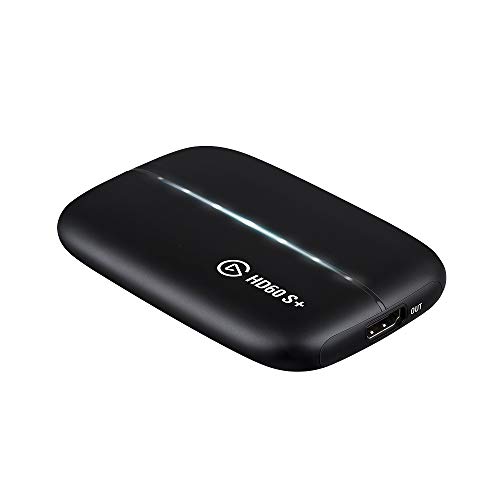
Elgato HD60 S+
HD60 S+ sits a tier below the HD60 X, trading passthrough headroom for a lower price. It still records 1080p60 with HDR10 and passes 4K30 through to a display. Owners describe stable performance capturing PS5, Xbox, and Switch gameplay at this level.
Pros
- HDR10 recording at 1080p60 for a lower entry price than the HD60 X
- Instant Gameview keeps monitor lag minimal
- Broad console compatibility including Switch
Cons
- 4K passthrough limited to 30fps versus 60fps on pricier models
- No native 4K recording option

Mirabox Capture Card (HSV321)
Mirabox skips proprietary software entirely, so the HSV321 shows up in OBS or Zoom as a plain webcam input. It captures 1080p60 while passing 4K30 through an HDMI loop-out port. Casual streamers use it for everyday sessions rather than competitive play.
Pros
- No software install needed on Windows, Mac, or Linux
- Works directly with OBS, Zoom, and Teams
- Low cost of entry for casual streaming
Cons
- Lacks HDR10 support on both capture and passthrough
- Build quality reports vary more than established brands

AVerMedia Live Gamer Mini (GC311)
Size, not spec sheets, drives the Live Gamer Mini’s design, and it fits in a laptop bag next to a controller and cables. It captures 1080p30 and passes 1080p60 through over a single USB 2.0 connection. Travel streamers and LAN attendees favor it for quick setup in a new spot.
Pros
- Small footprint packs easily for travel or LAN events
- USB 2.0 connection works on older laptops without 3.0 ports
- Simple setup with RECentral software
Cons
- No 4K passthrough or capture at any resolution
- Capture frame rate tops out at 30fps, not 60fps
Before you buy
What to look for in a capture card Connection type sets a hard ceiling on data throughput, so confirm USB 3.0, USB 3.2, or an internal PCIe slot before comparing resolution claims. Passthrough resolution only affects what a monitor shows during play, not what gets saved to a file. Latency becomes critical in competitive titles, where a few extra frames of delay throws off timing. Console compatibility lists also differ, and some budget cards skip Nintendo Switch or older hardware entirely.
4K passthrough vs true 4K capture Passthrough resolution describes only what reaches a monitor while gaming, and it never touches the saved recording. Native 4K capture, offered by the Elgato 4K X, stores footage at full 4K60 HDR10 for later editing. Cards like the HD60 X and HD60 S+ pass 4K through but record at 1080p instead. Anyone uploading 4K video needs a card that lists 4K under capture resolution, not just passthrough.
Best setup for single-PC streaming Running the game and the encoder on one machine puts pressure on USB bandwidth and CPU headroom alike. Razer Ripsaw X folds a camera and mic mixer into its single USB-C cable to ease that load. AVerMedia’s RECentral and Elgato’s software both support scene switching from one PC without a second capture box. A streaming rig still needs spare GPU and CPU capacity beyond what the capture card itself uses.
Budget and travel-friendly picks Casual streamers who record occasional sessions rarely need HDR10 or 4K60 capture, so a plug-and-play option like the Mirabox HSV321 covers the basics at a lower cost. Frequent travelers benefit from something compact, and the AVerMedia Live Gamer Mini fits in a bag next to a controller and cables. Both trade higher frame rates and 4K support for size or price. Matching the card to how often someone actually streams avoids paying for specs that sit unused.
How they stack up
| # | Model | Connection | Best for | Score | Price |
|---|---|---|---|---|---|
| 1 | Elgato HD60 X | USB 3.0 | Best overall | 9.4 | Check price |
| 2 | AVerMedia Live Gamer Ultra 2.1 (GC551G2) | USB 3.2 Gen 1 Type-C | Best for high-refresh esports capture | 9.1 | Check price |
| 3 | Elgato 4K X | USB 3.0 | Best for native 4K recording | 8.9 | Check price |
| 4 | Razer Ripsaw X | USB 3.1 Type-C | Best for single-PC streaming | 8.6 | Check price |
| 5 | Elgato HD60 S+ | USB 3.0 | Best value | 8.4 | Check price |
| 6 | Mirabox Capture Card (HSV321) | USB 3.0 | Best budget | 8.2 | Check price |
| 7 | AVerMedia Live Gamer Mini (GC311) | USB 2.0 | Best for portable and travel streaming | 8.0 | Check price |
Frequently asked questions
Do I need a capture card to stream on Twitch?
Only when streaming console gameplay through a separate PC. Single-PC streamers on the same machine as the game can often skip one, though cards like the Razer Ripsaw X still help with camera and audio mixing.
What is the difference between a capture card and a PC’s built-in encoder?
A capture card converts an external HDMI signal into a format a computer can record or stream. A built-in encoder instead compresses video already running on that same PC. Console streamers need the former; PC-only streamers usually rely on the latter through software like OBS.
Can a capture card work with just one gaming PC?
Yes. Cards such as the Razer Ripsaw X and AVerMedia Live Gamer Ultra 2.1 are commonly used on one-PC setups to bring in a second video source, like a camera or another console, alongside the main game feed.
Is 4K60 HDR10 passthrough necessary for console streaming?
It preserves picture quality on a monitor while playing, but it does not change what gets recorded unless the card also lists 4K under its capture resolution, as the Elgato 4K X does.
Which capture card works best with a PS5?
Elgato’s HD60 X and 4K X, along with AVerMedia’s Live Gamer Ultra 2.1, all list PS5 compatibility with HDR10 passthrough support in their current listings.
How much latency does a capture card add?
Cards with dedicated passthrough hardware, like the HD60 X’s Instant Gameview, keep display lag close to unnoticeable. Budget cards without a dedicated passthrough chip can introduce a more noticeable delay on the monitor.
Are budget capture cards from brands like Mirabox reliable?
Owners report the Mirabox HSV321 works reliably for basic 1080p60 capture without HDR10 or high frame rate features. Reliability reports vary more across budget brands than with established names like Elgato or AVerMedia.
Does a capture card work with a Nintendo Switch?
Several models here, including the Elgato HD60 X, HD60 S+, and Razer Ripsaw X, list Switch compatibility for docked capture and passthrough.
USB 3.0 vs USB-C capture card: does the connection type matter?
It sets the bandwidth ceiling. High frame rate modes like 1440p144 on the AVerMedia Ultra 2.1 need a fast USB 3.2 Type-C port, while standard 1080p60 capture runs fine over USB 3.0.
The verdict
Elgato HD60 X remains the strongest all-around choice for console streamers who prioritize steady passthrough over native 4K files. Creators archiving 4K footage should pick the Elgato 4K X instead, and anyone running a single-PC setup gains more from the Razer Ripsaw X’s built-in mixer. Skip the AVerMedia Live Gamer Mini unless portability outweighs frame rate, since its USB 2.0 link caps capture at 1080p30.