Generator Extension Cords: Gauge, Length, and Plug Guide
US Wire’s 74050 10/3 SJTW cord ranks best overall, thanks to lighted ends and a jacket that stays flexible in cold weather. Yellow Jacket’s 2588 delivers strong value for everyday use, while DEWENWILS HOEC15A suits homes running a manual transfer switch through an L14-30 connection.
Wire gauge, length, and plug type decide whether a generator cord keeps a home running, not the brand printed on the jacket. Wire too thin for the load drops voltage and can trip a breaker mid-storm. Seven cords built specifically for generator use appear here, from household-style extensions to L14-30 transfer switch cords.
Gauge ratings and plug configurations trip up many first-time generator owners, since two visually identical cords can carry very different loads. Manufacturer specifications, amperage ratings, plug configurations, and owner feedback on cold and wet durability shaped this ranking of seven cords.
Our top picks

US Wire 74050 10/3 SJTW Extension Cord
Lighted ends on this 10 gauge cord confirm power flow at a glance, without walking back to the generator. Owners running it through winter report the orange SJTW jacket stays flexible in freezing temperatures. A standard NEMA 5-15 plug matches the household-style outlet found on most portable generators.
Pros
- Lighted ends show live current without a multimeter
- Heavy 10 gauge copper limits voltage drop on long runs
- Orange SJTW jacket shrugs off gravel and concrete abrasion
Cons
- NEMA 5-15 plug caps output at 15 amps despite the thicker wire
- No twist lock connector for transfer switch setups
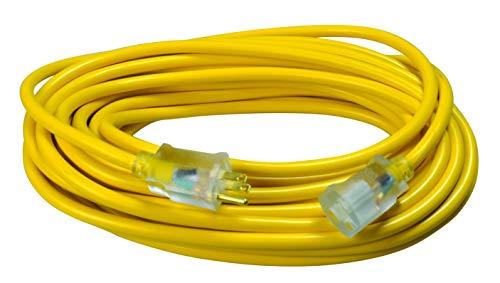
Yellow Jacket 2588 12/3 SJTW Extension Cord
Contractors have relied on this black and yellow 12 gauge cord for decades, and generator owners buy it for the same durability. Fifty feet of SJTW cordage connects a portable generator to a window air conditioner or refrigerator across wet grass. Molded ends resist the cracking that thinner cords develop after one season outdoors.
Pros
- Proven jacket compound resists oil, grease, and UV breakdown
- Molded plug ends outlast lighter duty cords
- Wide retail availability makes replacement quick
Cons
- 12 gauge wire drops more voltage than 10 gauge past 100 feet
- Rated for only 15 amps at 125 volts

Iron Forge Cable 10/3 100 Foot Extension Cord
A hundred feet of 10 gauge SJTW cordage lets a generator sit away from windows and doors during a storm. Reflective jacket striping helps locate the cord in a dark yard while refueling. Detached garages and sheds benefit most from the extra length, though a single NEMA 5-15 connector limits the load.
Pros
- Full 100 foot run skips coupling a second cord
- Reflective striping improves nighttime visibility
- 10 gauge wire keeps voltage sag low at distance
Cons
- Bulkier reel complicates storage compared to shorter cords
- Single 5-15 outlet powers only one appliance at a time

Journeyman-Pro 1004000RC 10/3 SJTW Cord
Ice storm outages inspired this cord’s negative 58 degree Fahrenheit flex rating. Lighted ends confirm the generator is delivering power without a walk to check it. Heavier SJTW jacketing resists the stiffening that thinner cords show once temperatures drop below freezing.
Pros
- Cold flex rating suits ice storms and northern winters
- Lighted plug ends confirm power without a multimeter
- 100 foot length reaches a detached generator location
Cons
- Heavier gauge and length add noticeable reel weight
- Still limited to a 15 amp household style plug

DEWENWILS HOEC15A Generator Power Cord
Homeowners feeding a manual transfer switch need this kind of setup: a 10 gauge, L14-30P twist lock plug splitting into four NEMA 5-20R household outlets. Locking rings on each end keep the connection secure while the generator runs under load. Twenty-five feet suits driveway generators positioned near the transfer switch panel.
Pros
- L14-30P plug matches nearly all transfer switch inlets
- Four 5-20R outlets run several appliances from one generator
- Twist lock rings prevent accidental disconnection under load
Cons
- 25 foot length keeps the generator closer to the house than longer cords allow
- 30 amp split phase rating will not run 240 volt equipment directly

Champion Power Equipment 48035 Power Cord
Champion designed this cord around the L14-30 outlet on its own portable generators, splitting power into four spring loaded 5-20R outlets inside a weatherproof box. Rain stays off the connections, unlike a bare pigtail end exposed to the elements. Generac and other brands sharing the same L14-30 receptacle work with it too.
Pros
- Weatherproof outlet box keeps connections off wet ground
- Spring loaded covers seal unused outlets from rain
- Compatible with any generator using a standard L14-30 outlet
Cons
- Larger distribution box stores less easily than a simple cord
- Champion offers only the 25 foot length in this style

Kolewali 25 Foot Generator Extension Cord
Budget buyers get the same basic function here as pricier options: a 10 gauge, L14-30P plug feeding four 5-20R household outlets over 25 feet. Molded connector blocks replace the weatherproof box found on costlier cords, simplifying the design. Transfer switch compatibility comes without paying extra for housing.
Pros
- Lower cost than boxed distribution cords with the same wire gauge
- Simple molded design has fewer parts that can fail
- 25 foot length reaches most panels from a driveway generator
Cons
- No weatherproof housing covers the four household outlets
- Warranty coverage runs shorter than more established cord brands
How they compare
| # | Model | Wire Gauge | Best for | Score | Price |
|---|---|---|---|---|---|
| 1 | US Wire 74050 10/3 SJTW Extension Cord | 10 AWG, 3 conductor SJTW | Best overall generator extension cord | 9.4 | Check price |
| 2 | Yellow Jacket 2588 12/3 SJTW Extension Cord | 12 AWG, 3 conductor SJTW | Best value for everyday generator use | 9.2 | Check price |
| 3 | Iron Forge Cable 10/3 100 Foot Extension Cord | 10 AWG, 3 conductor SJTW | Best for long distance generator runs | 9.0 | Check price |
| 4 | Journeyman-Pro 1004000RC 10/3 SJTW Cord | 10 AWG, 3 conductor SJTW | Best for cold climate outages | 8.8 | Check price |
| 5 | DEWENWILS HOEC15A Generator Power Cord | 10 AWG, 4 conductor SJTW | Best for transfer switch and panel setups | 8.6 | Check price |
| 6 | Champion Power Equipment 48035 Power Cord | 10 AWG, 4 conductor SJTW | Best for powering multiple appliances at once | 8.3 | Check price |
| 7 | Kolewali 25 Foot Generator Extension Cord | 10 AWG, 4 conductor SJTW | Best budget generator power cord | 8.0 | Check price |
Before you buy
What Gauge and Amperage Does a Generator Cord Need? Wire gauge decides how much current a cord carries without overheating. A 10 gauge cord handles up to 30 amps over shorter runs, while 12 gauge tops out closer to 15 to 20 amps for lighter loads like a lamp or refrigerator. Distance matters too, since voltage drop increases the farther current travels; a 100 foot run needs heavier gauge than a 25 foot cord under the same load. Check the generator’s rated amperage first, because undersized wire can trip breakers or overheat under sustained use.
How Long Should a Generator Extension Cord Be? Generators parked close to a home, garage, or camper suit shorter 25 to 50 foot cords. Longer 100 foot options let a generator sit farther from windows and doors, cutting the risk of exhaust fumes drifting indoors during a storm. Resistance builds with every added foot, though, and that lowers the voltage reaching an appliance. Many owners size up a gauge when choosing a longer cord to offset that drop, especially for sensitive electronics.
NEMA 5-15 vs L14-30: Which Plug Matches Your Setup? A standard NEMA 5-15 cord plugs directly into a generator’s household style outlet, working fine for lamps, fans, or a single appliance. Homes wired with a manual transfer switch usually need an L14-30P twist lock plug instead, matching the switch’s inlet. Several L14-30 cords split into four 5-20R household outlets, letting one generator run multiple devices at once. Mismatched plug types remain the most common reason a cord fails to deliver power despite a running generator.
Best Cords for Cold Weather and Outdoor Use SJTW jacketing resists oil, water, and abrasion better than lighter household cordage, useful when a cord crosses a driveway or lawn. Some cords carry a cold flex rating as low as negative 58 degrees Fahrenheit, staying pliable during ice storms while stiffer jackets crack. Lighted plug ends offer a quick visual check that power is flowing, skipping a trip to the breaker panel. Reflective jacket striping adds visibility for anyone refueling a generator after dark.
Common questions
What gauge extension cord works best for a generator?
Most portable generators pair well with a 10 gauge cord for runs up to 100 feet. Shorter runs under 50 feet powering a single appliance can use lighter 12 gauge cordage.
How long can a generator extension cord run before power drops?
Voltage drop becomes noticeable past 100 feet on a 10 gauge cord under heavy load. Staying under that distance, or stepping up a gauge for longer runs, keeps voltage closer to the generator’s output.
Can two extension cords connect together to reach a generator?
Linking cords adds connection points that raise resistance and moisture risk outdoors. A single cord rated for the full distance delivers steadier voltage with fewer failure points.
Is 10 gauge or 12 gauge better for generator use?
10 gauge wire carries more current with less voltage drop, suiting refrigerators, sump pumps, or multiple appliances. 12 gauge cords fit lighter, single appliance loads over shorter distances.
Which generator cord matches an L14-30 transfer switch?
An L14-30P plug matches the twist lock inlet on a manual transfer switch and generators with a 30 amp locking outlet. A standard NEMA 5-15 plug fits household style outlets for single appliances instead.
Are generator extension cords safe in the rain?
Cords rated SJTW or SJTOW are built for outdoor and wet location use. Keeping connection points off the ground and away from standing water still lowers shock risk during storms.
What makes a generator cord different from a regular extension cord?
Generator cords typically use heavier 10 or 12 gauge wire and configurations like L14-30 that match generator outlets and transfer switches. Standard extension cords usually run lighter gauge wire meant for indoor tools, not sustained outdoor generator loads.
Do generator extension cords hold up in cold weather?
Cords with a cold flex rating stay pliable down to negative 58 degrees Fahrenheit. Standard PVC jacketed cords can stiffen and crack in freezing conditions, so a cold rated jacket matters for winter outages.
Our take
No single cord fits every generator setup, since gauge, length, and plug type depend on load and distance from the house. US Wire’s 74050 covers most single appliance needs, while the DEWENWILS HOEC15A and Champion Power Equipment 48035 suit homes running a transfer switch. Match the cord’s amperage rating to the generator’s output before the next outage hits.