How to Pick a Fuel Can That Won’t Spill on Your Generator
Scepter’s FR1G101 leads this comparison, its flexible spout reaching a generator’s tank without splashing fuel. Briggs & Stratton’s 85043 handles simple backup storage at a low cost. Need one-handed pouring during a blackout? Surecan’s SUR14G rotating nozzle opens with a twist, no second hand required.
Three cans separate themselves from the field. Scepter’s FR1G101 bends its flexible spout right into a generator’s small fill neck, cutting splashback other cans can’t avoid. Briggs & Stratton’s 85043 skips extra features and keeps backup fuel storage affordable. Surecan’s SUR14G rotates open with one hand, a real advantage when a storm has you juggling a flashlight too.
Federal EPA spout rules choke flow to cut vapor loss, not to make pouring easy, and that tradeoff shows up fast at a generator’s cramped tank opening. Steel resists punctures that would crack a poly can, though it adds weight once full. We compared spout design, material, compliance markings and owner reports of spillage during real generator refueling.
How to pick the right one
What should you look for in a generator fuel can? Match spout style to your generator’s tank opening. A wide opening handles a fixed EPA spout fine, but small or recessed openings call for a flexible or rotating nozzle instead. Capacity should track runtime between fills, since a 5 gallon can typically covers 8 to 12 hours on a mid size portable generator. Weight matters too, since a full steel can adds several pounds over poly.
Steel vs poly cans, which fits your storage situation? Poly cans weigh less and never rust, making them the practical default for most home backup storage. Puncture resistance goes to steel, and FM approved models like the Eagle 1210 add a flame arrestor screen that matters near a workbench or other ignition sources. Pick steel if the can shares space with tools, poly if it sits alone in a shed.
Why do EPA and CARB compliance limit which can you can buy? EPA spout rules cut vapor emissions nationwide, while California and a handful of other states enforce the stricter CARB standard on top of that. A can compliant with both, like the Midwest Can 5600 or Scepter FR1G101, sells everywhere and skips the confusion of state specific versions. Check your state’s requirement before ordering an EPA-only can.
How much does pouring control matter during an actual outage? Refueling a hot, recently run generator in the dark and rain is exactly when spillage and fumbling happen. Push button and rotating nozzles, found on the No-Spill 1450 and Surecan SUR14G, cut the two-handed fumbling a basic fixed spout demands. Practicing with your can in daylight beats learning its quirks mid storm.
What we recommend

Scepter FR1G101 Military Fuel Can, 5 Gallon
Originally built to NATO military spec, the FR1G101 uses a removable flexible spout that bends into a generator’s tank without splashing. Heavy duty polyethylene resists cracking through cold winter storage, and a wide handle steadies the can once it’s full. CARB certification means it sells legally in every state, not just EPA-only ones.
Pros
- Flexible spout reaches tight tank openings
- Cold resistant polyethylene body
- Wide handle steadies a full can
Cons
- Bulkier to store than slim cans
- Spout removal needs a firm twist
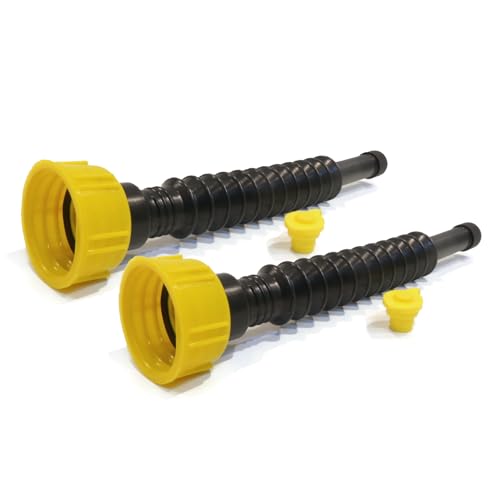
Briggs & Stratton 85043 Gas Can, 5 Gallon
This poly can skips extra features, pairing a standard EPA spout with backup fuel storage rather than frequent pouring. Its fixed spout means pouring technique matters more than on premium cans. Low cost makes stocking two or three easy for extended outages.
Pros
- Low cost for stocking backup fuel
- No parts to lose or replace
- Widely available for replacement
Cons
- Fixed spout pours less precisely
- Not CARB compliant in every state
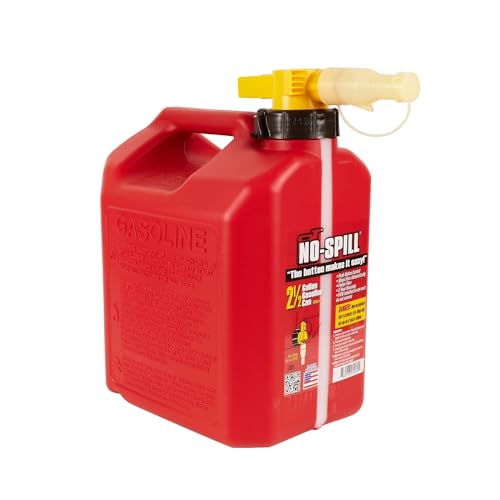
No-Spill 1450 Poly Gas Can, 5 Gallon
A push button spout releases fuel only while pressed, cutting flow the instant you let go. That control matters when topping off a tank without a drip tray underneath. Meeting both EPA and CARB standards, it also includes a built-in air vent that speeds pouring without glugging.
Pros
- Push button spout stops flow instantly
- Vented design pours without glugging
- Cuts spillage near hot generator surfaces
Cons
- Spout mechanism needs occasional cleaning
- Costs more than fixed-spout cans

Eagle 1210 Type I Steel Safety Can, 5 Gallon
Steel construction paired with a flame arrestor screen earns this can FM approval for garages where fuel sits near running equipment. A spring loaded lid closes automatically, sealing vapor between uses. Extra weight when full is the tradeoff for that safety margin.
Pros
- Flame arrestor adds a fire safety margin
- Self closing lid seals vapor automatically
- Steel resists punctures poly can’t survive
Cons
- Heavier to carry when full
- Costs more than poly equivalents

Surecan SUR14G Rotating Nozzle Gas Can, 5 Gallon
This nozzle rotates 360 degrees and opens with a twist instead of fighting a childproof spout two-handed, useful during a storm when a flashlight occupies your other hand. A translucent body shows the remaining fuel level at a glance. Some owners report the rotating joint loosening after several seasons of heavy use.
Pros
- One handed operation in low light
- Translucent body shows fuel level
- Rotating nozzle reaches awkward tank angles
Cons
- Rotating joint can loosen over years
- Premium priced next to basic poly cans

Wavian NATO Jerry Can, 5 Gallon
Powder coated steel and a cam lever lid, built to NATO jerry can spec, survive rougher handling in a truck bed than poly cans manage. A separate flexible spout attaches for pouring, then detaches for compact storage. Its trapezoidal shape stacks efficiently but needs specific storage racks, since it’s less common on store shelves.
Pros
- Steel body survives rough transport
- Cam lever lid seals tightly
- Detachable spout stores compactly
Cons
- Spout attaches separately, an extra step
- Trapezoidal shape needs specific racks

Midwest Can 5600 EPA/CARB Gas Can, 5 Gallon
A spout meeting both EPA and CARB standards lets this poly can sell legally in every state without a separate CARB-only version. The handle sits high for balance when tipping a full can. Auto shutoff is absent here, so pouring still takes a steady hand.
Pros
- Legal for sale in all fifty states
- High mounted handle balances a full can
- Reasonably priced for compliant design
Cons
- No auto shutoff or vent assist
- Spout is fixed, not removable
How they stack up
| # | Model | Capacity | Best for | Score | Price |
|---|---|---|---|---|---|
| 1 | Scepter FR1G101 Military Fuel Can, 5 Gallon | 5 gallons | Best overall | 9.4 | Check price |
| 2 | Briggs & Stratton 85043 Gas Can, 5 Gallon | 5 gallons | Best budget | 8.5 | Check price |
| 3 | No-Spill 1450 Poly Gas Can, 5 Gallon | 5 gallons | Best for spill free pouring | 9.0 | Check price |
| 4 | Eagle 1210 Type I Steel Safety Can, 5 Gallon | 5 gallons | Best steel safety can | 8.8 | Check price |
| 5 | Surecan SUR14G Rotating Nozzle Gas Can, 5 Gallon | 5 gallons | Best for one handed pouring | 8.9 | Check price |
| 6 | Wavian NATO Jerry Can, 5 Gallon | 5 gallons (20 liters) | Best heavy duty steel | 8.6 | Check price |
| 7 | Midwest Can 5600 EPA/CARB Gas Can, 5 Gallon | 5 gallons | Best value poly can | 8.3 | Check price |
Frequently asked questions
What size fuel can works best for a portable generator?
A 5 gallon can covers most portable generators, roughly 8 to 12 hours of runtime per fill depending on load. Bigger generators or longer outages often call for two 5 gallon cans rather than one large, harder to handle container.
Can you store a fuel can with stabilizer already added?
Yes. Fuel stabilizer extends usable fuel life to 12 months or longer in a sealed can, versus a few months untreated. Keep the can in a cool, ventilated spot away from direct sunlight.
Is a metal or plastic gas can safer near a generator?
Both work safely when used correctly, though FM approved steel cans with a flame arrestor, like the Eagle 1210, add protection in enclosed spaces near other ignition sources. Either way, keep the can several feet from a running generator.
Why do new gas cans pour so much slower than old ones?
Current EPA spout designs restrict flow and vent air more slowly to limit vapor escape while pouring. Push button or vented designs, like the No-Spill 1450, mostly offset that slowdown without sacrificing compliance.
Are CARB compliant cans required outside California?
Only California and a few states with matching rules require CARB compliance specifically. A can meeting both EPA and CARB standards works everywhere, so you skip checking state by state.
How long does gasoline stay usable in a sealed fuel can?
Untreated gasoline typically stays usable for 3 to 6 months in a sealed can before it degrades noticeably. Stabilizer extends that window to about a year, useful for a generator kept mainly for emergencies.
Jerry can vs standard gas can, what’s the real difference?
A jerry can, like the Wavian NATO style can, uses a stackable steel body and cam lever lid built for rugged transport, a design that started in the military. Standard gas cans are lighter and cheaper but handle repeated rough use in a truck bed less well.
Can these fuel cans hold diesel instead of gasoline?
Most are rated for gasoline specifically, though a few, including the Scepter and Wavian cans, also handle diesel. Check the label before filling with diesel, since some spouts are gasoline only.
The bottom line
For most generator owners, the Scepter FR1G101 balances a spill resistant flexible spout with cold tolerant, rugged construction. Budget minded buyers stocking backup fuel do fine with the Briggs & Stratton 85043 without overspending. When one handed pouring during an outage matters most, the Surecan SUR14G rotating nozzle earns its higher price.