Which Handheld GPS Holds a Signal Off the Grid?
Garmin’s GPSMAP 67 leads this group with multi band accuracy and long battery life. The eTrex 22x offers the best value for casual hikers. Garmin’s GPSMAP 66i adds two-way satellite messaging for serious backcountry safety.
Garmin’s GPSMAP 67 tops this group, combining multi band accuracy with battery life that outlasts most trips. Casual hikers get the best return from the eTrex 22x. Anyone traveling solo or off grid should weigh the GPSMAP 66i for its satellite messaging.
Reception and endurance decide a handheld GPS more than the map on screen ever will. We weighed satellite accuracy, battery life, mapping detail, ruggedness and messaging ability, since those factors decide whether a unit keeps you oriented deep in the backcountry.
The shortlist, ranked

Garmin GPSMAP 67 Handheld GPS
Multi band satellite reception pairs with a very long battery life and a bright, sunlight-readable screen here. Owners report accurate positioning even under tree cover and inside canyons. Long backcountry trips are where this combination pays off most.
Pros
- Excellent multi band accuracy
- Very long battery life
- Bright, readable display
Cons
- Priced at the higher end
- Physical buttons instead of a touchscreen

Garmin eTrex 22x Handheld GPS
Reliable positioning and preloaded mapping come packed into a compact, affordable body. Two AA batteries keep it running for hours, and owners report it as easy to learn. Weekend hikers make up most of its fan base for that reason.
Pros
- Strong value for the price
- Runs on widely available AA cells
- Simple, compact design
Cons
- Smaller screen than premium models
- No barometric altimeter

Garmin eTrex 32x Handheld GPS
A barometric altimeter and three-axis compass join the compact eTrex body on this model. Owners report the altimeter helps plan elevation gain on climbs. That compass keeps pointing correctly even while standing still, unlike GPS-only bearing.
Pros
- Adds an altimeter and compass over base eTrex models
- Runs on AA cells for easy resupply
- Compact and rugged build
Cons
- Small screen for detailed maps
- Menu system feels dated

Garmin Montana 700 Handheld GPS
A large, glove-friendly touchscreen sets this model apart, suited to vehicle and off-road use as well as hiking. Owners report the bigger display makes reading maps noticeably easier. Size and weight increase accordingly compared with pocket units.
Pros
- Large, easy to read screen
- Glove-friendly touch response
- Suits vehicles and trails alike
Cons
- Larger and heavier than pocket models
- Priced above most competitors here
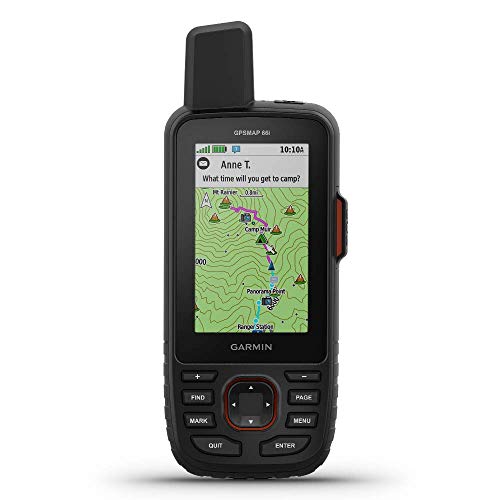
Garmin GPSMAP 66i Handheld GPS
Full mapping pairs with inReach satellite messaging here, letting users send texts and trigger an SOS with no cell signal. Owners heading deep into the backcountry treat two-way communication as a real safety layer. A subscription is required to unlock messaging.
Pros
- Satellite texting and SOS built in
- Accurate mapping alongside messaging
- Adds real peace of mind off grid
Cons
- Messaging requires an ongoing subscription
- Heavier than basic navigation-only units

Garmin eTrex 10 Handheld GPS
Waypoint navigation and geocaching cover the essentials here, in a rugged, low cost body. Owners report it as a dependable starter unit for anyone mainly needing coordinates and a track back to the trailhead. Detailed mapping is not part of the package.
Pros
- Very affordable entry point
- Simple, rugged construction
- Long AA battery life
Cons
- Monochrome screen only
- No detailed color mapping

Garmin Foretrex 701 Ballistic Edition GPS
Wrist mounting keeps hands free for climbing, hunting or paddling with this unit. Owners report the always-visible navigation and long AAA battery life as its biggest draws. A pocket unit becomes awkward exactly where this one stays convenient.
Pros
- Hands-free wrist-mounted design
- Long battery life on AAA cells
- Rugged, lightweight build
Cons
- Small monochrome screen
- No detailed color mapping
How to pick the right one
Why choose a dedicated GPS over a phone? Phones lean on cell towers and drain quickly, losing accuracy right when it matters most. A handheld GPS locks directly onto satellites, holds a position under tree cover, and runs for days on a set of batteries. That reliability is the core reason to carry a separate unit into the backcountry.
How much does satellite reception and accuracy matter? Newer units use multi band and multiple satellite systems, sharpening accuracy in canyons, forests and cities where signals bounce. Demanding terrain favors a multi band model like the GPSMAP 67, which holds a tighter fix than older single band units. Standard GPS and GLONASS reception is plenty on open trails.
AA batteries or rechargeable: which power source fits your trips? Trip length depends entirely on power. AA and AAA units let hikers carry cheap spares and swap them anywhere, suiting multi-day travel far from an outlet. Rechargeable models save money over time but need a power bank on longer trips.
Do you need satellite messaging for safety? Standard GPS units show location but cannot call for help. Models with inReach satellite messaging, like the GPSMAP 66i, let users text and trigger an SOS anywhere with a clear sky view. Solo or remote trips make that two-way link worth the added cost.
Side by side
| # | Model | Reception | Best for | Score | Price |
|---|---|---|---|---|---|
| 1 | Garmin GPSMAP 67 Handheld GPS | Multi band multi GNSS | Best overall | 9.4 | Check price |
| 2 | Garmin eTrex 22x Handheld GPS | GPS and GLONASS | Best value | 9.2 | Check price |
| 3 | Garmin eTrex 32x Handheld GPS | GPS and GLONASS | Best for navigation extras | 9.0 | Check price |
| 4 | Garmin Montana 700 Handheld GPS | 5 inch glove touch | Best large touchscreen | 8.7 | Check price |
| 5 | Garmin GPSMAP 66i Handheld GPS | Two way satellite inReach | Best for safety messaging | 8.5 | Check price |
| 6 | Garmin eTrex 10 Handheld GPS | GPS and GLONASS | Best budget basic | 8.3 | Check price |
| 7 | Garmin Foretrex 701 Ballistic Edition GPS | Wrist mounted | Best wearable | 8.0 | Check price |
Common questions
Do I need a GPS if I already have a phone?
Casual day hikes on marked trails rarely need more than a phone with offline maps. Remote or multi-day travel favors a dedicated GPS, which holds signal and runs for days where a phone loses reception and dies.
What is multi band GPS and does it matter?
Multi band units receive more satellite frequencies, improving accuracy in canyons, dense forest and near tall obstacles. Frequent travel through that kind of terrain makes a multi band model like the GPSMAP 67 noticeably more precise.
Which handheld GPS has the best battery life?
The GPSMAP 67 leads on runtime, while AA units like the eTrex series allow spare batteries for effectively unlimited use. The Foretrex 701 also runs long on AAA cells.
Can any of these send messages without cell signal?
Yes, the GPSMAP 66i includes inReach satellite messaging for two-way texts and an SOS anywhere with sky view. The rest are navigation-only and cannot communicate.
Are handheld GPS units waterproof?
Most carry a water resistance rating sufficient for rain and splashes. Prolonged submersion is still worth avoiding, so check the specific rating listed for each model.
Which handheld GPS is best for beginners?
The eTrex 22x stays easy to learn, compact and affordable while offering preloaded maps. The eTrex 10 works as an even simpler starting point for basic waypoints and geocaching.
Do handheld GPS units come with maps preloaded?
Most include a base map, and models like the eTrex 22x add more detailed preloaded mapping. Additional topographic maps can usually be loaded for finer detail on serious trips.
Is there a wearable handheld GPS option?
The Foretrex 701 mounts on the wrist and keeps hands free, suiting climbing, paddling and hunting. It trades a large map screen for convenience and a very long battery life.
How accurate is a handheld GPS compared to a phone?
Both perform similarly under open sky, but a dedicated GPS holds accuracy better under cover and does not depend on cell data. Multi band units keep the tightest fix in difficult terrain.
The verdict
Garmin’s GPSMAP 67 suits most serious hikers best, balancing multi band accuracy, long battery life and a readable screen. Choose the eTrex 22x for a compact, affordable option on marked trails, or the GPSMAP 66i when off-grid satellite messaging and an SOS button justify the added cost.


