How to Choose a Heat Gun That Won’t Quit Mid-Project
DeWalt D26960K Heat Gun Kit leads for precise LCD temperature control and a durable nozzle set. Wagner Spraytech HT1000 Heat Gun covers paint stripping and thawing for far less. Milwaukee 8988-20 Variable Temperature Heat Gun suits daily trade use with a rugged variable dial.
DeWalt D26960K Heat Gun Kit sets an exact temperature on its display rather than forcing a guess between two settings. Wagner Spraytech HT1000 Heat Gun is the budget choice for paint and thawing jobs. Milwaukee 8988-20 Variable Temperature Heat Gun handles trade use day after day.
Most heat guns quote a similar maximum temperature, so the real differences hide in how finely that heat gets dialed in and how much air moves it. We compared temperature ranges, control type, airflow settings, included nozzles and cord length, then weighed those against owner reports on overheating and element life.
The shortlist, ranked
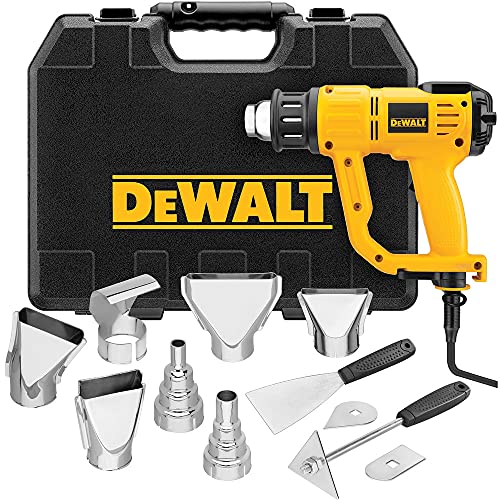
DeWalt D26960K Heat Gun Kit
DeWalt lets you dial an exact temperature on the D26960K’s display instead of guessing between two settings, which matters for shrink tubing and vinyl wrap as well as paint. Overload protection shuts the element down before it burns out. The included nozzle kit and hard case cover most jobs out of the box.
Pros
- Sets a precise temperature via LCD display
- Overload protection extends element life
- Complete nozzle kit ships in a hard case
Cons
- Bulkier than basic single setting guns
- Costs more than dual setting models

Milwaukee 8988-20 Variable Temperature Heat Gun
Milwaukee builds the 8988-20 for people using a heat gun most days on a jobsite. A variable dial spans a wide range, and high airflow strips paint quickly while low airflow keeps plastic work controllable. The impact resistant housing and hanging hook survive daily transport.
Pros
- Built for daily jobsite use
- Wide variable temperature range
- Hanging hook and long cord suit repeat use
Cons
- Minimum temperature runs high for delicate plastics
- Nozzles are sold separately

Makita HG6530VK Variable Temperature Heat Gun
Makita spans an unusually wide range on the HG6530VK, from gentle warming up to paint stripping heat. A digital display with memory settings recalls your last used temperature. Three airflow settings run quieter than most guns at low output.
Pros
- Wide low to high temperature span
- Memory setting recalls the previous temperature
- Three airflow speeds suit delicate work
Cons
- Digital controls adjust slower than a dial
- Heavier than single setting guns

Wagner Spraytech HT1000 Heat Gun
Wagner keeps the HT1000 to two settings, enough for softening old paint, loosening stuck fittings and thawing pipes. Fine control is absent, so shrink wrapping electronics is not its job. A stand up base frees both hands during longer tasks.
Pros
- Affordable for occasional household use
- Stands upright for hands free work
- Nothing to configure before starting
Cons
- No fine temperature control
- Minimum setting runs too hot for delicate materials

Seekone Heat Gun 1800W
Seekone bundles a variable dial, a wide temperature range and four nozzles at a price close to basic guns. Crafters and hobbyists working on resin, vinyl and small repairs pick this one first. The lighter duty build shows during long continuous sessions.
Pros
- Broad temperature range for the price
- Four nozzles included in the box
- Low setting suits craft and vinyl work
Cons
- Housing feels less robust than trade models
- Grip gets hot during long jobs

Porter-Cable PC1500HG Heat Gun
Porter-Cable keeps the PC1500HG light and slim, which matters when working overhead on window frames or soffits for an hour. Two heat settings and a support stand cover common tasks without extra complexity. Fine control gives way to comfort here, so pair it with a scraper for paint work.
Pros
- Light and comfortable for overhead work
- Support stand allows hands free heating
- Controls stay simple with no menus
Cons
- Only two heat settings available
- Cord runs shorter than rivals

Genesis GHG1500A Dual-Temperature Heat Gun
Genesis ships the GHG1500A with a set of nozzles, an easy first purchase for a specific project. It handles paint softening, thawing and adhesive removal competently. Without variable control, distance from the work becomes your only fine adjustment.
Pros
- Nozzles included at a low price
- Adequate power for household jobs
- Integrated stand holds it upright between uses
Cons
- Only two settings, no dial
- Plastic housing shows wear quickly
Compared at a glance
| # | Model | Temperature range | Best for | Score | Price |
|---|---|---|---|---|---|
| 1 | DeWalt D26960K Heat Gun Kit | 150 to 1100 degrees Fahrenheit | Best overall | 9.4 | Check price |
| 2 | Milwaukee 8988-20 Variable Temperature Heat Gun | 570 to 1000 degrees Fahrenheit | Best for trade use | 9.2 | Check price |
| 3 | Makita HG6530VK Variable Temperature Heat Gun | 120 to 1100 degrees Fahrenheit | Best temperature range | 9.0 | Check price |
| 4 | Wagner Spraytech HT1000 Heat Gun | 750 and 1000 degrees Fahrenheit | Best budget | 8.8 | Check price |
| 5 | Seekone Heat Gun 1800W | 122 to 1202 degrees Fahrenheit | Best value with accessories | 8.6 | Check price |
| 6 | Porter-Cable PC1500HG Heat Gun | Two heat settings | Best lightweight option | 8.3 | Check price |
| 7 | Genesis GHG1500A Dual-Temperature Heat Gun | 572 and 1000 degrees Fahrenheit | Best starter kit | 8.0 | Check price |
How to choose
Why temperature control matters more than wattage A two setting gun strips paint and thaws pipes, but its lower setting still runs hot enough to melt vinyl and ruin shrink tubing. Variable dials give a usable spread, and digital control returns to the exact figure a material calls for. Buy variable control if plastics, electronics or wraps are part of the job.
How airflow changes what the heat actually does Temperature describes the air leaving the nozzle, while airflow decides how much of that heat reaches the work. High airflow strips paint fast and scatters small parts. Low airflow gives control for shrink tubing and delicate repairs, so guns with two or three fan speeds outperform single speed models on paper.
Which nozzle fits which job A deflector nozzle protects glass while stripping window frames. A reflector wraps heat around pipe for soldering or shrink sleeving. A concentrator focuses on a small area, and a spreader widens the pattern for flat panels. Working without the right nozzle is the most common reason a surface scorches.
How to use a heat gun safely around old paint The nozzle stays dangerously hot for several minutes after switching off, so use the stand rather than setting the gun face down. Keep it moving to avoid igniting the substrate, and work in ventilated space with eye protection on. Homes built before 1978 may contain lead paint, and heating it above roughly 1000 degrees Fahrenheit releases toxic fumes, so test first.
Common questions
What temperature strips paint best?
Most paint softens between about 500 and 700 degrees Fahrenheit. Higher isn’t better, since excess heat scorches the wood underneath and can vaporize lead in older paint. Start low, keep the gun moving and scrape as soon as paint wrinkles.
Can a hair dryer replace a heat gun?
No. A hair dryer tops out around 140 degrees Fahrenheit, a fraction of what a heat gun produces. It might warm a sticker enough to peel but won’t strip paint or shrink tubing properly.
What temperature works for heat shrink tubing?
Most tubing activates between roughly 200 and 350 degrees Fahrenheit. Use low airflow and a reflector nozzle so heat wraps the tube evenly, and stop once it conforms rather than continuing until it scorches.
Is it safe to use a heat gun on old paint?
Only after checking for lead. Homes built before 1978 may have lead paint, and heating it releases toxic fumes. Test first, and if lead turns up, follow lead safe removal practice or choose a chemical stripper instead.
How long can a heat gun run continuously?
Most tolerate extended use but benefit from a cool down between long sessions. Models with thermal overload protection shut themselves off rather than burning the element. Blocking the air intake against clothing overheats a gun fastest.
What wattage should I look for in a heat gun?
Between 1500 and 1800 watts covers nearly all DIY and trade tasks. More watts mainly speeds heat up rather than raising the ceiling, so control features matter more than raw wattage.
Can heat guns thaw frozen pipes?
Yes, and it’s safer than an open flame. Keep the gun moving along the pipe rather than holding one spot, start from the tap end, and never apply high heat to plastic pipe.
How do I avoid scorching wood while stripping paint?
Keep the nozzle a few inches away and constantly moving, use the lowest setting that softens paint, and scrape immediately behind the heat. A deflector nozzle protects adjacent glass and trim.
Variable dial vs two setting heat gun: which do I need?
A two setting gun handles paint and thawing fine but runs too hot for plastics, wraps or electronics on its low setting. A variable dial or digital control gives the range those materials need. Choose variable control whenever the job isn’t just paint.
The verdict
DeWalt D26960K Heat Gun Kit is the one tool that handles paint, plastic and electronics safely, thanks to real temperature precision and a complete nozzle kit. Choose Wagner Spraytech HT1000 Heat Gun for paint stripping and thawing alone, or Milwaukee 8988-20 Variable Temperature Heat Gun if the gun sees daily use.