How to Choose the Right Heated Cat Bed for Winter
The K&H Thermo-Kitty Heated Cat Bed leads for indoor comfort with steady low wattage warmth. Cats living outdoors or in a garage need the weatherproof K&H Outdoor Heated Cat House instead. The Necoichi Self-Warming Bed is the budget pick, since it needs no electricity at all.
Older cats, thin-coated breeds, and outdoor cats all regulate body temperature more easily with a heated bed. Which bed fits depends on where the cat actually sleeps.
Safety features like chew-resistant cords and auto shutoff vary widely between models. We compared wattage, materials, and indoor versus outdoor ratings to sort genuinely safe options from risky ones.
Our top picks

K&H Pet Products Thermo-Kitty Heated Cat Bed
A 4-watt heating pad warms this bed roughly 12 degrees above room temperature, cozy without overheating. Common electric pet bed concerns get addressed here through a chew-resistant cord cover and MET safety listing. The washable cover comes off separately from the heating element.
Pros
- Low power draw safe for continuous use
- Chew-resistant cord suits curious cats
- Removable, washable outer cover
Cons
- Heating pad itself cannot be machine washed
- Raised bolster style takes up more floor space

K&H Pet Products Outdoor Heated Cat House
This is a fully enclosed shelter rather than an open bed, suited to community or barn cats facing cold weather. A thermostatically controlled heater switches on below roughly 46 degrees Fahrenheit, saving power in mild conditions. Moisture and wind resistance beat indoor-style beds by a wide margin.
Pros
- Fully enclosed shelter blocks wind and rain
- Thermostat saves power in mild weather
- Suits multiple outdoor or feral cats
Cons
- Bulkier footprint than indoor beds
- Higher wattage than indoor-only models

Necoichi Self-Warming Cat Bed
A reflective inner layer bounces a cat’s own body heat back instead of using a heating element. No cord, outlet, or thermostat is needed, which keeps things simple for apartments or crate use. Cats that like curling up tightly suit the donut shape well.
Pros
- Zero electricity cost or fire risk from cords
- Fully machine washable including the liner
- Portable, works anywhere without an outlet
Cons
- Provides less warmth than an actively heated pad
- Less effective in genuinely cold rooms or garages

K&H Pet Products Thermo-Kitty Fashion Splash Heated Bed
Stiff or older cats climb into this shallow, low-profile design far more easily than into deep bolster beds. The same 4-watt heating pad and thermostat control found across K&H’s Thermo-Kitty line power it. A plush cover adds cushioning for cats with joint sensitivity.
Pros
- Low sides make entry easy for stiff joints
- Consistent gentle warmth for arthritis relief
- Plush cover adds extra cushioning
Cons
- Less enclosed feel for cats that prefer hiding beds
- Cover fabric shows wear faster than heavier canvas
PetFusion Ultimate Cat Bed with Self-Warming Insert
A self-warming insert pairs with a sturdy, tear-resistant outer shell built for households with multiple cats sharing space. No cord means less risk of tangled wires when several cats compete for the same bed. Reinforced stitching handles frequent scratching and kneading better than softer alternatives.
Pros
- Durable shell resists scratching damage
- No cords to manage in multi-cat homes
- Machine washable cover and insert
Cons
- Warmth is passive, not actively heated
- Less warmth for cats with thin or short coats
Petmate Kitty Kup Heated Cat Bed
A curled-up cat gets wrapped by the cup-style shape, concentrating warmth in a smaller area than open bolster beds. Shelves, window perches, and tight apartment corners all suit its compact footprint. Extended daily use stays safe thanks to a low-wattage element.
Pros
- Small footprint fits shelves and perches
- Cup shape retains heat efficiently
- Low wattage suited to all-day use
Cons
- Too small for larger cat breeds
- Less padding underneath than bolster-style beds
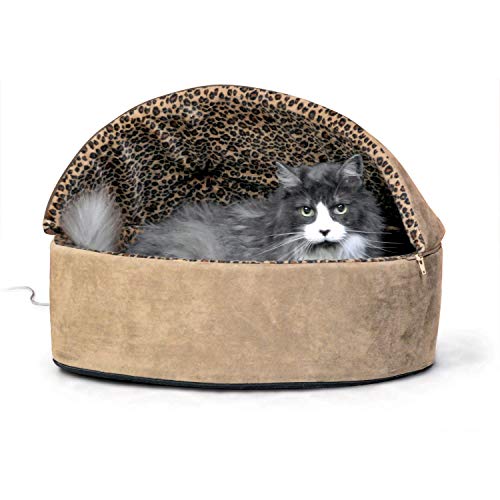
K&H Pet Products Thermo-Kitty Bed Deluxe
Extra insulation against cold concrete or tile floors comes from a thicker, higher-loft cushion compared to thinner heated pads. The same 4-watt thermostat-controlled element found across K&H’s Thermo-Kitty line still does the heating. Elevated foam construction keeps cats further from cold ground drafts.
Pros
- Extra loft insulates against cold floors
- Same trusted low-wattage heating element
- Sturdy enough for garage or basement placement
Cons
- Bulkier and heavier than standard flat pads
- Higher price than the standard Thermo-Kitty bed
How they compare
| # | Model | Wattage | Best for | Score | Price |
|---|---|---|---|---|---|
| 1 | K&H Pet Products Thermo-Kitty Heated Cat Bed | 4 watts | Best overall | 9.3 | Check price |
| 2 | K&H Pet Products Outdoor Heated Cat House | 25 watts | Best for outdoor cats | 9.0 | Check price |
| 3 | Necoichi Self-Warming Cat Bed | 0, no electricity | Best budget | 8.7 | Check price |
| 4 | K&H Pet Products Thermo-Kitty Fashion Splash Heated Bed | 4 watts | Best for arthritic or senior cats | 8.8 | Check price |
| 5 | PetFusion Ultimate Cat Bed with Self-Warming Insert | 0, self-warming insert | Best for multi-cat households | 8.5 | Check price |
| 6 | Petmate Kitty Kup Heated Cat Bed | 4 watts | Best for small spaces | 8.2 | Check price |
| 7 | K&H Pet Products Thermo-Kitty Bed Deluxe | 4 watts | Best for cold garages or basements | 8.0 | Check price |
What to look for
What makes a heated cat bed safe A MET or UL safety listing on the electrical component matters before anything else. Chew-resistant cord covers count most for kittens and cats that gnaw on cables. Auto-regulating thermostats prevent overheating far better than fixed-temperature pads, so check for one before buying.
Best heated beds for indoor cats versus outdoor shelters Indoor beds usually run on 4 to 6 watts and sit in a room with stable temperature. Outdoor shelters need weatherproof shells and higher wattage, often 20 to 25 watts, to handle real cold and moisture. Using an indoor-only bed outside risks water damage and electrical failure, so match the design to where the cat actually sleeps.
Heated pads versus self-warming beds for arthritis and thin coats Real warmth above room temperature comes from electric heated pads, useful for arthritic or thin-coated cats. Self-warming beds simply reflect a cat’s own body heat and add no external warmth, which suits already-warm rooms better. Cordless self-warming options remove fire and chewing risk entirely, a fair tradeoff for less committed warmth.
Choosing a bed for senior cats and multi-cat homes Low-profile beds without a high step-in edge help older cats with stiff joints. Cordless or self-warming beds reduce tangled wires and competition over one outlet in multi-cat households. Durable, reinforced fabric holds up longer when several cats share one bed, which matters more than wattage in that situation.
Common questions
Are heated cat beds safe to leave on all day?
Most low-wattage thermostat-controlled beds, typically 4 to 6 watts, are rated for continuous use. Always check the manufacturer’s listing before leaving one unattended overnight.
What is the best heated cat bed for outdoor cats?
An insulated, weatherproof shelter like the K&H Outdoor Heated Cat House is built for outdoor exposure, unlike indoor-only heated pads.
Do heated cat beds use a lot of electricity?
No, most run on 4 to 6 watts, comparable to a small nightlight. Continuous use adds very little to a power bill.
Can kittens use a heated cat bed safely?
Yes, as long as the bed has a chew-resistant cord cover, since kittens are more likely to gnaw on exposed wiring.
Self-warming vs heated cat bed, which is better for arthritis?
An actively heated bed provides more consistent warmth for arthritic joints. Self-warming beds only reflect existing body heat, which helps less on cold floors.
Is a heated cat bed worth it for indoor cats?
It can help thin-coated, senior, or cold-sensitive cats. Healthy adult cats in warm homes may not need one at all.
How do I clean a heated cat bed?
Most covers are machine washable, but the heating pad or cord unit itself should only be wiped down, never submerged or washed.
What wattage is safe for a cat heating pad?
4 to 6 watts is standard for indoor use and generally considered safe for prolonged contact, unlike higher-wattage outdoor shelter heaters.
Do heated cat beds need to be plugged in constantly?
Thermostat-controlled models are designed for it and cycle power on and off as needed. Self-warming beds skip this question entirely, since they use no electricity.
What is the difference between a cat heating pad and a heated cat bed?
A heating pad is a standalone accessory placed inside any bed or crate. A heated cat bed integrates the element directly into the cushion, so there is nothing extra to position.
The bottom line
Indoor cats generally do well with a low-wattage, thermostat-controlled bed like the K&H Thermo-Kitty, while outdoor or garage cats need a fully insulated, weatherproof shelter instead. Self-warming beds work as a safe, cordless middle ground for households wary of electrical pet products. Match wattage and design to where the cat actually sleeps before choosing a bed.


