Conductance vs Load Testing: Picking a Battery Tester
TOPDON BT100 tests the widest CCA range with conductance readings suited to daily shop use. Foxwell BT705 adds a built-in thermal printer for warranty slips. Schumacher DSR124 applies a true amp load instead of estimating health, catching marginal batteries the others might pass.
TOPDON BT100 rates the broadest span of battery types without extra accessories, a strong fit for a home garage or small shop. Its screen holds every result, but the unit skips a printer, so nothing prints for a warranty file.
Conductance testers read internal resistance in seconds; load testers pull real current and take longer. That gap changes how each tool handles a marginal battery near the end of its life. We compared published CCA ranges, testing methods, charging system checks and owner feedback on durability across current listings.
How to pick the right one
What to look for CCA range decides whether a tester rates a motorcycle battery, a passenger car battery or a dual-battery diesel truck. Conductance testers work fast without pulling real current, while direct load testers draw actual amperage for a clearer pass or fail. Charging system checks matter as much as the battery test, since a failing alternator wears down a good battery over time.
Best for occasional home garage use A mid-range conductance tester like the TOPDON BT100 covers most passenger vehicles without extra accessories. Compact units such as the Ancel BA101 suit quick checks between oil changes. Neither needs the bulk or cost of a shop-grade load tester for infrequent use.
Best for fleet and professional shops Shops testing dozens of batteries daily benefit from printed slips, which the Foxwell BT705 provides for warranty paperwork. Dual-battery diesel trucks need the higher CCA ceiling built into the Ancel BST500. Continuous-duty analog testers like the Associated Equipment 6029 skip the digital parts that wear out under constant shop use.
When a load test beats a conductance estimate A battery can pass a conductance test and still fail under real cranking load, especially once it ages. Direct load testers like the Schumacher DSR124 and Solar BA327 apply actual current for a more definitive result. This gap matters most before a warranty claim or a long trip.
The shortlist, ranked

TOPDON BT100
A 100 to 2000 CCA range spans motorcycle batteries through heavy-duty trucks in one device. Cranking voltage and alternator ripple show up in the same test cycle. Results appear on a color LCD, skipping the need for a companion app.
Pros
- Rates motorcycles through heavy trucks without swapping tools
- Charging system check runs automatically with every test
- Color LCD shows results without a phone app
Cons
- No printer for warranty paperwork
- Conductance reading can vary slightly from a true load test
Foxwell BT705
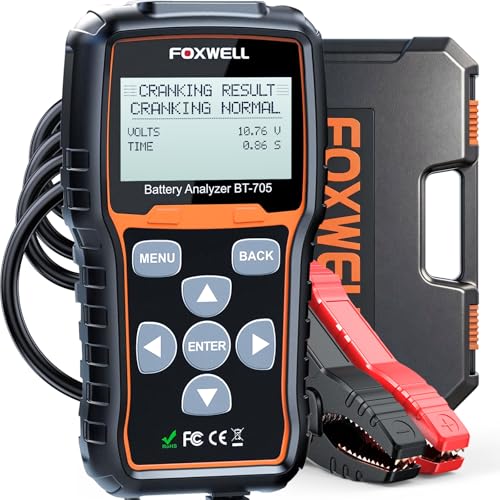
A thermal printer built into the housing outputs a slip listing CCA, health percentage and charging voltage. Twelve and 24 volt support extends coverage to light trucks and some commercial rigs. Rubberized casing survives daily handling on a shop counter.
Pros
- Printed slips speed up warranty claim paperwork
- 12V and 24V support covers more vehicle classes
- Rubberized housing holds up to daily shop use
Cons
- Printer paper adds a recurring cost
- Housing runs larger than pocket-style testers

Schumacher DSR124 Digital Battery Load Tester
A rotary dial sets the battery type before the unit applies an actual current load instead of estimating from conductance. Pass, warning or replace shows directly on the digital display. Cable clamps are rated for the higher draw a true load test needs.
Pros
- Real load test flags marginal batteries conductance testers miss
- Heavy-gauge clamps handle sustained current draw
- Pass, warning or replace readout needs no interpretation
Cons
- Maximum CCA runs lower than conductance-based rivals
- Each test takes longer than a conductance check

Ancel BST500
A 3000 CCA ceiling rates dual-battery diesel setups that smaller testers cannot judge accurately. Cranking and charging tests run separately, so a weak alternator does not get blamed on a good battery. Extended clamps in the kit fit larger commercial terminals.
Pros
- 3000 CCA ceiling suits dual-battery diesel trucks
- Extended clamps fit oversized commercial terminals
- Cranking and charging results stay separate and clear
Cons
- More capability than a single-battery passenger car needs
- No printer for fleet recordkeeping

Solar BA327
A 100 amp analog load test reads on a needle gauge instead of waiting for a digital estimate. Starting and charging tests share the same clamps as the battery check. An all-metal housing tolerates regular drops on a concrete shop floor.
Pros
- Needle gauge gives an instant, unambiguous reading
- Metal housing survives shop floor drops
- Costs less than most digital load testers
Cons
- No dedicated AGM or Gel setting
- Needle reads harder to see in bright sunlight

Associated Equipment 6029
High-amperage analog load design targets shops running test after test all day. Starter draw and alternator output checks use the same heavy-duty clamps as the load test. Skipping digital electronics cuts down on what can fail under constant use.
Pros
- Built for back-to-back testing all shift
- No digital electronics to fail under daily strain
- Heavy-duty clamps hold up under sustained high current
Cons
- Bulkier and heavier than portable digital units
- No memory or printout to track past results

Ancel BA101
A straightforward conductance test covers 100 to 1700 CCA for common car and light truck batteries. Cranking voltage and basic alternator output share one small LCD. Compact size lets it fit a glovebox instead of a shop drawer.
Pros
- Low cost suits occasional home garage checks
- Compact enough for glovebox storage
- Cranking and alternator checks appear together
Cons
- Lower CCA ceiling than heavy-duty rivals
- No 24V support for larger commercial vehicles
Side by side
| # | Model | CCA range | Best for | Score | Price |
|---|---|---|---|---|---|
| 1 | TOPDON BT100 | 100-2000 | Best overall | 9.4 | Check price |
| 2 | Foxwell BT705 | 100-2000 | Best for shop documentation | 9.1 | Check price |
| 3 | Schumacher DSR124 Digital Battery Load Tester | up to 1200 | Best for heavy-duty load testing | 8.8 | Check price |
| 4 | Ancel BST500 | 100-3000 | Best for heavy trucks and dual-battery systems | 8.6 | Check price |
| 5 | Solar BA327 | up to 1000 | Best value | 8.4 | Check price |
| 6 | Associated Equipment 6029 | up to 1000 | Best for continuous professional shop duty | 8.2 | Check price |
| 7 | Ancel BA101 | 100-1700 | Best budget | 8.0 | Check price |
Common questions
What is the difference between a conductance and a load battery tester?
Conductance testers estimate health from internal resistance within seconds. Load testers pull real current to show how a battery performs under actual draw.
Which CCA rating fits a diesel truck battery tester?
Dual-battery diesel trucks often need a tester rated to 2000 or 3000 CCA, above what most passenger car testers cover.
Can a battery tester also check the alternator?
Most testers here include a charging system check that reads alternator output voltage during the same test cycle.
Is an analog or digital battery tester more accurate?
Digital testers give a precise numeric readout. Analog load testers give an instant needle reading that some shops still prefer for speed.
How often should a car battery get tested?
Testing twice a year, before summer heat and before winter cold, catches most failing batteries before they strand a driver.
Do I need a printer on a tester for home garage use?
A printer mainly helps shops documenting warranty claims. A home garage rarely needs one over a standard LCD readout.
Can these testers check AGM and Gel batteries?
Most conductance testers on this list include separate settings for flooded, AGM and Gel chemistries.
What does a replace result mean if the battery still starts the car?
A replace result means the battery is degrading and may fail soon under cold weather or heavy electrical load, even if it still starts today.
Is a heavy-duty tester worth it for a single passenger car?
A heavy-duty tester adds CCA headroom and durability that a single passenger car rarely needs, so a mid-range model like the TOPDON BT100 usually covers it.
Our take
TOPDON BT100 covers the broadest range of everyday vehicles and remains the easiest pick for a home garage or small shop. Shops testing batteries daily should choose the Foxwell BT705 for its printed slips, or the Ancel BST500 for dual-battery diesel trucks. Anyone who wants a true load result rather than an estimate should pick the Schumacher DSR124 instead.