Where Extra Strength Actually Matters in Hiking Poles
Black Diamond Trail Ergo Cork combines thick aluminum shafts with dual FlickLock Pro clamps for the strongest all-round build. MSR DynaLock Explore adds winter-ready locks for the heaviest loads. Cascade Mountain Tech Aluminum Quick Lock delivers comparable strength for considerably less.
Black Diamond Trail Ergo Cork holds up best under a loaded pack, thanks to thick aluminum shafts and dual clamping locks. MSR DynaLock Explore steps up for winter travel and heavier loads, while Cascade Mountain Tech Aluminum Quick Lock covers similar ground for far less.
Carbon poles look strong on paper but can snap without warning under a sideways load in talus. Aluminum bends instead of shattering, which is why heavy-duty usually means alloy. This ranking weighs shaft material and diameter, lock clamping design, grip material, adjustment range and whether tips and baskets are replaceable, alongside owner reports of lock slippage under load.
Our top picks

Black Diamond Trail Ergo Cork
Dual FlickLock Pro clamps hold their set position under a loaded pack without creeping on descents. A cork grip angled 15 degrees forward keeps the wrist neutral while climbing. Cork also absorbs sweat instead of turning slick, unlike molded rubber.
Pros
- Clamps hold firm under full body weight on descents
- Forward-angled cork grip reduces wrist strain on climbs
- Tips, baskets and grips are all replaceable
Cons
- Weighs more than comparable carbon poles
- Does not collapse small enough for pack stowage

MSR DynaLock Explore
Snowshoeing and ski touring put sideways loads on poles, which is exactly what this aluminum build and DynaLock clamps are made for. Extended EVA grips let a hiker choke down without readjusting mid-traverse. Baskets swap between narrow trekking discs and wide powder discs.
Pros
- Clamp tension adjusts by hand, no tools needed
- Extended grips suit sidehill and traverse holds
- Accepts wide powder baskets for snow travel
Cons
- Shorter adjustment range than dedicated trekking poles
- EVA foam wears faster than cork over multiple seasons
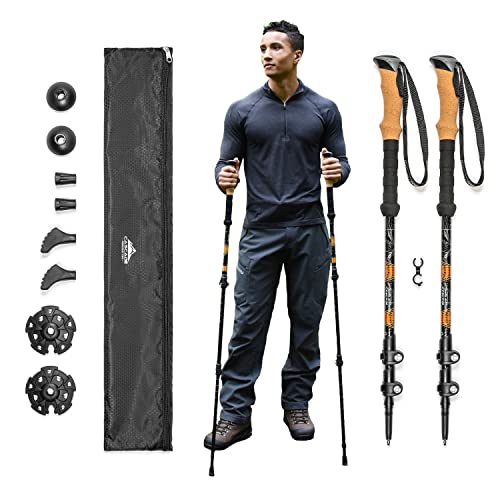
Cascade Mountain Tech Aluminum Quick Lock
Aircraft-grade aluminum shafts and external quick locks deliver most of what premium alloy poles offer at a lower cost. Rubber tips, mud baskets and snow baskets all ship in the box. Cork grips with EVA extensions handle sweat better than foam alone.
Pros
- Full accessory set included at purchase
- Wide adjustment range fits tall and short hikers
- Alloy shafts bend rather than shatter under load
Cons
- Lock levers need periodic screw tightening
- Heavier per pole than premium alloy competitors

Black Diamond Alpine Carbon Cork
A carbon upper shaft trims swing weight while an aluminum lower section absorbs abuse near the ground. FlickLock Pro clamps and a carbide tip round out an alpine-focused build. Distance-focused hikers gain more here than those prioritizing raw impact resistance.
Pros
- Lower swing weight over long mileage days
- Aluminum lower shaft resists rock strikes
- Interchangeable tech tip and carbide options
Cons
- Carbon upper can still fail if wedged and levered
- Costs more than a full alloy equivalent

LEKI Makalu Lite
LEKI designs load transfer through the strap rather than a tight grip on the handle. Aluminum HTS 6.5 shafts and SpeedLock 2 clamps hold up through heavy pack days. Aergon grips add a wide top surface for palming down on steep descents.
Pros
- Strap system shifts load off the fingers
- Wide grip top suits palming on descents
- Long maximum length fits taller hikers
Cons
- Minimum length runs too long for shorter hikers
- Foam grips absorb odor over repeated use

TrailBuddy Trekking Poles
7075 aluminum shafts give these more crush resistance than the plastic-heavy poles sold at the same price. Quick flip locks adjust tool-free between 24.5 and 54 inches. Cork grips and a full basket set come included with the pair.
Pros
- 7075 alloy is stronger than common 6061 shafts
- Compact minimum length suits pack strapping
- Baskets and rubber feet included at purchase
Cons
- Lock levers slip until screws are set correctly
- Straps use basic webbing with light padding

Montem Ultra Strong Trekking Poles
Stiff aluminum shafts resist the flex that makes poles feel uncertain when bracing against moving water. Foam grips extend well below the handle for quick height changes on steep banks. Tungsten carbide tips bite into wet rock better than steel.
Pros
- Low flex when bracing against current
- Extended foam grips allow fast height changes
- Carbide tips hold on wet slab
Cons
- Foam grips turn slippery when soaked
- Heavier than premium alloy competitors
Compared at a glance
| # | Model | Shaft | Best for | Score | Price |
|---|---|---|---|---|---|
| 1 | Black Diamond Trail Ergo Cork | Aluminium | Best overall | 9.4 | Check price |
| 2 | MSR DynaLock Explore | 7075 aluminium | Best for winter and heavy loads | 9.2 | Check price |
| 3 | Cascade Mountain Tech Aluminum Quick Lock | Aircraft grade aluminium | Best value | 9.0 | Check price |
| 4 | Black Diamond Alpine Carbon Cork | Carbon upper, aluminium lower | Best lightweight option | 8.8 | Check price |
| 5 | LEKI Makalu Lite | Aluminium HTS 6.5 | Best for wrist support | 8.6 | Check price |
| 6 | TrailBuddy Trekking Poles | 7075 aluminium | Best budget | 8.3 | Check price |
| 7 | Montem Ultra Strong Trekking Poles | Aluminium 7075 | Best for river crossings | 8.0 | Check price |
Before you buy
What makes a trekking pole heavy duty? Strength comes from shaft alloy, wall thickness and lock design, not marketing labels. 7075 aluminum resists denting from rock strikes better than generic alloy. External lever locks clamp harder than internal twist locks and can be field-tightened with a small screwdriver. Three-section poles adjust further, though each joint adds a potential slip point under load.
Which lock type holds best under a loaded pack? External lever locks, sold under names like FlickLock, SpeedLock and DynaLock, clamp around the shaft’s circumference and rarely creep. Twist locks rely on an expanding plug that slips once dirt or moisture gets inside. A quarter turn of the adjustment screw usually fixes a lever lock that starts sliding. Checking tension before a descent matters, since that is where a collapsing pole causes a fall.
How do grip and strap choice affect comfort on long days? Cork molds to the hand and stays usable when wet with sweat. EVA foam feels softer at first but absorbs more moisture and wears faster. Rubber suits cold weather and gloves, though it blisters bare hands in summer heat. Straps matter more than most hikers realize, since load should hang through the wrist so fingers rest on the grip instead of clenching it for hours.
What changes for snow, scree and river crossings? Snow calls for wide powder baskets and a longer pole setting so the tip still reaches through soft cover. Scree favors alloy shafts, since a carbon pole wedged between rocks snaps when levered sideways. River crossings need stiffness and a carbide tip that grips wet stone. Setting poles longer for descents and shorter for climbs, by roughly 5 to 10 centimeters each way, keeps balance steady.
Good to know
Are aluminum or carbon trekking poles better for heavy use?
Aluminum bends under a side load and stays usable, while carbon can shatter outright. Alloy poles like the Black Diamond Trail Ergo Cork are the safer buy for scree, talus and heavy packs. Carbon pays off when mileage and swing weight matter more than raw durability.
What weight can trekking poles support?
Poles are rated for downward load, not body suspension. Alloy poles from Black Diamond and MSR handle a hiker plus a heavy pack leaning hard on descents. Failure usually comes from side loads and lock slippage rather than straight compression.
How do you stop trekking pole locks from slipping?
Tighten the small screw on the lever lock a quarter turn at a time until it needs firm pressure to close. Clean grit from the shaft first. Cascade Mountain Tech and TrailBuddy poles often need this adjustment right out of the box.
Which trekking poles work best for winter hiking?
MSR DynaLock Explore is built for snow, with extended grips for traverses and wide powder baskets. Set the poles longer than summer length so tips still find ground through soft snow.
How tall should hiking poles be set?
Aim for the elbow at roughly 90 degrees on flat ground. Most hikers land between 110 and 130 centimeters. Shorten by about 5 centimeters for climbs and lengthen a similar amount for steep descents.
Is cork or foam better for trekking pole grips?
Cork resists sweat, molds to the hand and lasts longer, which is why Black Diamond and Cascade favor it. Foam feels softer at first and weighs slightly less, but soaks up moisture and wears faster.
Can trekking poles be repaired?
Tips, baskets, straps and grips are replaceable on Black Diamond, LEKI and MSR poles. Bent alloy sections can sometimes be straightened. Snapped carbon usually cannot be repaired, another point in alloy’s favor.
Is it better to hike with one pole or two?
Two poles distribute load evenly and help with balance on crossings. A single pole suits light day hikes and frees a hand for a camera. Anyone carrying a heavy pack over uneven ground benefits from a pair.
The verdict
Black Diamond Trail Ergo Cork buys alloy strength, reliable clamps and parts that can be replaced years from now. MSR DynaLock Explore earns its place for snow travel and the heaviest loads. Cascade Mountain Tech Aluminum Quick Lock covers most of the same ground for a fraction of the cost, provided the lock screws get tightened first.


