Which Heavy-Duty OBD2 Scanner Actually Reads Diesel Codes
Autel MaxiSys MS908CV II leads for mixed fleets, pairing bidirectional control with J2534 ECU programming. Launch X431 V+ HDIII suits techs who need topology mapping and ECU coding. ANCEL X7HD Pro fits diesel emissions shops, since it builds in DPF regeneration and DEF/SCR diagnostics.
Autel’s MaxiSys MS908CV II tops this lineup for mixed fleets. Bidirectional control and J2534 ECU programming push it past basic code readers. Its tablet-and-VCI setup costs more than a handheld tool, so budget-minded owner-operators tend toward the ANCEL HD3200 or Foxwell HD301.
We compared J1939, J1708, and J1587 protocol coverage, plus bidirectional test depth, display type, and emissions functions such as DPF regeneration, using listing specifications and owner reviews. Heavy-duty scanners split into tablet-based systems built for active tests and handheld readers built for quick, simple jobs.
What we recommend
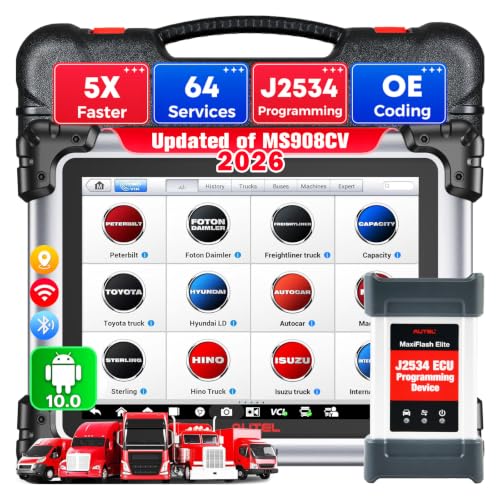
Autel MaxiSys MS908CV II
This tablet-based platform targets shops that service mixed fleets of trucks, buses, and construction equipment. Bidirectional control and J2534 ECU programming put it closer to dealer-level tools than typical code readers. Owners report the wireless VCI holds a stable connection through DPF regeneration cycles lasting 30 minutes or longer.
Pros
- Bidirectional control reaches active tests most rival tools skip, including forced DPF regeneration.
- J2534 ECU programming handles reflashing tasks that handheld code readers cannot perform.
- Coverage spans Class 1 through Class 9, so one tablet serves mixed light and heavy fleets.
Cons
- The tablet and VCI bundle costs more than handheld heavy-duty scanners.
- Menus assume some diesel diagnostic background, so new techs face a learning curve.

Launch X431 V+ HDIII
Launch designed the X431 V+ HDIII for technicians who need more than trouble codes. Topology mapping visualizes how the engine, ABS, and transmission modules communicate on the truck. Its software library extends beyond trucks into trailers and off-road machinery, which suits shops that service varied diesel equipment.
Pros
- Topology mapping shows how modules link together, speeding fault isolation on unfamiliar trucks.
- ECU coding and 40+ reset routines cover tasks basic code readers cannot touch.
- Software supports trucks, trailers, buses, and construction and agricultural machinery.
Cons
- Update subscriptions add an ongoing cost after the first year.
- Owners note the tablet runs warm during long bidirectional test sessions.

ANCEL X7HD Pro
ANCEL built the X7HD Pro around diesel emissions troubleshooting, with DPF regeneration and DEF/SCR routines front and center. Bidirectional control lets technicians trigger injector coding and cylinder cutout tests from the tablet. Coverage spans Freightliner, Kenworth, Peterbilt, Volvo, and Mack platforms, per the manufacturer’s compatibility list.
Pros
- DPF forced regeneration and SCR/DEF diagnostics target the two most common heavy-duty emissions complaints.
- Bidirectional and active tests confirm actuator response instead of just reading codes.
- Two years of included software updates reduce near-term subscription costs.
Cons
- Its 6000mAh battery still needs a wall charge during a full day of shop use.
- Front and rear cameras add bulk some techs find unnecessary for diagnostic work.

NEXAS NL102P
NEXAS aims the NL102P at owner-operators who want DPF regeneration without a tablet’s price tag. This handheld unit reads engine, transmission, and ABS codes across Class 4 to 8 trucks. Owners report the wired USB link stays stable through full diagnostic sessions, though it lacks the bidirectional depth of pricier tools.
Pros
- DPF regeneration on a handheld unit is rare at this price point.
- Wired USB connection avoids pairing issues that sometimes affect Bluetooth scanners.
- Lifetime free software updates keep coverage current without a subscription.
Cons
- No touchscreen means menu navigation relies on physical buttons.
- Live data streams slower than tablet-based tools with more processing power.

iCarsoft HD V3.0
iCarsoft markets the HD V3.0 as a multi-brand code reader for shops without dealer-specific tools. It switches between more than 15 heavy-duty brands using included adapter cables. Skipping bidirectional control keeps it simpler than tablet-based scanners, which suits techs who mainly need fast code reading and live data.
Pros
- Compatibility spans Freightliner, Kenworth, Cummins, Mack, Volvo, and Caterpillar in one unit.
- Plug-and-play design skips battery charging between shop visits.
- Lifetime free software updates cover new truck model years without added fees.
Cons
- No bidirectional control, so it reads and clears codes rather than running active tests.
- Adapter cables for different truck brands must be swapped manually.

ANCEL HD3200
ANCEL positions the HD3200 as an entry point into heavy-duty diagnostics without a tablet price tag. It adds DPF regeneration and oil reset on top of standard code reading, features most budget scanners omit. Coverage of Fuso, Hino, Isuzu, and UD engines suits shops running Asian-brand diesel trucks alongside American models.
Pros
- Two-in-one truck and car support means one tool covers a shop’s whole bay.
- DPF regeneration and oil reset functions go beyond basic code reading at a low cost.
- Asian diesel brand coverage, including Fuso, Hino, and Isuzu, fills a gap most competitors skip.
Cons
- No wireless connectivity, so the cable stays tethered during diagnosis.
- Bidirectional active tests are limited compared to tablet-based scanners.

Foxwell HD301
Foxwell built the HD301 as a straightforward code reader for owner-operators and small shops. Three adapter pin-outs connect to older 6-pin and 9-pin diagnostic ports alongside modern 16-pin trucks. Skipping DPF regeneration and bidirectional tests keeps the price down for buyers who mainly need to read and clear codes.
Pros
- Included 6-pin and 9-pin adapters cover older trucks that lack a 16-pin OBD2 port.
- Built-in DTC lookup library explains fault codes without a separate reference guide.
- Lower cost fits owner-operators who need code reading over active testing.
Cons
- No DPF regeneration or bidirectional control, unlike Foxwell’s own HD500 model.
- Live data refresh rate lags behind tablet-based diagnostic tools.
The lineup, side by side
| # | Model | Protocol coverage | Best for | Score | Price |
|---|---|---|---|---|---|
| 1 | Autel MaxiSys MS908CV II | J1939, J1708, J1587, and OBD2/EOBD for commercial platforms | Best overall | 9.4 | Check price |
| 2 | Launch X431 V+ HDIII | J1939, J1708, and J1587 for North American and Asian diesel platforms | Best for bidirectional control and topology mapping | 9.1 | Check price |
| 3 | ANCEL X7HD Pro | HDOBD/OBD2, J1939, and J1708 for Cummins, Detroit, Caterpillar, Volvo, and Paccar engines | Best for diesel engine and DPF diagnostics | 8.8 | Check price |
| 4 | NEXAS NL102P | J1939 and J1708 for Class 4 to 8 diesel trucks | Best value | 8.6 | Check price |
| 5 | iCarsoft HD V3.0 | J1587, J1939, and J1708 across truck and car OBD2 protocols | Best for multi-brand fleets | 8.4 | Check price |
| 6 | ANCEL HD3200 | J1939, J1708, J1850 PWM/VPW, and ISO 15765-4 for truck and car systems | Best budget | 8.2 | Check price |
| 7 | Foxwell HD301 | J1939, J1708, J1587, ISO 14230-4, and ISO 15765-4 | Best for owner-operators and basic code reading | 8.0 | Check price |
Before you buy
What separates heavy-duty scanners from passenger-car tools Passenger-car scanners read protocols like ISO 15765-4 CAN over a 16-pin connector. Trucks add J1939 and J1708 networks that carry engine, transmission, and brake data on a separate bus. A true heavy-duty scanner needs a 9-pin or 6-pin adapter alongside the standard OBD2 port. Cummins, Detroit, Caterpillar, and Volvo diesel engines each report codes differently, so broad brand coverage matters more than raw code count.
Tablet systems versus handheld code readers Tablet-based tools like the Autel MaxiSys MS908CV II and Launch X431 V+ HDIII add bidirectional control, letting a technician trigger DPF regeneration or injector coding from the screen. Handheld units such as the Foxwell HD301 and iCarsoft HD V3.0 read and clear codes without active tests. Emissions repairs generally need that bidirectional depth. An occasional check-engine light does not justify the tablet premium for most owner-operators.
Which scanner fits owner-operators and small fleets A single truck or two-truck operation rarely justifies a full diagnostic tablet. The ANCEL HD3200 and NEXAS NL102P both add DPF regeneration to a handheld form factor, closing much of the gap with pricier tools. Multi-brand shops benefit from the iCarsoft HD V3.0, which swaps adapter cables across more than 15 truck brands instead of locking into one ecosystem.
How much software updates and subscriptions cost over time Diesel engine software changes yearly as manufacturers add emissions controls and new modules. Autel and Launch bundle limited free updates, then charge a renewal fee after the first year or two. ANCEL and iCarsoft advertise lifetime free updates on several models, lowering long-term ownership cost. Terms shift between model revisions, so check the listing’s update policy before buying.
Frequently asked questions
What is the difference between a heavy-duty scanner and a regular OBD2 scanner?
A regular OBD2 scanner reads passenger-car protocols over a 16-pin connector. Heavy-duty scanners add J1939 and J1708 support through a 9-pin or 6-pin adapter, the networks trucks use for engine, transmission, and brake data.
Can I use a regular OBD2 scanner on a semi truck?
A standard scanner may read basic emissions data on some trucks, but it cannot access J1939 or J1708 networks. Most engine, transmission, and ABS codes on a semi truck stay hidden without heavy-duty protocol support.
Which heavy-duty scanner is best for DPF regeneration?
The Autel MaxiSys MS908CV II and ANCEL X7HD Pro both include forced DPF regeneration alongside bidirectional control. A technician can trigger the process directly instead of waiting for it to complete passively.
Autel MaxiSys MS908CV II vs Launch X431 V+ HDIII, which is better?
Both add bidirectional control and ECU coding. The Autel leans toward broader Class 1 to 9 coverage with J2534 programming, while the Launch adds topology mapping that visualizes module wiring on unfamiliar trucks.
Is a heavy-duty truck scanner worth it for an owner-operator?
For a single truck, a handheld model like the ANCEL HD3200 or NEXAS NL102P covers DPF regeneration and code reading at a lower cost than a tablet system. That fits occasional diagnostic needs better than a full platform.
What protocols do heavy-duty truck scanners need to support?
Look for J1939 and J1708 at minimum, since most American and European diesel engines report over these networks. J1587 support adds coverage for older trucks still running that standard.
Do heavy-duty scanners work on both trucks and cars?
Several models here, including the ANCEL HD3200 and iCarsoft HD V3.0, switch between truck and car OBD2 modes. That suits shops servicing a mixed bay of vehicles.
How often do heavy-duty truck scanners need software updates?
Diesel engine software changes yearly as new emissions modules ship. Some brands include free updates for life, while others charge a renewal fee after the first year or two, so check the listing before buying.
What does bidirectional control mean on a diesel scanner?
Bidirectional control lets the scanner send commands to the truck instead of only reading data. That includes forcing DPF regeneration, cycling relays, or coding a replacement injector.
Which heavy-duty scanner works best with Cummins engines?
The ANCEL X7HD Pro lists direct Cummins, Detroit, Caterpillar, Volvo, and Paccar engine coverage. The NEXAS NL102P also reads Cummins, Detroit, and Isuzu engines on a handheld budget.
Final word
Mixed fleets are best served by the Autel MaxiSys MS908CV II, since bidirectional control and J2534 programming cover more repair scenarios than any handheld tool here. Owner-operators running a single truck get more value from the ANCEL HD3200, which adds DPF regeneration without the tablet price tag. Anyone who needs topology mapping for unfamiliar wiring should pick the Launch X431 V+ HDIII instead.