How Flex Rating and Lacing Affect Heavy Duty Snowboard Boots
Burton’s Ruler balances durability and comfort for daily heavy use, based on its reinforced outsole and medium-stiff flex. The ThirtyTwo TM-2 delivers the stiffest flex here, built for freeride and backcountry terrain. K2’s Maysis fits wider feet better than any other boot on this list, thanks to its roomier last.
Heavy duty snowboard boots need a reinforced outsole, a durable liner and a flex rating matched to the terrain. Burton’s Ruler balances all-mountain durability with everyday comfort. ThirtyTwo pushes flex stiffer on the TM-2 for backcountry abuse, while BOA lacing on several models speeds up on-hill adjustments compared with traditional laces.
Liner compression resistance and outsole reinforcement decide most of a boot’s lifespan, details that rarely show up in a quick look at a listing photo. We compared flex ratings, lacing systems and liner materials across the spec sheets, then checked owner feedback on repeated heavy use before ranking these seven.
The shortlist, ranked

Burton Ruler Snowboard Boots
Burton builds the Ruler with a traditional lace system and a reinforced outsole rated for all-mountain abuse. Medium-stiff flex, about 6 out of 10, holds up to aggressive carving without sacrificing all-day comfort. Newer versions add a Vibram outsole for grip on icy lift lines.
Pros
- Reinforced outsole withstands heavy daily use
- Traditional laces allow precise, zone-by-zone tightening
- Heat-moldable liner improves fit over repeated wears
Cons
- Traditional laces take longer to tighten than BOA
- Medium-stiff flex feels less forgiving for beginners

ThirtyTwo TM-2 Snowboard Boots
ThirtyTwo pairs a stiff flex with a dual-zone BOA system across the outer boot and internal harness. That stiffness transmits more energy to the board on variable backcountry terrain. A reinforced ankle area resists compression during hard landings.
Pros
- Stiff flex improves board response on variable terrain
- Dual BOA zones adjust ankle and lower boot separately
- Reinforced ankle area handles hard landings well
Cons
- Stiff flex feels harsh on casual groomed runs
- Boots need a break-in period before full comfort

Vans Aura Snowboard Boots
Vans equips the Aura with a triple BOA system that controls the liner, lower boot and upper cuff independently. Quick-turn dials let riders retighten mid-run without removing gloves. Flex runs stiffer than Vans’ park-focused boots, suiting harder all-mountain riding.
Pros
- Triple BOA zones allow fast on-hill fit changes
- Heat-moldable liner conforms to foot shape over time
- Waffle-inspired outsole grips well when walking on ice
Cons
- Costs more than standard traditional-lace boots
- BOA cables need occasional replacement over years of use
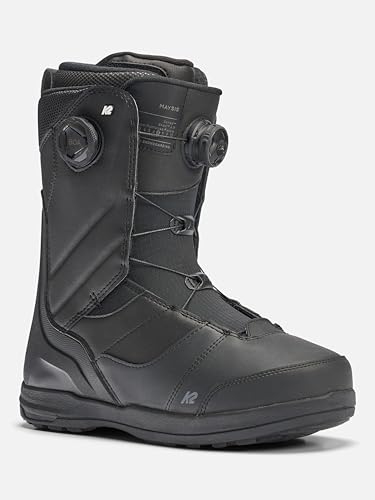
K2 Maysis Snowboard Boots
K2 cuts the Maysis on a roomier last than most competitors, easing pressure on wider forefeet. A single BOA zone handles the lower boot while a traditional lace secures the upper cuff. Intuition foam liner packs out to match foot shape over repeated wear.
Pros
- Wider last reduces pressure points for wide feet
- Intuition liner molds closely after a few wears
- Hybrid lacing balances speed with fine adjustment
Cons
- Roomier fit feels loose for narrow feet
- Medium flex offers less support for expert freeriding

DC Shoes Judge Snowboard Boots
DC positions the Judge as a durable, mid-priced option with a stiff-leaning flex for aggressive riding. A single BOA coiler lace system speeds up entry and exit at the lift line. A molded EVA footbed cushions repeated impacts.
Pros
- Lower price than many stiff all-mountain boots
- BOA coiler laces speed up putting boots on
- Cushioned footbed absorbs repeated hard landings
Cons
- Liner takes longer to break in than premium foams
- Fewer width options than K2 or Burton offer

Salomon Dialogue Snowboard Boots
Salomon builds the Dialogue with a single BOA lacing system for quick daily wear. An Ortholite EVA footbed resists compression after many days on snow. Medium flex balances support with enough give for varied terrain.
Pros
- Ortholite footbed resists packing out over a season
- BOA lacing simplifies putting boots on every morning
- Medium flex suits varied all-mountain terrain
Cons
- Not stiff enough for hard-charging freeride use
- Single BOA zone offers less adjustment than hybrid systems
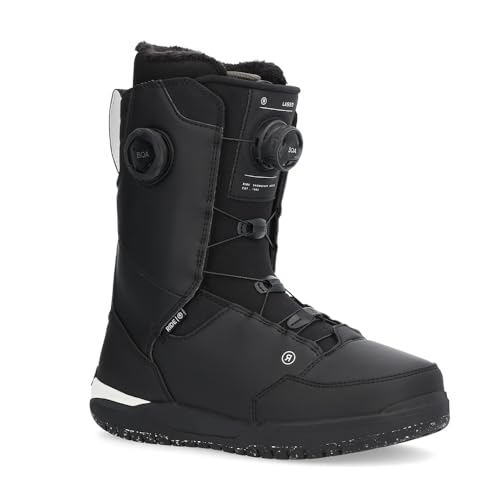
Ride Lasso Snowboard Boots
Ride’s Lasso uses a single BOA lace zone paired with a medium flex tuned for park and freestyle riding. Reinforced toe and heel areas hold up to repeated rail and box impacts. A removable, moldable liner extends the boot’s usable life across seasons.
Pros
- Reinforced toe and heel resist park impact damage
- Removable liner allows separate drying and replacement
- Medium flex suits freestyle and jib-focused riding
Cons
- Softer flex limits performance on steep, icy terrain
- Single BOA zone offers less adjustment than dual systems
What matters most
What makes a snowboard boot heavy duty Flex rating measures how much a boot resists bending, and stiffer boots generally hold up better to aggressive, repeated riding. Liner material affects how quickly cushioning packs out over a season of daily use. Outsole reinforcement, like Burton’s Vibram rubber, resists wear from walking across parking lots and lift lines. Lacing system decides how quickly and precisely a boot tightens each morning.
Choosing flex for your riding style Stiffer boots like the ThirtyTwo TM-2 transmit more energy to the board, suiting freeride and backcountry terrain. Medium flex boots such as the Salomon Dialogue balance support with comfort for all-mountain days. Softer flex, found on the Ride Lasso, helps with tricks on park and freestyle terrain. Matching flex to terrain style prevents both fatigue and lost control.
Fit and lacing systems for daily heavy use BOA systems, used on the Vans Aura and Salomon Dialogue, speed up putting boots on each morning. Traditional laces on the Burton Ruler allow more precise, zone-by-zone tightening but take longer. Hybrid systems, like the K2 Maysis, combine BOA speed with lace-up upper support. Riders who board most days often favor BOA for the reduced daily hassle.
Best boots for wide feet and cold weather durability K2 cuts the Maysis on a wider last, easing pressure points for riders with wider forefeet. Reinforced outsoles and rubber compounds resist cracking better in sub-freezing temperatures than basic soles do. Heat-moldable liners, common across Burton, Vans and K2 models, improve fit after the first few wears. Checking width sizing before buying avoids returns on boots that run wide or narrow.
How they compare
| # | Model | Lacing System | Best for | Score | Price |
|---|---|---|---|---|---|
| 1 | Burton Ruler Snowboard Boots | Traditional lace | Best overall heavy duty all-mountain boot | 9.3 | Check price |
| 2 | ThirtyTwo TM-2 Snowboard Boots | Dual-zone BOA | Best stiff boot for freeride and backcountry use | 9.1 | Check price |
| 3 | Vans Aura Snowboard Boots | Triple-zone BOA | Best BOA lacing for quick heavy duty adjustments | 9.0 | Check price |
| 4 | K2 Maysis Snowboard Boots | Hybrid, BOA lower and lace upper | Best for wide feet | 8.8 | Check price |
| 5 | DC Shoes Judge Snowboard Boots | BOA coiler lace | Best value heavy duty boot | 8.6 | Check price |
| 6 | Salomon Dialogue Snowboard Boots | BOA | Best for riders who board most days of the week | 8.3 | Check price |
| 7 | Ride Lasso Snowboard Boots | BOA | Best for park and freestyle heavy duty use | 8.0 | Check price |
Frequently asked questions
What flex rating is best for heavy duty snowboard boots?
A medium-stiff to stiff flex, roughly 6 to 8 out of 10, generally holds up better to aggressive, repeated riding than softer park-focused boots.
Are BOA laces more durable than traditional laces?
BOA cables resist fraying better than fabric laces but can fail if the dial mechanism breaks, while traditional laces are simple to replace anywhere.
How long do heavy duty snowboard boots typically last?
Liner compression and outsole wear from walking, not just riding, usually determine boot lifespan more than the riding itself.
What is the difference between stiff and medium flex boots?
Stiff boots like the ThirtyTwo TM-2 resist bending for more board response, while medium flex boots such as the K2 Maysis stay more forgiving.
Which snowboard boots run wide for wider feet?
The K2 Maysis is cut on a roomier last than most competitors, making it a common recommendation for riders with wider forefeet.
Can snowboard boots be heat molded at home?
Boots with heat-moldable liners, including models from Burton, Vans, and K2, can often be molded at a shop oven or with a hair dryer per the manufacturer’s instructions.
Are stiffer snowboard boots better for beginners or experts?
Stiffer boots generally suit experienced riders on variable terrain, while beginners usually do better with a softer, more forgiving medium flex.
How do you keep snowboard boots from packing out?
Rotating between two pairs, drying liners fully after each use, and choosing a durable foam liner like Intuition or Ortholite all slow compression over time.
Which lacing system works best for heavy duty riding, BOA or traditional?
BOA speeds up daily on and off and holds up well to repeated use, while traditional laces offer more precise zone tightening and are easier to fix trailside if something breaks.
Our take
Burton’s Ruler offers the most balanced mix of durability, support and comfort for daily heavy use. Riders pushing into backcountry or freeride terrain get more from the stiffer ThirtyTwo TM-2. Wide-footed riders should look to the K2 Maysis, while park-focused riders are better served by the softer Ride Lasso.


