High Accuracy Multimeters for Precision Work
The Fluke 87V stands out as the top choice for high-accuracy measurements, catering to electricians and engineers who demand reliable readings in demanding environments. Its main advantage is exceptional accuracy and durability, but its main limitation is a higher price point.
Whether you are troubleshooting complex electronics or verifying industrial equipment, a high accuracy multimeter is essential. The market offers many options, but not all deliver the precision you need.
We compared specifications and owner feedback to identify meters that provide reliable, repeatable measurements. From budget-friendly picks to professional-grade tools, there is a fit for every level of expertise.
The top picks, ranked

Fluke 87V True RMS Multimeter
The Fluke 87V is a legend in the industry, known for its rugged build and precise measurements. It offers a wide range of functions, including true RMS, low-pass filter, and high-voltage capability.
Pros
- Excellent accuracy and reliability
- Built to withstand tough conditions
- Comprehensive feature set
Cons
- Pricey for hobbyists
- Large and heavy

Keysight U1232A True RMS Multimeter
Keysight’s U1232A offers high accuracy in a compact, ergonomic design. It features a backlit display, data logging, and a built-in flashlight, perfect for low-light conditions.
Pros
- Compact and easy to carry
- Bright display with flashlight
- Robust feature set
Cons
- Battery life could be better
- No auto-range manual hold

Fluke 117 Electricians True RMS Multimeter
The Fluke 117 is a favorite among electricians for its non-contact voltage detection and AutoVolt function, which automatically selects AC or DC voltage. It provides accurate readings without manual switching.
Pros
- Easy to use with auto-ranging
- Built-in non-contact voltage detector
- Durable and reliable
Cons
- Not as high accuracy as 87V
- Limited CAT rating

Klein Tools MM700 True RMS Multimeter
Klein Tools MM700 offers solid performance at a competitive price. It includes features like low impedance mode, which helps prevent ghost voltage readings.
Pros
- Affordable without sacrificing quality
- Low impedance mode for accurate AC readings
- Auto-ranging and backlit display
Cons
- Accuracy not as high as top models
- No data logging
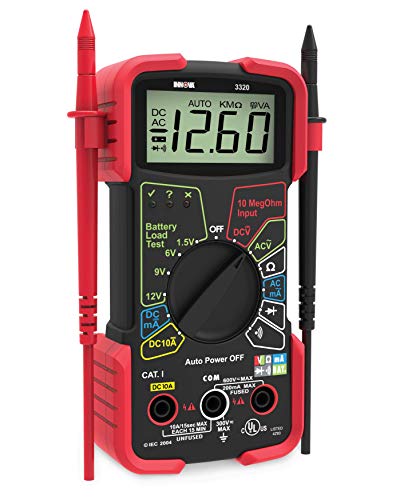
INNOVA 3320 Auto-Ranging Digital Multimeter
The INNOVA 3320 is a budget-friendly option that still delivers decent accuracy for basic electrical measurements. It features auto-ranging and a large digital display.
Pros
- Very affordable price
- Simple to operate
- Good for basic home use
Cons
- Not true RMS
- Lower accuracy and resolution

Amprobe AM-530 True RMS Multimeter
Amprobe AM-530 is designed for heavy-duty use in industrial settings. It offers high accuracy, a backlit display, and a rugged case that meets safety standards.
Pros
- High safety rating
- Rugged construction
- Accurate readings
Cons
- No auto-ranging hold
- Slightly bulky

Extech EX330 Autoranging Mini Multimeter
The Extech EX330 is a compact multimeter that doesn’t compromise on functionality. It includes a non-contact voltage detector and a built-in flashlight, making it handy for tight spaces.
Pros
- Small and lightweight
- Includes NCV and flashlight
- Good value for money
Cons
- Not true RMS
- Limited accuracy
How to choose
Compared at a glance
| # | Model | Accuracy | Best for | Score | Price |
|---|---|---|---|---|---|
| 1 | Fluke 87V True RMS Multimeter | DC: 0.05% + 1 digit | Professional electricians and engineers | 9.6 | Check price |
| 2 | Keysight U1232A True RMS Multimeter | DC: 0.09% + 5 digits | Field service technicians | 9.2 | Check price |
| 3 | Fluke 117 Electricians True RMS Multimeter | DC: 0.5% + 2 digits | HVAC and electrical diagnostics | 9.0 | Check price |
| 4 | Klein Tools MM700 True RMS Multimeter | DC: 0.5% + 5 digits | DIY and professional use | 8.8 | Check price |
| 5 | INNOVA 3320 Auto-Ranging Digital Multimeter | DC: 0.5% + 2 digits | Beginners and basic tasks | 8.0 | Check price |
| 6 | Amprobe AM-530 True RMS Multimeter | DC: 0.3% + 4 digits | Industrial maintenance | 8.7 | Check price |
| 7 | Extech EX330 Autoranging Mini Multimeter | DC: 0.5% + 1 digit | Compact and versatile needs | 8.4 | Check price |
Frequently asked questions
What does high accuracy mean in a multimeter?
High accuracy refers to how close a measurement is to the true value. In multimeters, it is typically specified as a percentage of the reading plus a digit count. For instance, an accuracy of 0.05% means the reading can deviate by that fraction.
Why is true RMS important?
True RMS (Root Mean Square) is important because it provides accurate measurements of AC voltage and current even when the waveform is not a perfect sine wave. Many modern devices draw non-sinusoidal currents, so true RMS meters are essential for correct readings.
What is the difference between CAT III and CAT IV safety ratings?
CAT III is for measurements in distribution circuits, such as in three-phase motors and commercial appliances. CAT IV is for measurements at the origin of low-voltage installations, like utility meters and main service panels. CAT IV offers higher protection against transient surges.
Can I use a multimeter on live circuits?
Yes, but you must use a meter with an appropriate safety rating and follow proper safety procedures. Always wear appropriate PPE and ensure the meter is designed for the voltage level you are working with.
How do I maintain my multimeter’s accuracy?
Regular calibration is recommended to ensure accuracy. Store the meter in a dry environment, handle it with care, and replace the battery as needed. Some meters have a self-test or calibration mode.
What is the best multimeter for beginners?
For beginners, a budget-friendly model like the INNOVA 3320 is sufficient for basic household tasks. It provides auto-ranging and a clear display, though it lacks true RMS and high accuracy.
Are more expensive multimeters worth it?
If your work requires precise measurements or involves high-energy electrical systems, investing in a higher-end meter like the Fluke 87V is worthwhile. For occasional use, a mid-range model may suffice.
How many counts should a good multimeter have?
Counts indicate resolution. A 4000-count meter displays up to 3999, while a 6000-count displays up to 5999. Higher counts provide better resolution, which is useful for reading small voltage changes.
Can multimeters measure temperature?
Some multimeters have a temperature measurement function, usually with a thermocouple probe. This is handy for HVAC and appliance troubleshooting. Check the specifications of the model you consider.
What is auto-ranging?
Auto-ranging automatically selects the correct measurement range for the signal being measured. This simplifies operation for users who may not know the expected value. Many multimeters feature manual ranging as well.
The bottom line
For professionals who demand the utmost in accuracy and durability, the Fluke 87V is the clear winner, offering precision that justifies its premium cost. If you are on a budget but still need reliable measurements, the Klein Tools MM700 provides a compelling balance of price and performance.


