Hose Timers Compared: App Control vs Simple Dials
For most yards, the Orbit B-hyve pairs app control with automatic rain skip, though it needs strong WiFi at the spigot. RAINPOINT’s Bluetooth timer covers yards where that signal never reaches. The Melnor Digital Water Timer suits anyone who wants onboard scheduling with no app at all.
Orbit’s B-hyve pulls local weather data and skips a scheduled watering after rain, something no dial timer can do. That control depends on WiFi reaching the outdoor spigot, which some yards never get. RAINPOINT’s Bluetooth timer and Melnor’s onboard digital unit each solve that gap a different way, without giving up scheduling flexibility.
Hose timers split mainly by how you set and monitor a schedule, from a twist dial to a WiFi-linked app. We compared connectivity type, outlet count for split yards, and how long a battery typically lasts before parts need replacing.
What to look for
What to look for in a hose timer Every hose timer sets a watering schedule, but how much control you get over that schedule varies widely. App-linked models like the Orbit B-hyve add remote access and automatic rain skip. Onboard digital and dial timers handle the same basic job without WiFi or an app to manage.
WiFi vs Bluetooth vs no connectivity WiFi timers reach a phone from anywhere with signal, but that signal has to be strong right at the spigot, often the weakest spot in a home network. RAINPOINT’s Bluetooth timer connects directly to a nearby phone instead, trading away-from-home access for a connection that does not depend on the router. Fully offline timers skip connectivity problems entirely, at the cost of any remote control.
Single-zone vs multi-outlet yards One outlet covers a single garden bed or a yard watered as one zone, which fits most of the lineup here. Nelson’s Digital Water Timer instead runs a front and back yard on separate schedules from one unit, useful wherever plant needs differ by area. Two smaller single-outlet timers can cover the same ground but take up more space at the bib.
Battery life and weatherproofing Most hose timers run on a 9V or a pair of AA batteries, and a full growing season is typical before they need replacing. Gardena’s sealed, weatherproof housing matters more for a unit left mounted outdoors all year than for one stored indoors each winter. Cold climates still call for removing most timers before the first freeze, sealed housing or not.
Our top picks
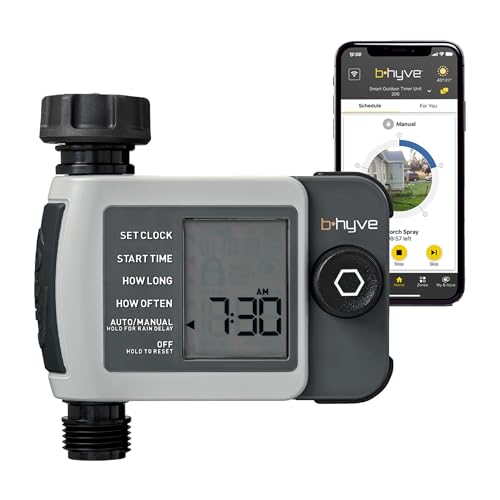
Orbit B-hyve Smart Indoor/Outdoor Hose Watering Timer
A phone app adjusts the watering schedule from anywhere with a WiFi or cellular connection. Built-in rain skip checks forecast data and pauses watering automatically after local rainfall. Owners in areas with unpredictable summer storms point to that rain skip as the feature that pays for itself over a season.
Pros
- Remote scheduling from anywhere via app
- Automatic rain skip saves water
- Manual override button for quick watering
Cons
- Requires home WiFi reaching the spigot
- App setup takes longer than dial timers
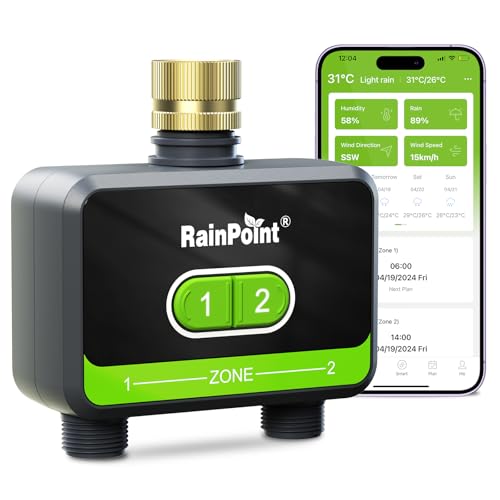
RAINPOINT Bluetooth Smart Water Timer
Bluetooth connects straight to a nearby phone, so no home WiFi network has to reach the spigot at all. Several independent daily schedules can run for different plant zones from the same unit. Detached garden areas far from a router are where owners say Bluetooth holds a connection more reliably than WiFi timers do.
Pros
- Works without home WiFi coverage
- Supports several schedules per day
- Long battery life between changes
Cons
- Bluetooth range limits control away from the yard
- No automatic weather rain skip

Melnor Digital Water Timer
A digital display and onboard buttons set the entire schedule without any app or WiFi dependency. Multiple start times and run durations per day cover most garden routines. Skipping another phone app is exactly why owners describe this as the simplest option they trust to just work.
Pros
- No app or WiFi setup required
- Straightforward digital interface
- Long single-battery runtime
Cons
- No remote access away from the yard
- No weather-based rain skip

Orbit 62061 Single-Outlet Hose Watering Timer
Button presses set watering duration and frequency, with no digital display or app to configure first. A single garden bed or a row of container plants is about the right scope for it. Watering one fixed zone on a routine is where owners say the low cost beats feature-heavy smart timers.
Pros
- Low cost for basic scheduled watering
- Simple setup with no app needed
- Manual override for immediate watering
Cons
- No multi-zone outlet option
- No weather or rain-skip adjustment

Rain Bird 1ZEHTMR Simple-to-Set Hose End Timer
One daily start time and run duration are set with a twist dial, skipping digital menus entirely. It threads directly onto a single hose bib to cover one watering zone. Small yards with just one schedule to maintain are where owners call this an easy step up from no timer at all.
Pros
- Lowest cost option in this group
- Easy dial setup with no learning curve
- Compact size at the spigot
Cons
- Only one schedule per day
- No app, Bluetooth or rain-skip features

Gardena Water Timer
A sealed housing resists sun and rain exposure better than the lighter plastic on timers left outdoors year round. Digital controls handle multiple watering intervals across a single day. Harsh summer sun climates are where owners rank the housing durability above cheaper competitors.
Pros
- Durable housing for permanent outdoor mounting
- Multiple daily interval programming
- Consistent European engineering reputation
Cons
- No app or remote control option
- Fewer retailers stock replacement parts locally

Nelson Digital Water Timer
Two outlets run independent schedules for a front and back yard from a single unit, replacing a second timer. Setting each zone’s duration goes through a digital display. Split yard layouts are why owners call the dual outlet a practical space saver right at the spigot.
Pros
- Two independent zones from one timer
- Digital display eases programming
- Good fit for split front and back yards
Cons
- Bulkier at the spigot than single-outlet models
- No smartphone or rain-skip features
Side by side
| # | Model | Connectivity | Best for | Score | Price |
|---|---|---|---|---|---|
| 1 | Orbit B-hyve Smart Indoor/Outdoor Hose Watering Timer | WiFi with smartphone app | Best overall | 9.3 | Check price |
| 2 | RAINPOINT Bluetooth Smart Water Timer | Bluetooth smartphone app | Best for no-WiFi yards | 9.0 | Check price |
| 3 | Melnor Digital Water Timer | None, onboard digital controls | Best onboard programming | 8.7 | Check price |
| 4 | Orbit 62061 Single-Outlet Hose Watering Timer | None, mechanical dial and buttons | Best value | 8.4 | Check price |
| 5 | Rain Bird 1ZEHTMR Simple-to-Set Hose End Timer | None, mechanical dial | Best budget | 8.2 | Check price |
| 6 | Gardena Water Timer | None, onboard digital controls | Best build quality | 8.1 | Check price |
| 7 | Nelson Digital Water Timer | None, onboard digital controls | Best for two-zone yards | 8.0 | Check price |
Questions worth asking
What is the best hose timer for automatic watering?
The Orbit B-hyve offers the most automation, combining app control with weather-based rain skip. Melnor’s Digital Water Timer covers the same core scheduling on the device itself, for anyone who would rather skip the app.
Do hose timers work without WiFi?
Yes. The Melnor Digital Water Timer and Rain Bird 1ZEHTMR both run entirely on onboard programming, with no WiFi or app involved.
Which hose timer works best without home WiFi?
RAINPOINT’s Bluetooth Smart Water Timer connects straight to a nearby phone, so it does not depend on a WiFi signal reaching the yard at all.
How long does a hose timer battery last?
Most run on a single 9V or two AA batteries and last roughly one full watering season, though heavy use and temperature extremes can shorten that.
Can a hose timer water two areas of my yard?
Dual-outlet timers like the Nelson Digital Water Timer run two independent zones from one unit. Single-outlet timers need a splitter or a second timer to cover more than one area.
What does rain skip mean on a smart hose timer?
It is a feature on timers like the Orbit B-hyve that pauses a schedule automatically once local weather data shows recent or forecast rainfall, cutting wasted water.
Is Bluetooth or WiFi better for a hose timer?
WiFi allows control from anywhere with internet access. Bluetooth timers like the RAINPOINT only connect when a phone is nearby, but they sidestep signal issues at outdoor spigots.
Can hose timers be left outside all year?
Timers with sealed, weatherproof housings, like the Gardena Water Timer, are built for permanent outdoor mounting. Manufacturers still recommend bringing most timers indoors over a hard freeze.
How do I program a basic hose timer?
Digital timers set a start time and duration through onboard buttons and a small display. Mechanical dial timers, like the Rain Bird 1ZEHTMR, use a simple twist dial instead.
Our pick
Pick the Orbit B-hyve if remote scheduling and automatic rain skip actually change how you garden. Anyone without reliable WiFi at the spigot should look at RAINPOINT’s Bluetooth timer instead. Watering one small bed on a fixed routine, the Rain Bird 1ZEHTMR does the job for the least money.