Indoor Bike Trainers for Winter Miles and Zwift
The Wahoo KICKR CORE is our overall pick for its quiet direct drive design and accurate power measurement. The Garmin Tacx Flux S is the value direct drive alternative, and the Sportneer Fluid Bike Trainer Stand covers basic indoor riding without electronics.
For structured indoor training and virtual riding, the Wahoo KICKR CORE gives the best combination of quiet running and accurate power, with the Garmin Tacx Flux S offering nearly the same experience for less and the Sportneer Fluid stand covering anyone who just wants to spin without an app subscription.
Trainer choice is confusing because direct drive and wheel on units sit in the same listings while behaving completely differently on noise, accuracy and tyre wear, and because a smart trainer needs a cassette and a subscription before it does anything interesting. We ranked these seven based on published power accuracy figures, resistance ratings, connectivity standards and what riders report about road feel and noise through a shared floor.
What to look for
Direct drive versus wheel on is the core decision Direct drive trainers replace the rear wheel entirely, mounting the bike onto a cassette on the trainer itself. That eliminates tyre slip and wear, cuts noise dramatically and improves power accuracy. Wheel on trainers press a roller against your tyre, which is quicker to set up and cheaper but noisier, harder on tyres and less accurate because readings vary with tyre pressure and how tightly the roller is clamped.
Smart features are what make apps work A smart trainer broadcasts power over ANT+ and Bluetooth and accepts resistance commands, so a virtual course can make you work harder up a hill and a workout can hold you at a set wattage. Without that, apps can still work using a speed sensor and estimated power, but the experience is much cruder. If Zwift or a structured plan is the goal, smart control is not an optional extra.
Noise matters more than people plan for The loudest part of a direct drive trainer is usually your own chain, which surprises people used to older magnetic units. Wheel on trainers generate a persistent hum from tyre on roller that carries through floors, which is a genuine problem in a flat or a shared house. A trainer mat helps with vibration transfer, though it does nothing about airborne noise.
Budget for the extras before you commit A direct drive trainer usually needs a cassette matching your groupset, and possibly an adapter for your axle standard. Most riders also add a front wheel block, a trainer mat, a fan and a subscription to a training platform. Those additions can total a meaningful share of the trainer’s own cost, so account for them rather than discovering them after delivery.
Our top picks

Wahoo KICKR CORE Smart Trainer
The KICKR CORE removes the rear wheel and drives a heavy flywheel directly, which gives a convincing road feel and near silent operation beyond the noise of your own drivetrain. Power accuracy is quoted within a tight tolerance, and it controls resistance automatically in Zwift and similar apps.
Pros
- Very quiet, suitable for flats and shared houses
- Accurate power without a separate power meter
- Heavy flywheel gives a realistic road feel
Cons
- Cassette usually sold separately
- Heavy and awkward to move between rooms

Garmin Tacx Flux S Smart Trainer
The Flux S delivers direct drive quietness and app controlled resistance at a lower outlay than premium units, with a decent flywheel weight and accuracy that is more than sufficient for structured training. It ships with a cassette on many versions, which removes a hidden extra cost.
Pros
- Direct drive performance at a mid range outlay
- Often supplied with a cassette fitted
- Stable frame that resists rocking under sprints
Cons
- Lower maximum gradient simulation than premium units
- Slightly louder than the quietest direct drive trainers

Elite Suito-T Smart Trainer
The Suito-T folds its legs in for storage, which makes it the most practical direct drive trainer for a flat where the bike cannot live permanently set up. It comes ready to ride apart from the cassette, and the accuracy is competitive with much larger units.
Pros
- Folds down for storage in small flats
- Quick setup with minimal calibration needed
- Competitive accuracy for the size
Cons
- Lighter flywheel gives a slightly less realistic feel
- Cassette not included on the T version
Saris M2 Smart Trainer
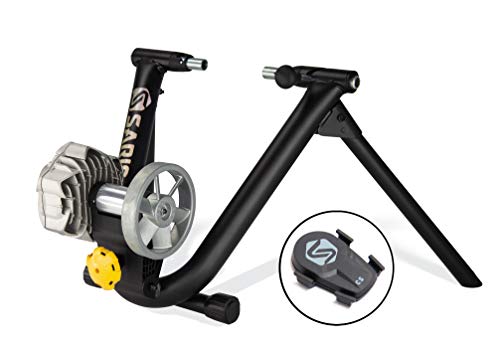
The M2 keeps the rear wheel on the bike, so setup takes seconds and there is no cassette to buy or fit. It still transmits power and responds to app resistance commands, making it the easiest route into virtual riding if you swap the bike between indoor and outdoor use frequently.
Pros
- Fastest setup and takedown of any smart trainer here
- No cassette purchase needed
- Folds reasonably flat for storage
Cons
- Noisier than direct drive units
- Wears the rear tyre and needs a trainer tyre ideally
Wahoo KICKR SNAP Smart Trainer
The KICKR SNAP is Wahoo’s wheel on trainer, using a heavier flywheel than most in its class to produce a more convincing feel than the price suggests. It works with the same apps and ecosystem as the direct drive KICKRs, so there is an upgrade path later.
Pros
- Better road feel than most wheel on trainers
- Full app control and Wahoo ecosystem support
- No cassette needed to get started
Cons
- Tyre pressure changes affect power readings
- Louder than direct drive alternatives
Kinetic Road Machine Smart Control
Kinetic’s Road Machine uses a sealed fluid resistance unit that ramps smoothly with speed, which many riders find more natural than magnetic systems. The Smart Control version adds app controlled resistance and power broadcasting on top of that proven frame.
Pros
- Smooth progressive fluid resistance
- Very stable steel frame under hard efforts
- Sealed unit that resists leaks
Cons
- Heavier than folding trainers to store
- Fluid units warm up and drift slightly on long sessions

Sportneer Fluid Bike Trainer Stand
This is a basic fluid resistance stand with no electronics at all, which suits warmups, recovery spins and anyone who wants indoor riding without subscriptions or pairing. Resistance builds with speed and the frame folds flat against a wall.
Pros
- Cheapest way to ride indoors
- No pairing, apps or subscriptions required
- Folds flat for storage
Cons
- No power data or app controlled resistance
- Noticeably louder than smart trainers
How they compare
| # | Model | Drive type | Best for | Score | Price |
|---|---|---|---|---|---|
| 1 | Wahoo KICKR CORE Smart Trainer | Direct drive | Best overall | 9.4 | Check price |
| 2 | Garmin Tacx Flux S Smart Trainer | Direct drive | Best value direct drive | 9.2 | Check price |
| 3 | Elite Suito-T Smart Trainer | Direct drive | Best for small spaces | 9.0 | Check price |
| 4 | Saris M2 Smart Trainer | Wheel on | Best wheel on smart trainer | 8.8 | Check price |
| 5 | Wahoo KICKR SNAP Smart Trainer | Wheel on | Best for road feel on a budget | 8.6 | Check price |
| 6 | Kinetic Road Machine Smart Control | Wheel on fluid | Best fluid resistance | 8.3 | Check price |
| 7 | Sportneer Fluid Bike Trainer Stand | Wheel on fluid | Best budget | 8.0 | Check price |
Frequently asked questions
Do I need a smart trainer for Zwift?
No, but the experience is much better with one. A smart trainer adjusts resistance to match the virtual terrain and reports accurate power. Without one, you can ride using a speed sensor and estimated power, though the gradient simulation disappears entirely.
Will a direct drive trainer fit my bike?
Most modern trainers support common axle standards through supplied adapters, covering quick release and most thru axle sizes. Check the freehub type matches your cassette brand, since Shimano, SRAM XDR and Campagnolo freehubs are not interchangeable.
Do I need a special trainer tyre?
Only for wheel on trainers. A dedicated trainer tyre resists the heat and wear from the roller far better than a road tyre and runs quieter. Direct drive trainers remove the rear wheel entirely, so the question does not arise.
How accurate is trainer power compared with a power meter?
Direct drive smart trainers typically quote accuracy within 2 to 3 percent, which is close to a dedicated power meter. Wheel on trainers are usually quoted around 5 percent and vary more with tyre pressure and clamping force, so consistency matters more than absolute numbers.
Are indoor trainers loud enough to annoy neighbours?
Direct drive units are quiet enough that drivetrain noise dominates. Wheel on trainers produce a constant hum that transmits through floors, which can be a real issue in upstairs flats. A trainer mat reduces vibration transfer considerably.
Do I need a cassette for a direct drive trainer?
Usually yes, and it should match the speed and brand of your groupset. Some trainers include one, others do not, so check before ordering and factor the cost and fitting into your decision.
Will indoor training damage my bike?
Sweat is the real hazard, since it is corrosive and drips onto the stem, headset and top tube. A sweat guard and wiping the bike down after each session prevents nearly all of it. Frame stress from a fixed trainer is a non issue on modern designs.
How do I stop overheating indoors?
A large fan is not optional. Without airflow, core temperature rises fast because there is no wind to carry heat away, and perceived effort climbs even though your power has not changed. Most experienced indoor riders use one or two powerful fans.
Final word
The Wahoo KICKR CORE is the trainer we would buy for serious indoor training, because it is quiet enough for a flat and accurate enough to base a whole training plan on. The Garmin Tacx Flux S delivers most of that experience for meaningfully less, and the Sportneer stand is a perfectly reasonable way to spin through winter without joining a virtual world.