Invisible Fences for Dogs Who Test the Boundary
The PetSafe YardMax in-ground fence leads for most gardens thanks to its rechargeable collar and boundary mode that reclaims usable yard space. The PetSafe Stubborn Dog system suits strong willed larger breeds, and the SportDOG SDF-100A covers big acreage with a tough collar.
For most gardens the PetSafe YardMax in-ground fence is the sensible starting point, the PetSafe Stubborn Dog system carries the strongest correction range for determined dogs, and the SportDOG SDF-100A is built for large properties. All three depend far more on training than on hardware.
Containment systems are widely misunderstood: they stop a dog leaving but do nothing to stop anything entering, and a dog that runs through a boundary in excitement can be reluctant to cross back. Wireless systems trade the digging of a buried wire for a circular boundary that shifts with terrain and buildings. We compared coverage, correction levels, collar design and waterproofing, and weighed the training commitment each system realistically requires.
The top picks, ranked

PetSafe YardMax Rechargeable In-Ground Fence PIG00-14582
The YardMax mode places the correction zone right at the wire rather than well inside it, so the dog keeps more of the garden to play in. The rechargeable collar removes the battery hunt that owners report as the main annoyance with older systems, and coverage expands with extra wire.
Pros
- Boundary mode preserves yard space
- Rechargeable collar
- Expandable with extra wire
Cons
- Burying wire is a weekend job
- Collar is bulky on small breeds

PetSafe Stubborn Dog In-Ground Fence PIG00-10777
Built for dogs that ignore lower level systems, with a stronger correction range and a robust collar suited to larger breeds. It is not a first choice for a soft or nervous dog, and for a boundary testing husky or a working breed it is often the system that finally holds.
Pros
- Correction range suits strong willed dogs
- Durable collar housing
- Same expandable wire system
Cons
- Too strong for timid dogs
- Battery replacement rather than charging

SportDOG Brand In-Ground Fence SDF-100A
Designed for rural blocks, this system covers a large area out of the box and expands well beyond it, with a collar built to the standard SportDOG applies to its field gear. Owners with sporting breeds report it holds up to water, mud and heavy cover.
Pros
- Genuine large property coverage
- Tough collar for working dogs
- Tone and vibration options
Cons
- Long wire runs take real effort
- Overkill for a suburban garden
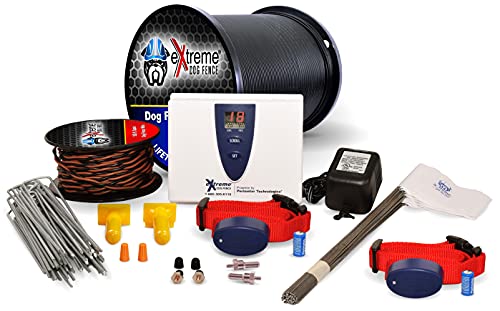
Extreme Dog Fence Second Generation In-Ground System
Sold with heavier gauge wire than most kits, which is the part of these systems that actually fails when a spade or a tree root finds it. The kit approach lets you choose wire length up front, so a large garden does not need an immediate second order.
Pros
- Heavier wire resists breaks
- Choose your own kit size
- Compatible with common collars
Cons
- Thicker wire is harder to bury
- Instructions assume some DIY confidence

PetSafe Basic In-Ground Fence PIG00-13661
The straightforward version of the PetSafe in-ground range, with the essential transmitter, collar and wire and none of the extra modes. For an average garden and a dog that responds to training, it does the same core job for less.
Pros
- Lower cost entry to in-ground
- Same proven transmitter design
- Easy to expand later
Cons
- No boundary reclaim mode
- Battery replacements add up

PetSafe Stay + Play Wireless Fence PIF00-12917
Creates a circular boundary from a central transmitter with no wire to bury, which makes it the practical option for rentals and for travel. The circle is affected by walls, slopes and metal structures, so the usable area is smaller and less precise than the specification suggests.
Pros
- No trenching at all
- Portable for holidays
- Rechargeable collar
Cons
- Boundary shifts with terrain and buildings
- Circular shape wastes garden corners

Havahart Radial-Shape Select Wireless Dog Fence
Lets you set the boundary radius in segments rather than one fixed circle, which fits an awkwardly shaped plot better than a standard wireless system. It still cannot follow a property line exactly, and it avoids the worst of the wasted corners.
Pros
- Shapes the boundary in segments
- No wire to bury
- Covers a decent area
Cons
- Still cannot follow straight property lines
- Signal affected by structures
What to look for
In-ground or wireless A buried wire follows your property line exactly, works around obstacles and holds a consistent boundary, at the cost of a weekend cutting a trench or laying wire under turf. Wireless systems set up in an hour and project a circle from a transmitter, which walls, slopes and metal sheds distort. If you own the property and want a boundary you can trust, in-ground is the better system; wireless suits renters and temporary situations.
Training is the product Every system here works only if the dog learns where the boundary is, which takes a couple of weeks of short sessions with boundary flags, a long lead and plenty of reward for turning back. Skipping training leaves a dog that gets corrected without understanding why, which creates anxiety rather than containment. Owners report that the households where these systems fail are almost always the ones that rushed this stage.
What a containment system cannot do It does not stop other dogs, wildlife or people entering your garden, and it does not stop theft. A dog in high drive can run through the correction zone chasing a cat, then hesitate to cross back and end up stranded outside. For dogs with a strong prey drive, a history of escaping or serious reactivity, a physical fence remains the only dependable answer.
Collar fit, contact points and skin care The collar has to sit snugly enough for the contact points to touch skin, which for thick coated breeds may mean the longer probes supplied in the box. Too tight or left in one position for days causes pressure sores, so reposition it daily, take it off overnight and check the skin regularly. Match the correction level to the dog, starting at tone only and moving up only as far as needed.
The lineup, side by side
| # | Model | Coverage | Best for | Score | Price |
|---|---|---|---|---|---|
| 1 | PetSafe YardMax Rechargeable In-Ground Fence PIG00-14582 | About 1/3 acre included, expandable to 10 | Best overall | 9.4 | Check price |
| 2 | PetSafe Stubborn Dog In-Ground Fence PIG00-10777 | About 1/3 acre included, expandable | Best for determined dogs | 9.2 | Check price |
| 3 | SportDOG Brand In-Ground Fence SDF-100A | About 1 1/3 acre included, expandable to 100 | Best for large properties | 9.0 | Check price |
| 4 | Extreme Dog Fence Second Generation In-Ground System | Kit dependent, up to several acres | Best wire quality | 8.8 | Check price |
| 5 | PetSafe Basic In-Ground Fence PIG00-13661 | About 1/3 acre included | Best budget in-ground | 8.6 | Check price |
| 6 | PetSafe Stay + Play Wireless Fence PIF00-12917 | Circle up to about 3/4 acre | Best wireless | 8.3 | Check price |
| 7 | Havahart Radial-Shape Select Wireless Dog Fence | Adjustable radius, up to around 2 acres | Best for irregular gardens | 8.0 | Check price |
Questions worth asking
Do invisible fences actually work?
For most dogs, yes, when paired with proper boundary training. They are least reliable with high prey drive dogs, dogs that have already learned to bolt, and puppies too young to understand the training.
In-ground or wireless, which should I choose?
In-ground if you own the property and want a boundary that follows your actual lines. Wireless if you rent, travel, or need something set up quickly and accept a circular, less precise boundary.
How long does training take?
Plan on two to four weeks of short daily sessions with flags and a long lead. Most systems recommend starting on tone only, and rushing this stage is the most common reason containment fails later.
Will the collar hurt my dog?
The static correction is designed to startle rather than injure, and every system on this list includes a tone or vibration only setting. Start at the lowest level and increase only if the dog ignores the warning tone.
What age can a puppy use one?
Most manufacturers suggest around six months, and the more useful measure is whether the puppy can reliably follow basic training cues. Younger puppies do not connect the correction with the boundary.
Does the system still stop other animals coming in?
No. Containment is one directional. Neighbouring dogs, wildlife and people can walk straight into your garden, which is one reason a physical fence remains preferable where it is possible.
What happens if the wire breaks?
The transmitter alarms and containment stops working. Breaks usually happen where wire crosses a path or a border, and a wire break locator or a careful walk of the run with a radio will find it.
Can two dogs use one system?
Yes. All of these support additional collars on the same transmitter, and each dog needs its own correctly fitted collar and its own training, since dogs learn boundaries at different rates.
The bottom line
The PetSafe YardMax is the pick for most gardens because its boundary mode keeps the correction zone tight against the wire and gives your dog more room to actually use. Strong willed larger breeds are better served by the PetSafe Stubborn Dog system, and rural properties should look at the SportDOG SDF-100A. Whichever you install, budget several weeks for boundary training and remember that no invisible fence keeps anything out of your garden.