Jewelry Pliers Guide: Matching Jaw Shape to Your Craft
Wubbers Classic Series Bail Making Pliers shape the most repeatable loops for wire wrapping. The IMZAY 6-Piece Set gives beginners five tools in one affordable case. The Xuron 9200 Micro-Shear Flush Cutter trims wire cleanest without crushing the end. Jaw shape and cutter sharpness affect accuracy more than price does.
Wubbers Classic Series Bail Making Pliers form the most repeatable loops here, thanks to two fixed-diameter step barrels instead of a tapered jaw. Wire wrappers who need matching bails or jump rings benefit most from that repeatability. The tradeoff: only two loop sizes ship on one tool, and the price sits above general-purpose beading pliers.
Jewelry pliers split by jaw shape, and picking the wrong one slows a project down fast. Round nose jaws form loops, flat or chain nose jaws grip and bend, flush cutters trim wire ends without crushing them. We compared jaw diameter, cutting edge angle, and handle material across pliers used for wire wrapping, chainmaille, and bead stringing.
What matters most
What jaw shape does for you Round nose jaws taper to a point and shape loops. Chain or flat nose jaws grip flat wire and close jump rings without rounding it. Flush cutters trim wire ends level instead of pinching them flat. Diameter matters too, since tapered jaws span a range of sizes while stepped jaws repeat one fixed size.
Best for wire wrapping and coiling Stepped or tapered round jaws, like those on the Wubbers Classic and Beadalon Wrapping Pliers, let a wrapper repeat the same loop size across an entire piece. Spring-loaded handles cut the squeezing effort needed across dozens of wraps. Cushioned grips prevent blisters during long wrapping runs.
Best for beginners and small budgets Multi-tool sets such as the IMZAY 6-Piece Set or Beadsmith 3-in-1 cover round, flat, and cutting tasks without multiple purchases. Combined jaws trade some precision for lower cost and less to store. A beginner who outgrows a set can add single-purpose pliers like the Tronex 5211 later.
Cutting wire without damaging it Shear-style cutters such as the Xuron 9200 leave a flush edge instead of the pinched flat end anvil-style cutters produce. Flush cuts matter most on visible wire ends in a finished piece. Cutter capacity, listed in wire gauge, should match the thickest wire a project uses before buying.
The best picks, ranked

Wubbers Classic Series Bail Making Pliers
Two fixed-diameter step barrels sit on one jaw, so every loop comes out the same size without measuring by eye. Hardened steel resists marring during repeated bends in sterling silver or copper wire. A cushioned handle cuts hand fatigue across long wrapping sessions.
Pros
- Two fixed jaw sizes on one tool
- Hardened steel resists wire marks
- Cushioned grip suits extended sessions
Cons
- Costs more than general-purpose pliers
- Only two loop diameters per tool

Xuron 9200 Micro-Shear Flush Cutter
Shear-style jaws slice wire flush on one side rather than crushing it the way anvil-style cutters do. Spring-loaded action reopens the jaws automatically, speeding up repetitive trimming across a project. At 2.4 ounces, the body stays light through long beading sessions.
Pros
- Flush cut leaves no sharp burr
- Spring-loaded handle speeds repeat cuts
- Light body reduces hand strain
Cons
- Rated only up to 16 gauge wire
- Blade cannot be resharpened once dull
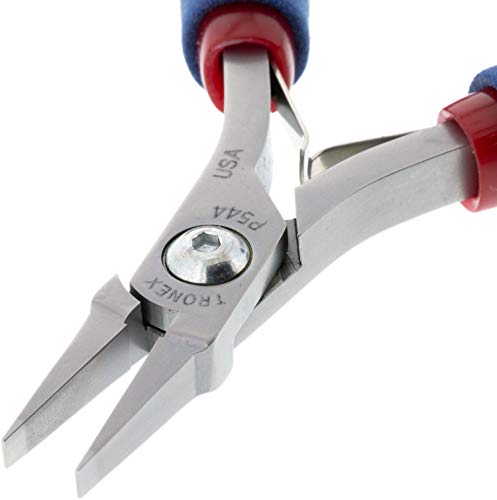
Tronex 5211 Long Flat Nose Pliers
Jaw length runs longer than standard flat nose pliers, giving more surface to straighten kinked wire in one pass. Smooth, non-serrated tips avoid tooth marks on soft metals like sterling silver. A narrow profile reaches into tight chainmaille links other pliers cannot enter.
Pros
- Long jaw straightens wire in fewer passes
- Smooth tips avoid marring soft metal
- Narrow tip fits tight chainmaille links
Cons
- Flat jaws alone cannot form round loops
- Grip runs firmer than cushioned competitors

The Beadsmith Wire Looping Pliers, 3-in-1
Three jaw profiles combine into a single plier, cutting the number of tools a beginner needs to buy. A built-in spring holds the jaws open between squeezes, reducing hand strain over a session. Carbon steel construction keeps an edge through regular studio use.
Pros
- Three jaw shapes in one tool
- Spring action reduces hand fatigue
- Costs less than three separate pliers
Cons
- Combined jaws trade some precision for range
- Spring can loosen under heavy daily use

Beadalon Wrapping Pliers
Three barrel sizes step onto one jaw, letting a wrapper change loop diameter without switching tools. A built-in spring reopens the jaws between wraps, speeding up repetition. Comfort-grip handles cut blistering during long coiling runs.
Pros
- Three loop sizes on a single jaw
- Spring action speeds repetitive wraps
- Comfort grip suits extended coiling sessions
Cons
- Barrel steps limit sizes to fixed increments
- Not built for cutting or flattening wire

IMZAY 6-Piece Jewelry Pliers Set
Five jaw styles plus a cutter bundle into one set, covering most beginner wire-wrapping tasks without separate purchases. A zippered pouch keeps the pieces organized inside a craft bag. PVC-coated handles cushion grip through longer sessions.
Pros
- Five tools plus cutter in one set
- Zippered case keeps pieces organized
- Affordable entry point for new beaders
Cons
- Jaws wear faster than single-purpose tools
- Cutter dulls sooner than a dedicated flush cutter

Wubbers Mega Round Nose Pliers
A 12mm taper scales up Wubbers’ round nose design, forming jump rings and loops too large for standard pliers. Hardened jaws hold their shape under repeated heavy-gauge bending. Wide handle spread suits larger hands working thicker wire.
Pros
- Tapered jaw reaches larger loop sizes
- Built for thicker gauge wire
- Hardened steel holds up under heavy use
Cons
- Too large for fine, delicate loop work
- Bulkier to store than standard pliers
Compared at a glance
| # | Model | Jaw shape | Best for | Score | Price |
|---|---|---|---|---|---|
| 1 | Wubbers Classic Series Bail Making Pliers | Two fixed step barrels, 5.5mm and 8.5mm | Best overall | 9.4 | Check price |
| 2 | Xuron 9200 Micro-Shear Flush Cutter | Up to 16 gauge wire | Best for clean wire cuts | 9.1 | Check price |
| 3 | Tronex 5211 Long Flat Nose Pliers | 1.25 inches flat | Best for precision gripping | 8.8 | Check price |
| 4 | The Beadsmith Wire Looping Pliers, 3-in-1 | Round, half-round, and flat sections | Best value | 8.6 | Check price |
| 5 | Beadalon Wrapping Pliers | Stepped round barrels, three sizes | Best for wire wrapping | 8.4 | Check price |
| 6 | IMZAY 6-Piece Jewelry Pliers Set | Round nose, chain nose, flat nose, cutter, and bent nose | Best budget | 8.2 | Check price |
| 7 | Wubbers Mega Round Nose Pliers | Up to 12mm tapered | Best for large loops and jump rings | 8.0 | Check price |
Common questions
What is the difference between round nose and chain nose pliers?
Round nose pliers have tapered cylindrical jaws for forming loops and curves. Chain nose pliers have flat, tapered jaws for gripping wire and closing jump rings without leaving round dents.
Can regular hardware pliers work for jewelry making?
Hardware store pliers usually carry serrated jaws that leave tooth marks on soft wire. Smooth-jaw jewelry pliers like the Tronex 5211 protect the metal finish instead.
How many pliers does a beginner actually need?
A round nose, a flat or chain nose, and a flush cutter cover most beading and wire-wrapping projects. Sets like the IMZAY 6-Piece bundle exactly those three shapes.
Which wire gauge can the Xuron 9200 cut?
The 9200 is rated up to 16 gauge wire. That covers most jewelry wire but not the thicker stock used in heavier chainmaille or structural pieces.
Do stepped jaw pliers make wire wrapping easier than tapered jaws?
Stepped jaws like those on the Wubbers Classic repeat exact loop diameters every time. Tapered jaws on standard round nose pliers require judging position by eye for consistent sizing.
Are cushioned grip pliers worth the extra cost?
Cushioned grips reduce hand fatigue and blistering during sessions longer than 30 minutes. That matters more for production wrapping than for occasional hobby use.
Can jewelry pliers cut wire above 16 gauge?
Most jewelry pliers, including the sets on this list, target wire between 16 and 24 gauge. Thicker gauge wire needs heavier-duty tools not covered here.
How do I know when a plier’s cutting jaw needs replacing?
A cutter leaving burrs or needing extra squeezing pressure on wire it once cut cleanly signals a dulled edge. A worn Xuron blade shows this pattern first.
Wubbers Classic vs Beadalon Wrapping Pliers: which forms better loops?
Wubbers Classic uses two fixed step barrels for exact repeat diameters. Beadalon steps three barrel sizes onto one jaw, trading some repeatability for more size options.
Is a 3-in-1 plier as precise as separate single-purpose pliers?
Combined jaws on a tool like the Beadsmith 3-in-1 save money and storage space. Dedicated single-purpose pliers like the Tronex 5211 still edge out precision on any one task.
Final word
Wubbers Classic Series Bail Making Pliers takes the top spot for anyone shaping repeat loops, since fixed step jaws remove the guesswork tapered jaws require. Beginners assembling a first toolkit should start with the IMZAY 6-Piece Set instead, then add single-purpose pliers as specific projects demand them. Anyone cutting wire regularly should pair either choice with the Xuron 9200 for cleaner finished ends.