How to pick a kayak paddle you can swing all day
Werner Skagit FG IM is our overall pick, combining fibreglass blades with a mid weight shaft and adjustable feather. Bending Branches Whisper offers similar performance for recreational paddlers at less cost. Aqua-Bound Sting Ray Hybrid is the lightweight choice for long touring days.
Werner Skagit FG IM tops our kayak paddle list, since fibreglass blades cut flutter without the cost of full carbon. Bending Branches Whisper does most of the same work for casual weekend paddling. Anyone covering serious distance should look at the Aqua-Bound Sting Ray Hybrid, which drops noticeable weight per stroke.
Paddle choice confuses people because length gets all the attention while weight decides comfort. You lift a paddle roughly a thousand times an hour, so 200 grams of difference is felt by the afternoon. We compared shaft materials, blade construction, stated weights, available lengths, ferrule adjustment and drip ring design, then weighed owner feedback on flex and durability against rocks.
How to pick the right one
What length kayak paddle do you need? Two measurements decide it: your height and the boat’s width. A 26 to 30 inch recreational kayak usually needs 220 to 230 centimetres for a paddler under 5 foot 10, and 230 to 240 for taller people. Wider fishing kayaks push you to 240 or 260. Sit on tall gets a longer paddle than sit inside, because your hands start higher above the water. When you are between sizes, go longer for wide boats and shorter for narrow ones.
Shaft material and why weight matters so much You lift the paddle roughly a thousand times an hour, so grams add up into shoulder fatigue. Aluminium is cheapest and heaviest, and it gets uncomfortably cold. Fibreglass is the sensible middle, damping vibration at around 32 to 35 ounces. Carbon shafts like the Aqua-Bound Sting Ray Hybrid drop toward 30 ounces and transmit less shock. Spend on the shaft before you spend on blades if you paddle for hours.
Blade shape: high angle versus low angle Low angle blades are longer and narrower, designed for a relaxed stroke with the shaft near horizontal. They suit touring, fishing and anyone covering distance. High angle blades are shorter and wider, made for a near vertical stroke that accelerates the boat quickly. Recreational paddlers almost always want low angle. Fishing paddles add practical touches, like the hook retrieval notch on the Bending Branches Angler Classic.
Ferrules, feathering and looking after a paddle A ferrule is the joint in the middle. Snap button designs offer fixed positions, usually 0 and 60 degrees, while systems like Posi-Lok allow any angle. Feathering offsets the blades to reduce wind resistance on the recovery blade, and most paddlers settle between 30 and 45 degrees. Rinse the ferrule with fresh water after salt use, since grit inside it is what causes rattle. Store paddles split apart and out of direct sun.
The top picks, ranked

Werner Skagit FG IM Kayak Paddle
Fibreglass reinforced nylon blades hold their shape under load, so the catch feels solid rather than mushy. Werner uses a smooth ferrule that adjusts feather angle in 15 degree increments and locks without play. Weight sits near 32 ounces, which is a real drop from typical aluminium recreational paddles.
Pros
- Stiff blades transfer power without flutter
- Ferrule adjusts feather and locks with no rattle
- Light enough for full day touring
Cons
- Costs more than aluminium shaft paddles
- Only three length options in this model

Bending Branches Whisper Kayak Paddle
Bending Branches pairs a fibreglass shaft with moulded polypropylene blades, keeping weight near 34 ounces at a modest cost. A two piece snap button ferrule offers 0 and 60 degree feather. Blade shape is wide and short, which suits the slower cadence of a recreational sit inside kayak.
Pros
- Fibreglass shaft at a recreational cost
- Wide blade suits relaxed cadence paddling
- Two piece design fits in a car boot
Cons
- Only two feather positions available
- Plastic blades flex more than fibreglass ones

Aqua-Bound Sting Ray Hybrid Kayak Paddle
A carbon shaft under abX reinforced nylon blades brings weight down to roughly 30 ounces without full carbon cost. Aqua-Bound uses its Posi-Lok ferrule, which allows infinite feather adjustment and length changes on some models. Blades are a low angle design, so they reward a relaxed touring stroke.
Pros
- Among the lightest at this cost level
- Infinite feather adjustment, not fixed steps
- Carbon shaft damps vibration through the hands
Cons
- Carbon shaft scratches on rocky launches
- Low angle blade suits touring more than sprinting

Bending Branches Angler Classic Kayak Paddle
One blade carries a moulded hook retrieval notch and a measuring scale printed along the shaft, both aimed at anglers. A wooden shaft with fibreglass reinforcement gives warmth in cold weather that aluminium cannot match. Weight is higher at around 36 ounces, which matters less on a fishing kayak that moves in short bursts.
Pros
- Hook notch retrieves snagged lures from branches
- Wood shaft stays comfortable in cold water
- Measuring scale saves carrying a tape
Cons
- Heaviest option here for long crossings
- Wood shaft needs occasional oiling
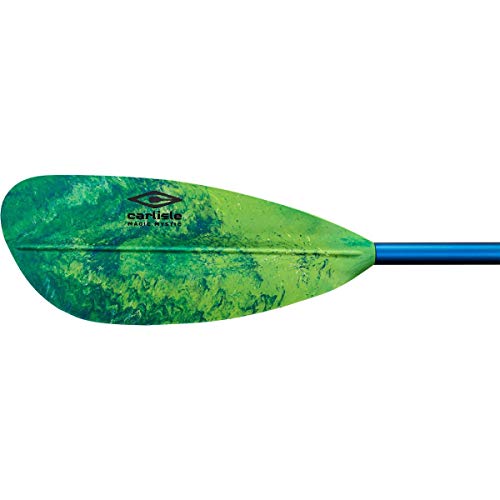
Carlisle Magic Plus Kayak Paddle
Carlisle offers this in lengths from 220 up to 260 centimetres, which matters for taller paddlers and wider recreational hulls. Polypropylene blades over a fibreglass shaft keep the weight near 35 ounces. Drip rings are included, so water does not run down onto your legs.
Pros
- Widest length range for tall paddlers
- Fibreglass shaft resists cold and vibration
- Drip rings supplied in the box
Cons
- Fixed 60 degree feather only
- Blades flex under a hard forward stroke

Pelican Poseidon Kayak Paddle
An anodised aluminium shaft with polypropylene blades keeps this simple and inexpensive, which suits a first season on flat water. Blades separate into two pieces for car storage, and drip rings sit on both sides. Weight lands nearer 38 ounces, so it is best on shorter outings.
Pros
- Low cost entry for a first kayak
- Anodising resists corrosion in fresh water
- Splits down for storage in a small car
Cons
- Aluminium gets cold in the hands quickly
- Heaviest swing weight of the group
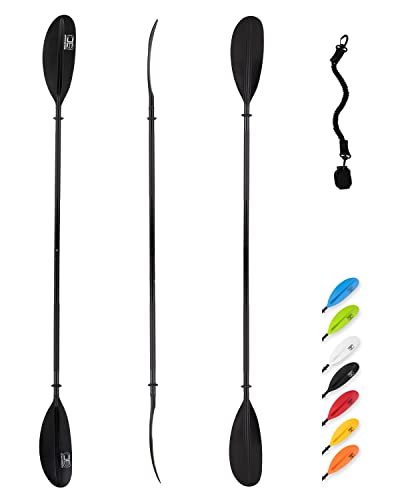
OCEANBROAD Kayak Paddle 230cm
Three feather positions and a two piece aluminium shaft make this a sensible spare paddle to strap on deck. Blades are PP plastic with a moulded rib for stiffness. It also serves as the second paddle for a tandem kayak where cost matters more than swing weight.
Pros
- Cheap enough to carry as a deck spare
- Three feather angles despite the low cost
- Includes drip rings and a paddle leash on some listings
Cons
- Plastic blades flex noticeably under load
- Single length option limits fit
How they stack up
| # | Model | Blade | Best for | Score | Price |
|---|---|---|---|---|---|
| 1 | Werner Skagit FG IM Kayak Paddle | Fibreglass reinforced nylon, mid size | Best overall | 9.4 | Check price |
| 2 | Bending Branches Whisper Kayak Paddle | Moulded polypropylene, wide profile | Best value | 9.2 | Check price |
| 3 | Aqua-Bound Sting Ray Hybrid Kayak Paddle | abX reinforced nylon, low angle | Best lightweight | 9.0 | Check price |
| 4 | Bending Branches Angler Classic Kayak Paddle | Fibreglass reinforced nylon with hook retrieval notch | Best for kayak fishing | 8.8 | Check price |
| 5 | Carlisle Magic Plus Kayak Paddle | Polypropylene, symmetrical | Best for touring beginners | 8.6 | Check price |
| 6 | Pelican Poseidon Kayak Paddle | Polypropylene, two piece | Best for beginners | 8.3 | Check price |
| 7 | OCEANBROAD Kayak Paddle 230cm | PP plastic with reinforcing rib | Best budget spare | 8.0 | Check price |
Common questions
What size kayak paddle do I need for my height?
For a boat 26 to 30 inches wide, paddlers under 5 foot 10 usually take 220 to 230 centimetres, and taller paddlers take 230 to 240. Add roughly 10 centimetres for a wide fishing kayak.
Is a lighter kayak paddle really worth the money?
Yes if you paddle for more than an hour at a time. Dropping from a 38 ounce aluminium paddle to a 30 ounce carbon shaft removes a meaningful amount of lifted weight over thousands of strokes.
What does feathering a kayak paddle mean?
It means offsetting the two blades so the recovering blade slices through wind rather than catching it. Most paddlers use 30 to 45 degrees. Paddles like the Aqua-Bound Sting Ray Hybrid allow any angle, while simpler ferrules offer fixed steps.
High angle or low angle blades: which should you choose?
Low angle for touring, fishing and recreational paddling with a relaxed cadence. High angle for fitness paddling and quick acceleration, since it needs a more vertical, energetic stroke.
Which kayak paddle is best for fishing?
The Bending Branches Angler Classic, because of its hook retrieval notch and the measuring scale on the shaft. Length also matters, since fishing kayaks are wide and usually need 240 centimetres or more.
Are fibreglass paddle blades better than plastic?
Fibreglass reinforced blades stay stiffer under load, so more of your effort moves the boat instead of bending the blade. Plastic blades cost less and survive scraping across rocks, which is why they dominate recreational paddles.
Should you carry a spare paddle?
On open water or any trip away from shore, yes. A cheap two piece such as the OCEANBROAD paddle straps to the deck and weighs little. Losing a paddle without a spare turns a good day into a rescue.
How do you stop water running down the shaft?
Fit drip rings a few inches from each blade, which most paddles here include. Keeping your hands lower on the recovery and pausing the blade briefly at the end of the stroke also helps.
Our take
Werner Skagit FG IM is the paddle we would put in most kayaks, since stiff fibreglass blades and a 32 ounce weight suit both a lazy afternoon and a long crossing. Recreational paddlers on a budget lose very little with the Bending Branches Whisper. Distance paddlers should stretch to the carbon shafted Aqua-Bound Sting Ray Hybrid, then size the length to their boat width rather than to their height alone.
You might also need

How to Pick Decoys That Actually Fool Ducks and Turkey
How to Pick a Hedge Trimmer That Won’t Bog Down
