Keyboard Stands Compared: X-Style, Z-Style, and Table
RockJam’s Xfinity Double-X fits most home players, the Quik Lok T20 EX delivers strong bracing at a lower price, and the On-Stage KS8190 table stand suits studio setups that need extra surface area. Hamilton’s KB90 Traveler II fits gigging musicians who travel light and pack tight.
RockJam’s Xfinity Double-X suits most home and practice setups, holding 61 to 88-key keyboards near 110 pounds while folding flat in under a minute. Gigging musicians who need more bracing should look at the On-Stage KS7190 instead. Studio players wanting extra surface area for a mixer fit better with the On-Stage KS8190 table stand.
Stability, folding speed, and floor footprint pull in different directions for these frames. We compared listed weight ratings, tubing gauge, and owner feedback on wobble before ranking these seven stands.
How to choose
X-style, Z-style, or table stand X-style stands fold flattest and generally cost less, which suits musicians packing a car trunk every week. Z-style stands sit lower and steadier, favoring seated home players. Table-style stands add flat surface area next to the keys for a mixer or laptop.
Matching weight capacity to your keyboard An 88-key digital piano can weigh over 40 pounds on its own. Choose a stand rated well above that number for a safety margin. Double-braced frames such as the On-Stage KS7190 resist flex under heavier stage pianos. Lighter 61-key controllers sit fine on single-brace travel stands.
Best for small apartments and travel Hamilton’s KB90 Traveler II folds into a narrow bundle that fits a closet shelf or car trunk. Single-X frames generally weigh less than double-tier or table designs. Portability trades away some stability, worth it when space stays the main constraint.
Best for two-keyboard rigs Players stacking a synth over a main keyboard need a double-tier frame like the World Tour Deluxe. Confirm the top tier still allows a comfortable arm angle while seated. Combined weight capacity should cover both instruments, not just the heavier one.
What we recommend
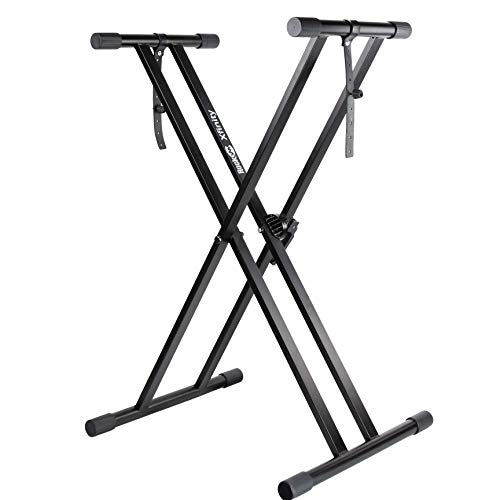
RockJam Xfinity Heavy-Duty Double-X Keyboard Stand
Arrives pre-assembled, so unfolding the legs and locking the pin is the entire setup. The double-braced X-frame supports 61 to 88-key keyboards through daily home practice. Rubber end caps cushion contact points against scuffs.
Pros
- No tools needed for assembly
- Locking pin blocks accidental collapse
- Rubber end caps protect the keyboard base
Cons
- Footprint runs wider than single-brace designs
- Height adjusts in fixed notches, not continuously

On-Stage KS7190 Heavy-Duty Double-X Keyboard Stand
Quad bracing on each side of the X keeps a fully loaded 88-key stage piano steady during energetic playing. Height adjusts through several notches instead of one fixed slot. Owners moving gear between venues cite the fold-flat profile as a plus for van loading.
Pros
- Extra bracing resists flex under heavier stage pianos
- Wide height range covers seated and standing play
- Folds flat for van or car transport
Cons
- Heavier to carry than single-brace stands
- Pull pin can pinch fingers if rushed

Hamilton Stands KB90 Traveler II Keyboard Stand
Aluminum tubing keeps total weight low enough to fit a gig bag side pocket. A quick-release lever sets height without a separate pin. Musicians rotating between rehearsal spaces benefit most from the smaller folded size.
Pros
- Lighter than steel double-X stands
- Quick-release lever skips the separate pin
- Folds small enough for car trunks
Cons
- Lower weight rating than double-braced models
- Less lateral stability under heavier keyboards

World Tour Deluxe Keyboard Stand
A second tier sits above the main platform for a synth or controller stacked over the primary keyboard. Padded end caps and non-slip feet keep both levels steady during layered sets. Two-keyboard rigs skip a separate rack stand entirely with this frame.
Pros
- Holds a full two-keyboard rig without a rack
- Padded contact points protect keyboard finish
- Folds flat despite the extra tier
Cons
- Bulkier to store than single-tier stands
- Top tier sits higher, less ergonomic while seated

Quik Lok T20 EX Double Braced Keyboard Stand
Double bracing on a lower-cost frame delivers much of the stability found on pricier stands. Non-slip rubber feet keep it planted on hardwood or tile stages. Pin-lock height adjustment keeps setup simple for players who want few moving parts.
Pros
- Strong bracing relative to the price
- Rubber feet resist sliding on smooth floors
- Simple pin-lock height adjustment
Cons
- Finish wears faster than premium brands
- No padded arm cushions included

On-Stage KS8190 Table-Style Keyboard Stand
A Z-frame design creates a flat, table-like surface wide enough for a keyboard plus a small mixer or laptop. Fixed height suits a dedicated studio corner more than a stage setup that changes nightly. Minimal wobble comes from the wider base compared with folding X-stands.
Pros
- Extra surface area for gear beyond the keyboard
- Very stable with minimal wobble
- Clean look for a permanent studio spot
Cons
- Fixed height limits seated versus standing flexibility
- Larger footprint than folding X-stands

Liquid Stands MS1078 Z-Style Keyboard Stand
This Z-style stand adjusts from 22 to 33.5 inches, covering seated and standing heights alike. Keyboards from 54 to 88 keys fit the frame at a lower price than the On-Stage table stand. Folding hardware still lets it collapse for storage despite the Z shape.
Pros
- Wider height range than most Z-stands
- Lower price than premium table stands
- Folds despite the Z-frame design
Cons
- Narrower surface than dedicated table stands
- Assembly required out of the box
How they stack up
| # | Model | Frame style | Best for | Score | Price |
|---|---|---|---|---|---|
| 1 | RockJam Xfinity Heavy-Duty Double-X Keyboard Stand | Double-X, double braced | Best overall | 9.4 | Check price |
| 2 | On-Stage KS7190 Heavy-Duty Double-X Keyboard Stand | Double-X, quad braced | Best for heavy-duty use | 9.1 | Check price |
| 3 | Hamilton Stands KB90 Traveler II Keyboard Stand | Single-X | Best for travel | 8.8 | Check price |
| 4 | World Tour Deluxe Keyboard Stand | Double-X, double-tier | Best for two keyboards | 8.6 | Check price |
| 5 | Quik Lok T20 EX Double Braced Keyboard Stand | Double-X, double braced | Best value | 8.4 | Check price |
| 6 | On-Stage KS8190 Table-Style Keyboard Stand | Z-frame, table-style | Best for studio setups | 8.2 | Check price |
| 7 | Liquid Stands MS1078 Z-Style Keyboard Stand | Z-frame | Best budget Z-style | 8.0 | Check price |
Frequently asked questions
What is the difference between an X-style and a Z-style keyboard stand?
X-style stands use crossed legs that fold flat and adjust height at the pivot point. Z-style stands use angled side supports that sit lower and often feel steadier for seated playing.
Can a keyboard stand hold an 88-key digital piano?
Most double-braced stands rated above 150 pounds handle 88-key digital pianos without issue. Check the listed weight capacity against your keyboard’s actual weight, not just its key count.
Are keyboard stands adjustable for both standing and seated play?
Many X-style and Z-style stands adjust across a range like 22 to 39 inches, covering both positions. Table-style stands usually stay fixed at one seated height.
Is a double-tier keyboard stand worth buying for just one keyboard?
No, a single-tier stand costs less, weighs less, and folds easier for one keyboard. Double-tier frames only pay off once a second instrument gets stacked on top.
How much weight can a typical keyboard stand hold?
Budget single-X stands often top out near 80 to 110 pounds, while double-braced models can rate 200 to 300 pounds. Match the rating to your keyboard’s actual weight plus any gear placed on top.
Do keyboard stands fold down for transport?
Most X-style and Z-style stands fold flat for a car trunk or gig bag pocket. Table-style stands usually skip folding, since they favor a fixed studio setup.
Which keyboard stand works best in a small apartment?
A single-X travel stand like the Hamilton KB90 Traveler II takes up the least floor space when folded. Its lighter weight also helps when carrying it between rooms often.
Keyboard stand versus keyboard table, which fits a home studio?
A folding stand suits players who move gear often and need it out of the way fast. A table-style stand suits a fixed studio corner where extra surface area for a mixer or laptop outweighs portability.
How tall should a keyboard stand be for standing performances?
Standing performance height typically falls between 36 and 39 inches at the keys, near elbow level. The On-Stage KS7190 and World Tour Deluxe both reach that range at their tallest setting.
Our take
RockJam’s Xfinity Double-X covers the most players, balancing weight capacity, price, and fold-flat storage. Gigging musicians needing extra stability should step up to the On-Stage KS7190, while anyone stacking a second keyboard should choose the World Tour Deluxe instead.


