Large-Screen TVs Built to Hold Up in a Dark Home Theater
Sony’s Bravia 9 leads this list for home theater rooms, pairing Mini LED contrast with near-OLED black levels. Movie purists who want per-pixel dimming should look at the LG C4 OLED instead. For similar brightness at a lower cost, the Hisense U8N covers most of the same ground.
Sony’s Bravia 9 suits dedicated theater rooms that need deep blacks without losing brightness to daytime glare. Its Mini LED backlight drives thousands of dimming zones, keeping halos around bright objects to a minimum. Price runs higher than most sets compared here, which matters most when a room already has good light control.
Panel technology matters more than screen size once a set passes 65 inches, since contrast and viewing angle decide how a dark room actually looks. We compared peak brightness, panel type, native refresh rate, and port specifications from each manufacturer’s current listing rather than marketing claims.
The top picks, ranked

Sony Bravia 9 65-Inch Mini LED TV
Thousands of Mini LED dimming zones push peak brightness past 2,000 nits while keeping blacks under control. Sony’s XR processor handles motion smoothing and upscaling across mixed 4K and 1080p sources. Home theater owners get contrast close to OLED without losing OLED’s dimmer daytime output.
Pros
- Mini LED backlight delivers deep blacks at high peak brightness
- XR processor handles upscaling and motion well across sources
- Wide viewing angle rivals sets built on OLED panels
Cons
- Costs more than most sets in this size class
- Google TV interface occasionally feels sluggish

LG C4 65-Inch OLED evo TV
Self-lit OLED pixels turn fully off for true black, which matters most in a dark dedicated theater. LG’s Alpha 9 processor tunes gaming and film picture modes separately. Owners report noticeably better shadow detail than LED-backlit sets at a similar price.
Pros
- Per-pixel dimming produces true black levels
- Four full-bandwidth HDMI 2.1 ports suit AV receiver setups
- Wide off-angle viewing suits rooms with side seating
Cons
- Peak brightness trails Mini LED sets in a bright room
- Long-term static images carry some burn-in risk

Samsung QN90D 75-Inch Neo QLED TV
A matte anti-glare coating paired with Neo QLED backlighting keeps the picture visible even near windows. Samsung’s Tizen platform bundles the same game bar and multi-view tools found across its lineup. Seventy-five inches fills a theater wall without any OLED burn-in concern.
Pros
- Anti-glare coating suits rooms with ambient light
- No burn-in risk compared to OLED panels
- Four HDMI 2.1 ports handle multiple 4K sources at once
Cons
- Black levels still trail true OLED in dark rooms
- Skips Dolby Vision support, offering HDR10+ only
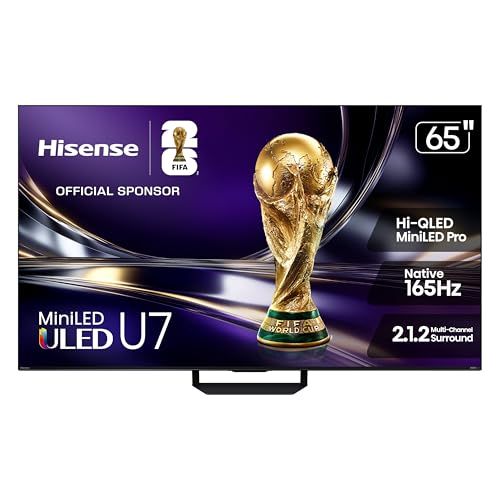
Hisense U8N 65-Inch Mini LED TV
Mini LED backlighting and a claimed 3,000 nit peak brightness rival sets that cost far more. Hisense pairs the panel with Google TV and a built-in ATSC 3.0 tuner for newer broadcast standards. Budget-focused theater buyers get most of that contrast performance without the premium brand price.
Pros
- High peak brightness for its price bracket
- Strong local dimming performance for a budget set
- Built-in ATSC 3.0 tuner supports newer broadcasts
Cons
- Off-angle color shift is more noticeable than premium sets
- App interface shows occasional lag

TCL QM8 85-Inch QD-Mini LED TV
An 85 inch panel fills a theater wall at a price closer to a 65 inch OLED. Quantum dot color sits over the Mini LED backlight, widening the color gamut. Owners cite strong shadow detail thanks to a high count of local dimming zones for its size.
Pros
- Largest screen size in this comparison for its price
- Quantum dot layer widens the color gamut
- High dimming zone count controls blooming well
Cons
- Cabinet depth runs bulkier than slimmer competing panels
- Google TV platform shows occasional stutter

Vizio M-Series Quantum 65-Inch TV
A quantum dot layer paired with full-array local dimming brings respectable contrast to an entry-level price. SmartCast software supports AirPlay and Chromecast without a separate streaming box. It suits a secondary theater setup or a first large-screen upgrade.
Pros
- Lowest price per inch in this comparison
- Quantum dot layer improves color over basic LED panels
- SmartCast supports AirPlay and Chromecast natively
Cons
- Only one full-bandwidth HDMI 2.1 port
- Local dimming zone count trails Mini LED rivals

LG G4 77-Inch OLED evo TV
A slim Gallery Design panel sits nearly flush against a wall once mounted, suiting a dedicated theater build. Its Brightness Booster panel pushes higher peak nits than standard OLED sets. Installers favor the flush mount alongside consistent OLED black levels.
Pros
- Slim design mounts nearly flush against a wall
- Brightness Booster raises peak nits over standard OLED
- Four full-bandwidth HDMI 2.1 ports suit AV gear
Cons
- Needs the included wall mount for the flush look
- Costs more than the standard C-series OLED
How to pick the right one
What matters more than screen size Panel type decides contrast long before diagonal inches enter the picture. OLED turns pixels fully off for true black, while Mini LED dims backlight zones to approximate it. Refresh rate and HDMI 2.1 bandwidth matter more for gaming and AV receivers than for movie viewing alone.
Best large-screen TVs for a dark dedicated theater A dark, light-controlled room favors OLED, since ambient light no longer washes out its dimmer peak brightness. Both the LG C4 and G4 deliver per-pixel black levels that Mini LED cannot fully match. Static content like channel logos still carries a small long-term burn-in risk on any OLED panel.
Best large-screen TVs for a bright living room theater Rooms with windows or overhead lighting benefit from Mini LED or Neo QLED brightness instead. Both the Sony Bravia 9 and Samsung QN90D push past 2,000 nits, cutting through glare that would wash out OLED. A matte anti-glare coating, like Samsung’s, further reduces window reflections.
Sizing the screen to the room Seating distance should roughly match screen diagonal for an immersive but not overwhelming view. A 65 inch set suits closer seating, while 75 to 85 inch panels need more room depth. Wall-mount clearance and cabinet depth also matter, since some Mini LED sets run bulkier than slim OLED panels.
The lineup, side by side
| # | Model | Panel type | Best for | Score | Price |
|---|---|---|---|---|---|
| 1 | Sony Bravia 9 65-Inch Mini LED TV | Mini LED | Best overall | 9.4 | Check price |
| 2 | LG C4 65-Inch OLED evo TV | OLED evo | Best for movie purists | 9.2 | Check price |
| 3 | Samsung QN90D 75-Inch Neo QLED TV | Neo QLED | Best for bright rooms | 9.0 | Check price |
| 4 | Hisense U8N 65-Inch Mini LED TV | Mini LED | Best value | 8.7 | Check price |
| 5 | TCL QM8 85-Inch QD-Mini LED TV | QD-Mini LED | Best for largest screen size | 8.5 | Check price |
| 6 | Vizio M-Series Quantum 65-Inch TV | Full-array LED | Best budget | 8.2 | Check price |
| 7 | LG G4 77-Inch OLED evo TV | OLED evo | Best for wall mounting | 8.9 | Check price |
Common questions
What is the best large-screen TV for a home theater room?
The Sony Bravia 9 balances high peak brightness with strong local dimming, making it a solid all-around pick for dedicated theater rooms. The LG C4 OLED suits buyers who prioritize true black levels over raw brightness.
Is OLED or Mini LED better for a dark home theater?
OLED generally wins in a fully dark room, since it turns pixels off completely for true black. Mini LED closes much of that gap in brightness and can look better once any ambient light enters the room.
How big of a TV is too big for a living room?
Size depends on seating distance more than the room itself, with 65 inches suiting seating around 8 feet and 75 to 85 inch panels needing 10 feet or more. Sitting too close can make individual pixels or panel structure visible.
Do large-screen TVs need a soundbar or AV receiver?
Built-in speakers on most large TVs struggle to fill a theater-sized room with clear dialogue and bass. A soundbar or full AV receiver setup, connected through eARC, is standard for a proper home theater build.
What is the difference between HDMI 2.0 and HDMI 2.1 for a home theater?
HDMI 2.1 supports higher bandwidth for 4K at 120Hz and features like variable refresh rate, which matter for gaming consoles. Movie playback at standard frame rates works fine over HDMI 2.0, so it matters less for pure film viewing.
Can OLED TVs get burn-in from watching movies?
Burn-in risk from movies alone stays low, since content changes frequently and rarely holds a static image for hours. Risk rises with fixed elements like news tickers or paused menus left on screen for extended periods.
Is a 75 or 85 inch TV worth it over 65 inches for home theater?
Larger sizes suit rooms with seating 9 feet or farther from the screen, where a 65 inch panel looks small. Price per inch improves at larger sizes, but the room needs enough depth to avoid sitting too close.
What refresh rate do I need for a home theater TV?
120Hz or higher handles motion smoothing for movies and supports high frame rate gaming without added hardware. Most current large-screen models compared here already include native 120Hz or 144Hz panels.
Sony Bravia 9 vs LG C4: which is better for a home theater?
The Bravia 9 suits rooms with some ambient light, since its Mini LED backlight pushes brighter peak highlights. The C4 suits a fully dark room, where its per-pixel OLED blacks matter more than raw brightness.
Is a 65 inch TV big enough for a home theater?
A 65 inch screen works well for seating around 8 feet away, which fits many standard living rooms. Dedicated theater rooms with seating farther back often move up to 75 or 85 inches instead.
Our take
The Sony Bravia 9 earns the top spot for pairing Mini LED brightness with contrast that rivals OLED, suiting theater rooms with some ambient light. Buyers with a fully dark, light-controlled room should lean toward the LG C4 OLED for its true per-pixel blacks. The Hisense U8N remains the pick for anyone who wants similar Mini LED performance without the premium brand price.