LED Headlight Bulbs Ranked on Beam Pattern and Heat
Philips Ultinon Pro9000 LED bulbs are our overall pick for chip placement and beam control. Hikari Ultra Focus bulbs give the tightest cutoff in a projector housing, and SEALIGHT Scoparc S1 bulbs are the best value upgrade for most vehicles.
If you are replacing halogen bulbs and want light where it belongs rather than scattered everywhere, the Philips Ultinon Pro9000 is the one to buy, with the Hikari Ultra Focus the sharper choice in projector housings and the SEALIGHT Scoparc S1 the sensible value upgrade.
LED headlight bulbs are the most oversold category in car accessories, because the headline lumen numbers are usually theoretical chip output rather than light on the road, and a bulb that puts its chips in the wrong plane produces glare instead of usable distance. Housing type matters enormously. We compared chip placement, cooling design, driver dimensions and what owners report about fitment and flicker to rank the seven below.
What we recommend

Philips Ultinon Pro9000 LED Headlight Bulbs
Philips builds these with the emitters positioned to sit where a halogen filament would, which is what allows the reflector or projector to focus the light properly instead of scattering it. The result is a defined beam with a proper cutoff rather than raw brightness. Owners report the beam pattern is the reason to pay more, since it is what actually determines how far ahead you can see.
Pros
- Beam pattern holds a genuine cutoff
- Chip placement matches halogen geometry
- Manufacturer backing and warranty support
Cons
- Costs considerably more than generic bulbs
- Still not legal for road use in every jurisdiction

SEALIGHT Scoparc S1 LED Headlight Bulbs
A compact bulb with an integrated driver in the base, which avoids the separate ballast box that causes fitment problems behind crowded headlight housings. Beam performance is respectable for the level, with a reasonably controlled pattern. Owners report it is the upgrade that fits where larger bulbs will not, particularly on vehicles with tight dust cap clearance.
Pros
- No separate ballast box to find space for
- Fits tight dust caps other bulbs will not clear
- Strong value for the performance
Cons
- Fan is audible in a quiet garage
- Beam control is good but not at Philips level

Hikari Ultra Focus LED Headlight Bulbs
The chip arrangement here is aimed at reproducing a tight beam with a sharp horizontal cutoff, which is what a projector housing needs to avoid throwing light into oncoming traffic. Cooling uses a copper substrate to move heat away from the emitters. Owners report the cutoff line is noticeably cleaner than typical aftermarket bulbs, which matters for both visibility and courtesy.
Pros
- Clean horizontal cutoff in projectors
- Copper heat path handles sustained output
- Bright without excessive scatter
Cons
- Larger body needs clearance behind the housing
- Reflector housings show more glare than projectors
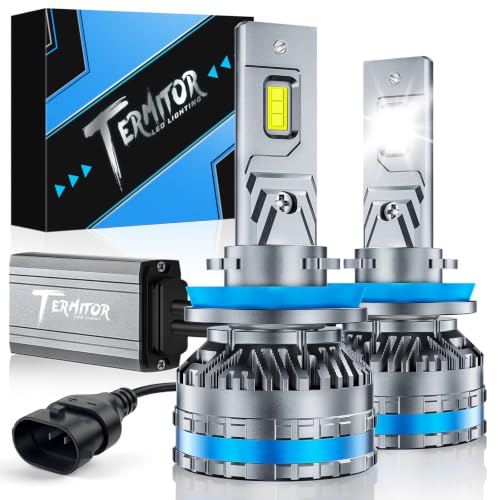
Fahren LED Headlight Bulbs
Aimed squarely at maximum usable brightness, with a large heat sink and high output emitters, which suits vehicles with well designed projector housings that can control the extra light. The turbo cooling fan runs at high speed. Owners report a clear step up in illumination and note that the same output in a poor reflector housing produces glare.
Pros
- Very bright in a suitable housing
- Substantial cooling for sustained output
- Long rated lifespan
Cons
- Bright enough to cause glare in reflector housings
- Fan noise is noticeable at idle

Auxbeam F-16 Series LED Headlight Bulbs
Built around a slim profile designed to clear dust caps and housings that reject bulkier bulbs, without giving up active cooling entirely. Adjustable collars help align the beam correctly during fitting. Owners report the adjustability is the useful part, since a bulb rotated even slightly out of plane ruins the beam pattern.
Pros
- Fits housings that reject larger bulbs
- Adjustable collar helps set the beam plane
- Reasonable cooling in a slim body
Cons
- Smaller heat sink limits sustained output
- Some vehicles still need a CANbus decoder

SYLVANIA ZEVO LED Headlight Bulbs
From an established lighting manufacturer with a proper warranty and consistent quality control, which is worth something in a category full of unbranded sellers. Output is moderate rather than extreme, with attention paid to beam control. Owners report it is the choice when reliability and support matter more than the biggest number on the box.
Pros
- Real warranty and manufacturer support
- Consistent quality control between units
- Sensible beam control rather than raw output
Cons
- Less bright than aggressive aftermarket bulbs
- Fitment range narrower than some rivals

Beamtech LED Headlight Bulb
A straightforward, widely fitted LED bulb that gives a clear improvement over tired halogens without any complexity. Cooling is passive on some versions and fan assisted on others. Owners report it is a sensible way to find out whether an LED conversion suits your housing before spending more, while noting the beam pattern is basic.
Pros
- Cheapest route to an LED upgrade
- Simple installation with no separate ballast
- Clear improvement over worn halogens
Cons
- Beam pattern is loose compared with premium bulbs
- Lifespan varies more between units
Side by side
| # | Model | Chip layout | Best for | Score | Price |
|---|---|---|---|---|---|
| 1 | Philips Ultinon Pro9000 LED Headlight Bulbs | Emitters positioned to match halogen filament location | Best overall | 9.4 | Check price |
| 2 | SEALIGHT Scoparc S1 LED Headlight Bulbs | Integrated driver in the bulb base | Best value | 9.2 | Check price |
| 3 | Hikari Ultra Focus LED Headlight Bulbs | Focused pattern with defined cutoff | Best beam pattern | 9.0 | Check price |
| 4 | Fahren LED Headlight Bulbs | High brightness emitter pairing | Best for output | 8.8 | Check price |
| 5 | Auxbeam F-16 Series LED Headlight Bulbs | Slim body for restricted housings | Best for tight housings | 8.5 | Check price |
| 6 | SYLVANIA ZEVO LED Headlight Bulbs | Established automotive lighting manufacturer | Best manufacturer support | 8.2 | Check price |
| 7 | Beamtech LED Headlight Bulb | Compact bulb with integrated driver | Best budget | 8.0 | Check price |
How to choose
Beam pattern beats brightness every time A headlight housing is an optical system designed around the exact position of a halogen filament. LED bulbs that place their chips in the same plane and position let the reflector or projector focus light onto the road with a clean cutoff. Bulbs that do not simply scatter light, which looks bright from the driver’s seat while illuminating less road and blinding oncoming traffic. Ignore the lumen claims on the box and look at where the emitters sit.
Projector and reflector housings behave differently Projector housings use a lens and a shield to create a hard cutoff line, and they tolerate LED conversions comparatively well. Reflector housings rely on the bulb being a point source in a specific place, and they scatter light from a poorly matched LED badly. If your car has reflector housings, choose conservatively, aim carefully afterwards, and accept that the result will never be as clean as a factory projector.
Check clearance before ordering Fitment failures are the most common complaint in this category. Measure the space behind the headlight, including the depth available under the dust cap, and check whether the bulb has an integrated driver or a separate box that needs mounting. Fan cooled bulbs need airflow, so a sealed dust cap over a fan can shorten life. Some vehicles also need a CANbus decoder to stop bulb out warnings or flickering.
Aim the lights after any bulb change Any change of bulb type shifts where the light lands, and an LED conversion without re aiming is the main reason drivers get flashed by oncoming traffic. Park square on to a wall at a measured distance, mark the existing hot spot before changing bulbs, and adjust afterwards so the cutoff sits at or slightly below the original height. It takes twenty minutes and makes more difference than choosing a brighter bulb.
Common questions
Are LED headlight bulbs legal?
It depends entirely on where you are. In many jurisdictions, retrofit LED bulbs in a housing certified for halogen are not approved for road use, even when sold openly. Rules also differ for projector and reflector housings. Check local regulations before fitting, and treat any bulb marketed for off road use accordingly.
Why do my new LED bulbs blind oncoming drivers?
Usually because the chips do not sit where the halogen filament did, so the housing cannot focus the light, or because the lights were not re aimed after the change. Rotating the bulb so the emitters lie in the correct plane and re aiming the headlights fixes most cases. Reflector housings are far more prone to this than projectors.
Do lumen ratings mean anything?
Very little as marketed. Most quoted figures are theoretical chip output rather than measured light on the road, and many are simply inflated. A well focused bulb with a moderate figure puts far more usable light ahead of you than a scattered high output one. Beam pattern and chip placement are the specifications that matter.
Do I need a CANbus decoder?
Some vehicles, particularly European models, monitor bulb current and will report a bulb failure or flicker when an LED draws less than a halogen. A decoder or resistor resolves it. Check whether the bulb is described as CANbus ready for your vehicle before assuming you need one.
Why do LED bulbs have fans?
LEDs generate heat at the base rather than radiating it forward like a halogen filament, and that heat must be moved away or the emitters dim and fail early. Fans do that in a compact body. Passive heat sinks and braided designs exist but need more space or accept lower output.
Will LED bulbs fit in my car?
Only if there is physical space. The bulb base is larger than a halogen and may not clear the dust cap, and bulbs with separate drivers need somewhere to mount the box. Check the bulb size your vehicle uses, then check the depth available behind the headlight before ordering.
What colour temperature should I choose?
Around 5500K to 6000K is the practical range, being white without a strong blue cast. Higher temperatures look more dramatic but scatter more in rain and fog and actually reduce perceived contrast. Anything much above 6500K trades usable visibility for appearance.
How long do LED headlight bulbs last?
Rated lifespans run to tens of thousands of hours, but real life depends heavily on cooling. A bulb with an obstructed fan or a sealed housing runs hot and dims early. Failures also cluster in cheap units with poor drivers, which is where buying from an established manufacturer pays off.
The bottom line
Philips Ultinon Pro9000 bulbs are the ones to fit if you want light on the road rather than a bright glow around the car, because the chip placement lets the housing do its job. Hikari Ultra Focus is the alternative worth considering in a projector housing, and SEALIGHT Scoparc S1 is the value pick when clearance behind the headlight is tight. Whatever you fit, re aim the headlights afterwards.


