Do You Really Need a Lens Filter on Your Camera?
Hoya HD3 UV Filter earns the top spot for its hardened glass and dense multi coating. B+W XS-Pro UV MRC-Nano 010M suits salt air, rain and dust better than any filter here. K&F Concept Variable ND2 to ND32 gives video shooters one to five stops for the lowest cost. All three preserve resolution.
Hoya’s HD3 UV Filter is the safest pick for protecting a front element without changing color or sharpness. Anyone shooting near rain, dust or salt air should look at the B+W XS-Pro UV MRC-Nano 010M instead. Video shooters get more value from the K&F Concept variable ND, since one ring replaces several fixed filters.
A weak filter quietly erases the sharpness a lens was built to deliver. Coating layer count, glass flatness and ring thickness matter more than any marketing claim. We compared published optical specifications, checked owner reports on flare and vignetting, and weighed real world use cases like video, travel and harsh weather.
What we recommend

Hoya HD3 UV Filter
Hoya builds the HD3 around chemically strengthened glass, so it resists the scratches that ruin cheaper UV filters. A 16 layer coating keeps transmission high enough that exposure barely shifts once the filter is mounted. Owners report almost no visible flare change on backlit frames.
Pros
- Coating resists fingerprints and smears
- Barely measurable effect on exposure
- Thin ring avoids vignetting on wide lenses
Cons
- Costs more than basic UV glass
- Slim ring removes front filter threads on some sizes

B+W XS-Pro UV MRC-Nano 010M Filter
MRC-Nano coating is why this filter keeps showing up on lenses that live outdoors, since water beads and rolls off instead of pooling. Schott glass and a brass ring stay flat and unscrew easily after a cold shoot. Photographers use it as a long term protector rather than a creative tool.
Pros
- Water and oil repellent surface
- Brass ring resists seizing on the lens
- High flatness suits high resolution sensors
Cons
- Priced at the premium end
- Slim design is harder to grip when wet
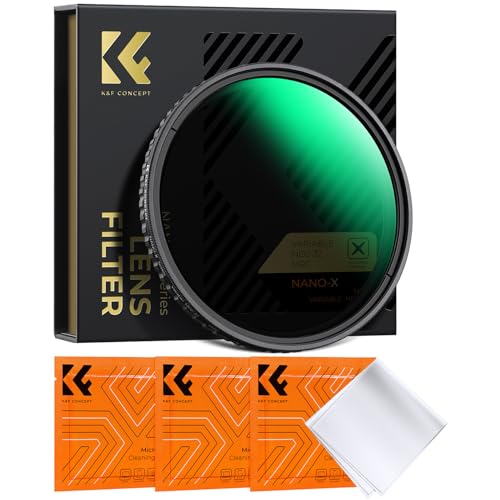
K&F Concept Variable ND2 to ND32 Filter
One ring on this filter covers one to five stops, enough to hold a cinematic shutter angle through most daylight. K&F pairs a 28 layer coating with hard stops so the ring cannot rotate into the X pattern. A slight warm color cast appears at the strongest setting, according to the listing and owner feedback.
Pros
- Replaces several fixed ND filters
- Hard stops prevent cross pattern banding
- Knurled ring turns smoothly in cold weather
Cons
- Mild color cast at the strongest setting
- Thicker stack can vignette on ultra wide lenses

PolarPro QuartzLine Circular Polarizer
Fused quartz glass and a machined aluminum frame make this the polarizer landscape photographers keep recommending for cutting glare on water and foliage. Rotation feels firm without sticking, so glare can be dialed in precisely. Expect about a stop and a half of light loss, typical for a circular polarizer.
Pros
- Deepens skies and cuts reflections cleanly
- Low color shift compared to most CPLs
- Solid grip ring works with gloved hands
Cons
- Uneven sky darkening on ultra wide lenses
- Heavier than resin bodied polarizers

Tiffen UV Protector Filter
Tiffen has sold this basic protector for decades, and it still does the one job it claims: keeping grit and fingerprints off the front element. Coating is single layer at best, so strong point lights can cause a visible reflection. That tradeoff works fine for kit zooms and travel lenses.
Pros
- Very affordable protection
- Sold in nearly every thread size
- Light enough to leave on permanently
Cons
- More prone to ghosting near bright lights
- Coating marks show up easily

Urth UV Lens Filter Plus+
Urth uses Japanese optical glass with a 20 layer nano coating, then packs it in a rigid case that survives a bag better than typical plastic clamshells. Its slim ring stacks without vignetting on most 24mm lenses. Build and optics land between budget and boutique tiers.
Pros
- Good coating quality for the price tier
- Knurled ring is easy to remove
- Sturdy case protects it in a bag
Cons
- Some size variants sell out often
- Less scratch resistant than hardened glass options

Breakthrough Photography X4 CPL Filter
Breakthrough tunes the X4 for color neutrality, so skies deepen without the green or magenta drift some polarizers add. Its traction frame turns easily even in cold weather with gloves on. Based on specifications, it ranks among the flattest polarizers available in common thread sizes.
Pros
- Very neutral color rendering
- Brass frame removes easily in cold weather
- Strong flare and ghosting control
Cons
- Thicker profile than slim UV filters
- Limited stock in less common sizes
How they stack up
| # | Model | Type | Best for | Score | Price |
|---|---|---|---|---|---|
| 1 | Hoya HD3 UV Filter | UV protection | Best overall | 9.4 | Check price |
| 2 | B+W XS-Pro UV MRC-Nano 010M Filter | UV protection | Best for outdoor and weather use | 9.2 | Check price |
| 3 | K&F Concept Variable ND2 to ND32 Filter | Variable ND | Best value for video | 9.0 | Check price |
| 4 | PolarPro QuartzLine Circular Polarizer | Circular polarizer | Best circular polarizer for landscapes | 8.8 | Check price |
| 5 | Tiffen UV Protector Filter | UV protection | Best budget | 8.6 | Check price |
| 6 | Urth UV Lens Filter Plus+ | UV protection | Best for everyday carry | 8.3 | Check price |
| 7 | Breakthrough Photography X4 CPL Filter | Circular polarizer | Best for neutral color rendering | 8.0 | Check price |
What matters most
What does a lens filter actually protect against? A UV or clear filter is insurance for the front element, since modern sensors already handle ultraviolet light on their own. Circular polarizers cut reflections and deepen skies by blocking specific light angles. Neutral density glass buys slower shutter speeds or wider apertures in bright light. Buying the wrong category is the most common mistake, so start from the problem, not the price.
How much do coatings really affect image quality? Nearly every filter on this list uses decent optical glass, but coating count and quality decide how it behaves against a streetlight or low sun. Multi coated surfaces reflect far less light back into the lens, which keeps ghost blobs out of night shots. Water repellent top layers make the difference between wiping a filter once and fighting smears all afternoon.
How do I find the right filter size for my lens? Filter sizes are printed on the front of the lens barrel or inside the cap next to a circle with a line through it. Buying for your largest thread and adding step up rings costs less than duplicating filters across several lenses. That approach does lose the ability to fit the original lens hood. Slim rings help on ultra wide lenses, where a thick frame can clip the corners of the frame.
Can you stack multiple filters without hurting the shot? Every filter added to a lens introduces more thickness and two extra air to glass surfaces. Stacking a polarizer on top of a UV filter reliably darkens corners on a wide lens and invites flare. Removing the protector before adding a creative filter avoids both problems. On lenses of 24mm and wider, owners report that slim or extra slim rings are worth the extra cost.
Good to know
Do digital cameras still need UV filters?
Not for blocking ultraviolet light, since digital sensors already filter it internally. Many photographers keep one on anyway as a sacrificial layer that takes a scratch instead of the front element. That reasoning holds up best on lenses that go near sand, spray or curious toddlers.
Will a cheap filter lower image quality?
It can. Uncoated or poorly polished glass adds reflections and softens fine detail, and the effect shows up most against bright point lights at night. A well coated filter is the sensible pairing for a lens worth protecting.
What is the difference between a linear and circular polarizer?
Circular polarizers include an extra layer that keeps autofocus and metering working correctly on modern cameras. Linear versions mostly suit older manual gear. Buy circular unless you have a specific reason not to.
How many stops of ND does video work need?
One to five stops covers most daylight situations while holding a 180 degree shutter angle. Bright beach or snow scenes can call for six stops or more. That usually means reaching for a fixed ND rather than a variable one.
Why does my variable ND filter show a dark X shape?
That cross pattern appears when the two polarizing layers rotate past their usable range. It shows up worst on wide angle lenses. Filters with hard stops prevent it by physically limiting rotation.
Can I leave a polarizer on the lens all the time?
It is not ideal. A polarizer costs a stop or more of light and can darken skies unevenly on wide lenses. Fit it when you want the effect and remove it otherwise.
How should I clean a lens filter?
Blow off loose grit first, then add a few drops of lens fluid to a microfiber cloth and wipe from the center outward. Dry wiping trapped sand is what scratches coatings in the first place.
Are step up rings worth buying?
Yes, for saving money across several lenses, with two tradeoffs. You cannot mount the original lens hood over the ring, and a tall stack of adapters raises the risk of vignetting on wide lenses.
Which filter is best for landscape photography?
A circular polarizer earns its place in most landscape kits by cutting glare on water and foliage while deepening skies. Fused quartz or SCHOTT glass options keep color shift low. Pair it with a UV filter only when the lens genuinely needs extra protection.
Our pick
Hoya’s HD3 UV Filter remains the safest choice for photographers who want a filter and forget it, thanks to hardened glass that survives daily cleaning without costing sharpness. Reach for the B+W XS-Pro 010M if the camera lives outdoors in rain or salt air. Video shooters get the most flexibility from the K&F Concept variable ND, since one filter replaces a full ND set.