Paddleboards Light Enough to Carry to the Water Alone
iRocker’s Cruiser stays under 20 pounds inflated and takes the top spot here for all-around solo paddling. Thurso Surf’s Waterwalker matches that weight savings at a lower price, while SereneLife’s board packs down smallest of the seven for car trunks and closet storage.
iRocker’s Cruiser balances low board weight with enough volume to stay stable underfoot, making solo carrying and paddling easier. Full inflation still takes 10 to 15 minutes, longer than a rigid board needs.
Board weight and packed dimensions vary more between brands than paddle length or fin count. We compared listed board weight, deck length, and owner reports on rigidity at full inflation.
What we recommend

iRocker Cruiser 10’6″ Inflatable Paddle Board
Twenty pounds of board weight stays light enough to carry one-handed from a car to the water. Dual-layer PVC construction keeps rigidity high despite that low weight. A backpack, pump, and paddle ship in the same box, so no separate purchases are needed.
Pros
- Low weight without sacrificing rigidity
- Full kit ships with backpack, pump, and paddle
- 435-pound capacity is high for the board’s size
Cons
- Full inflation takes 10 to 15 minutes
- Backpack straps wear down with frequent travel

Thurso Surf Waterwalker 10’6″ Inflatable SUP
Military-grade PVC covers the outer layer at a weight close to pricier boards. A dual-action pump cuts inflation time compared to single-action alternatives. Weight capacity tops out at 350 pounds, lower than the iRocker Cruiser’s 435.
Pros
- Dual-action pump speeds up setup
- Matches premium boards on weight at a lower price
- Ships with a repair kit and a fin
Cons
- 350-pound capacity trails the iRocker Cruiser
- Deck pad runs thinner than some competitors

Retrospec Weekender 4 Inflatable Paddle Board
Single-layer PVC construction keeps the price down while still landing under 23 pounds. First-time paddlers get a functional board without paying for multi-layer construction. Weight capacity caps at 240 pounds, the lowest of the seven boards here.
Pros
- Lowest price among these seven lightweight boards
- Stays under 23 pounds for solo carrying
- Packs down compact for closet or trunk storage
Cons
- 240-pound capacity limits larger paddlers
- Single-layer PVC flexes more at full length

Atoll 11′ Inflatable Stand Up Paddle Board
Eleven feet of length improves glide over longer paddles across open lakes. Military-grade PVC keeps weight close to boards a foot shorter. A center fin plus two side fins add tracking stability on straight-line paddling.
Pros
- Extra length improves glide on open water
- Tri-fin setup aids straight-line tracking
- Weight stays reasonable despite the longer deck
Cons
- Maneuvering in tight spots is harder at 11 feet
- Slightly heavier than 10-foot alternatives
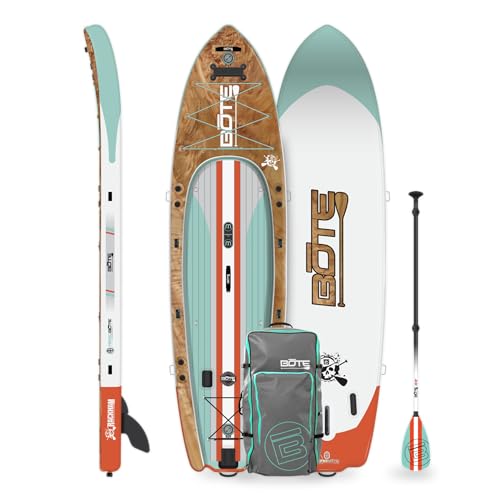
BOTE Rackham Aero Inflatable Paddle Board
Built-in rod holders and gear mounting points suit anglers who fish standing up. A wider deck adds stability for casting, though it adds weight over pure touring boards. Weight capacity clears 500 pounds, the highest of the seven.
Pros
- Rod holders are built directly into the deck
- 500-plus pound capacity handles gear and coolers
- Wide stance improves stability while casting
Cons
- Heaviest board in this comparison at 33 pounds
- Overkill for paddlers who do not fish
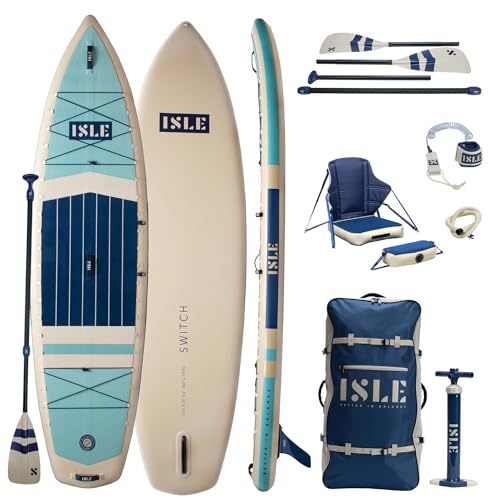
Isle Pioneer Inflatable Paddle Board
A 32-inch deck width improves balance for first-time paddlers still finding their footing. The included paddle collapses into three pieces, matching the board’s compact backpack. Weight capacity reaches 275 pounds, enough for most solo beginners.
Pros
- Wide deck improves stability for beginners
- Three-piece paddle packs down small
- Reasonable 22-pound weight for new paddlers to carry
Cons
- Wide deck slightly slows paddling speed
- 275-pound capacity limits larger adults with gear

SereneLife Inflatable Stand Up Paddle Board
This board packs into a backpack roughly the size of a large duffel bag, fitting car trunks and closets that reject longer boards. A shorter 9-foot-6 deck trades some top-end speed for that compact size. Weight capacity sits at 220 pounds, the lowest here.
Pros
- Smallest packed size of the seven boards
- 21-pound weight makes solo transport easy
- Fits smaller car trunks and closets
Cons
- Shorter length reduces top-end speed
- 220-pound capacity trails the touring-length boards
How to pick the right one
What to look for in a lightweight paddleboard Board weight under 25 pounds makes solo transport realistic for most adults. Weight capacity deserves a separate check, since a light board with low capacity may struggle with gear or a passenger aboard. Packed size matters too for anyone storing a board in a closet or small trunk.
Inflatable vs hard lightweight boards Inflatable boards fold into a backpack and store in a closet, unlike rigid boards that need roof racks and garage space. Rigid boards glide slightly better per stroke thanks to a stiffer hull. Most lightweight boards sold today are inflatable, since foam-core rigid boards rarely drop under 25 pounds.
Best lightweight paddleboards for calm lakes and beginners Wider decks around 32 inches, like the Isle Pioneer, add stability for paddlers still adjusting their balance. Shorter 10-foot lengths turn more easily in calm water than longer touring boards. A wide, stable deck matters more than top speed for a first outing.
Best lightweight paddleboards for longer touring paddles Boards over 11 feet, like the Atoll, glide farther per paddle stroke than 10-foot boards. That extra distance per stroke pays off on longer lake or coastal routes rather than short recreational outings. Tri-fin setups also help longer boards track straighter over distance.
Compared at a glance
| # | Model | Board weight | Best for | Score | Price |
|---|---|---|---|---|---|
| 1 | iRocker Cruiser 10’6″ Inflatable Paddle Board | ~20 lbs | Best overall | 9.3 | Check price |
| 2 | Thurso Surf Waterwalker 10’6″ Inflatable SUP | ~21 lbs | Best value | 9.0 | Check price |
| 3 | Retrospec Weekender 4 Inflatable Paddle Board | ~23 lbs | Best budget | 8.6 | Check price |
| 4 | Atoll 11′ Inflatable Stand Up Paddle Board | ~24 lbs | Best for all-around touring | 8.4 | Check price |
| 5 | BOTE Rackham Aero Inflatable Paddle Board | ~33 lbs | Best for fishing | 8.2 | Check price |
| 6 | Isle Pioneer Inflatable Paddle Board | ~22 lbs | Best for beginners | 8.0 | Check price |
| 7 | SereneLife Inflatable Stand Up Paddle Board | ~21 lbs | Best for compact storage | 7.9 | Check price |
Common questions
How much does a lightweight paddleboard typically weigh
Most lightweight inflatable boards weigh between 18 and 25 pounds, compared to 30 pounds or more for standard inflatable and hard boards.
Are inflatable paddleboards as durable as hard boards
Multi-layer PVC inflatable boards hold up well to regular use. Hard boards resist punctures better on rocky shorelines and shallow launches.
Can one person carry and inflate a paddleboard alone
Yes. Boards under 25 pounds with an included pump are built for solo setup, typically taking 10 to 15 minutes to reach full pressure.
What weight capacity do I need for a paddleboard
Add body weight plus any gear or a passenger, then choose a board rated at least 50 pounds above that total for stable footing.
Is a longer or shorter paddleboard better for beginners
Shorter boards around 10 feet with a wide deck balance more easily for beginners than longer touring boards designed for distance.
How long does it take to inflate a lightweight paddleboard
Most dual-action pumps included with lightweight boards reach full pressure in about 8 to 12 minutes of pumping.
Do lightweight paddleboards perform as well as heavier ones
Lighter boards can flex slightly more at full length, though multi-layer construction in premium models narrows that gap in everyday paddling.
Can lightweight paddleboards be used for fishing
Some, like the BOTE Rackham Aero, are built specifically for fishing with rod holders and gear mounts, though they weigh more than pure touring boards.
Which lightweight paddleboard has the highest weight capacity
The BOTE Rackham Aero rates above 500 pounds, the highest capacity among these seven boards, aided by its wider fishing-focused deck.
Final word
iRocker’s Cruiser fits most paddlers who want a light board that still handles varied conditions well. Budget-conscious buyers should choose the Thurso Surf Waterwalker instead, for nearly identical weight at a lower price. Anglers should skip the lightest options entirely and pick the BOTE Rackham Aero for its built-in fishing features and higher weight capacity.



