Which Marine Battery Charger Matches Your Boat’s Setup?
The NOCO GENIUS10 leads this comparison for single-battery boats, followed by the GENPRO10X2 for dual lithium banks and the ProMariner ProSport 20 Plus for dual lead-acid setups. Bank count, amperage, and battery chemistry compatibility separate these seven chargers most.
Bank count, amperage, and battery chemistry support separate seven real marine battery chargers. Single-battery boats fit the NOCO GENIUS10, while the GENPRO10X2 covers two banks including lithium packs. Larger pontoon boats running three batteries fit better with the Minn Kota MK-330D.
Picking the wrong amperage either charges too slowly or stresses a small battery bank. Spec sheets, owner feedback, and manufacturer chemistry ratings across portable and onboard designs shaped how these seven were sorted by real use case.
The top picks, ranked

NOCO GENIUS10
Ten amps flow to a single battery bank on the GENIUS10. Eight charging modes cover lithium, AGM, gel, and flooded chemistries. IP65 sealing blocks dust and spray on an open boat deck.
Pros
- Switches between lithium and lead-acid automatically
- Compact housing fits tight console storage
- Digital display reads charge percentage and voltage
Cons
- Only one bank, no multi-battery version at this amperage
- Not built for permanent onboard mounting

NOCO GENPRO10X2
NOCO built the GENPRO10X2 for permanent mounting near two battery banks. PowerOnDemand technology adjusts output automatically for lithium chemistry. IP68 sealing means it survives full submersion, not just splashes.
Pros
- Rated for lithium marine batteries from the start
- Sealed housing tolerates bilge moisture
- Isolated outputs stop cross-bank contamination
Cons
- Permanent mounting requires drilling
- Draws more current than portable single-bank units

ProMariner ProSport 20 Plus
Twenty amps split across two isolated outputs on the ProSport 20 Plus. ProMariner potted the internal electronics in resin against condensation. Owners typically mount it below deck near the battery compartment.
Pros
- Selectable profile for AGM, gel, or flooded batteries
- Potted electronics resist vibration and moisture
- Per-bank LED status simplifies monitoring
Cons
- No lithium battery compatibility
- Housing runs bulkier than compact portable units

Minn Kota MK-330D Precision Charger
Three separate batteries, including trolling motor banks, charge at once on the MK-330D. Each output reads independently on its digital display. A corrosion-resistant case handles fresh or salt water.
Pros
- Independent readout for each of three banks
- Automatic temperature compensation extends battery life
- Built-in reverse polarity and spark protection
Cons
- Not rated for lithium batteries
- Larger footprint needs dedicated mounting space

Minn Kota MK-110P Precision Charger
A single 10 amp output pairs with a portable carry handle on the MK-110P. Anglers use it to top off a trolling motor battery between trips. Its digital display tracks charge state without guesswork.
Pros
- Carry handle makes it easy to move between boats
- Digital display shows real-time charge percentage
- Automatic shutoff guards against overcharging
Cons
- No lithium charging profile
- Single bank limits it to one battery at a time

Dual Pro Sportsman Series SS2
Dual Pro positioned the Sportsman SS2 as its entry-level onboard charger. Two 6 amp outputs handle a starting battery and a small accessory bank. Potted circuitry stands up to saltwater fishing trips.
Pros
- Costs less than higher-amp Dual Pro models
- Compact housing suits smaller and bass boats
- Color-coded LEDs track each bank
Cons
- 6 amps per bank charges slower than 10A rivals
- Not rated for lithium battery chemistry
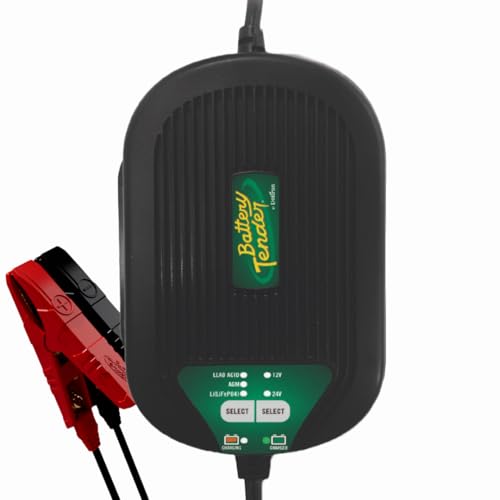
Battery Tender 022-0165-DL-WH Waterproof Marine Charger
This Battery Tender unit trickle-charges a single battery at 1.25 amps. Boat owners rely on it during winter storage rather than a full recharge. A marine-rated case handles cockpit or console mounting.
Pros
- Low amperage prevents overcharging during long storage
- Small enough to stay connected all winter
- Waterproof case suits open-cockpit installation
Cons
- 1.25 amps charges a drained battery too slowly
- No lithium-specific charge profile
Side by side
| # | Model | Bank Count | Best for | Score | Price |
|---|---|---|---|---|---|
| 1 | NOCO GENIUS10 | 1 bank | Best overall marine battery charger | 9.4 | Check price |
| 2 | NOCO GENPRO10X2 | 2 banks | Best for lithium marine batteries | 9.2 | Check price |
| 3 | ProMariner ProSport 20 Plus | 2 banks | Best for dual-battery boats | 9.0 | Check price |
| 4 | Minn Kota MK-330D Precision Charger | 3 banks | Best for multi-battery pontoon boats | 8.8 | Check price |
| 5 | Minn Kota MK-110P Precision Charger | 1 bank | Best for trolling motor batteries | 8.6 | Check price |
| 6 | Dual Pro Sportsman Series SS2 | 2 banks | Best budget onboard charger | 8.3 | Check price |
| 7 | Battery Tender 022-0165-DL-WH Waterproof Marine Charger | 1 bank | Best for off-season storage | 8.0 | Check price |
How to choose
What Should You Look for in a Marine Battery Charger? Four factors decide charger fit: bank count, amperage, battery chemistry, and waterproofing. A boat with one battery needs only a single-bank unit. Multiple batteries, like a starting bank plus a trolling motor bank, call for two or three outputs. Amperage affects charge speed, since higher amp ratings recharge a drained battery faster. Chemistry matters because lithium batteries need a dedicated charge profile that AGM-only chargers lack. Waterproofing ratings, from splash-resistant to fully submersible, determine where a unit can mount safely.
How Many Amps and Banks Does Your Boat Need? Small aluminum boats with a single starting battery run fine on a 10 amp single-bank charger. Bass boats often carry a starting battery plus a trolling motor bank, favoring a two-bank charger like the ProSport 20 Plus. Pontoon and larger cruisers frequently run three separate batteries for house power, starting, and accessories. Minn Kota’s MK-330D addresses that three-bank scenario with independent 10 amp outputs per bank. Higher total amperage shortens charge time but draws more current from shore power or a generator.
Lithium vs AGM vs Flooded: Which Chemistry Does Your Charger Support? AGM and flooded lead-acid batteries share similar charge profiles, so most standard marine chargers handle both. Lithium batteries behave differently and need a charger with a lithium-specific algorithm, like the NOCO GENPRO10X2. Using a lead-acid-only charger on a lithium battery can undercharge it or trigger the battery’s internal protection circuit. Owners switching to lithium should confirm chemistry compatibility before buying rather than assuming any charger works. Flooded batteries also need periodic equalization charging, a feature not every charger includes.
Charging for Storage vs Charging After a Day on the Water Trickle chargers like the Battery Tender 022-0165-DL-WH exist to maintain a battery during winter storage, not to recharge a dead one quickly. A 1.25 amp maintainer can stay connected for months without overcharging a battery. Active boaters who drain a battery after a day on the water need higher amperage, closer to 10 amps per bank, for a same-day recharge. Waterproof onboard chargers stay wired permanently and activate whenever shore power connects. Portable units suit boats stored in a garage where shore power is not always available.
Good to know
How many amps do I need to charge a marine battery?
Most single starting batteries charge well on 10 amps. Larger house battery banks or multiple batteries benefit from 15 to 30 amps split across banks, like the Minn Kota MK-330D’s 30 amp total output.
What is the difference between a marine battery charger and a car battery charger?
Marine chargers use waterproof, corrosion-resistant enclosures rated for wet cockpits and salt spray. Car chargers typically lack that sealing and are not built for permanent onboard mounting.
Can I use a lithium battery charger on an AGM marine battery?
Some chargers, including the NOCO GENPRO10X2, detect chemistry automatically and switch profiles for lithium, AGM, gel, or flooded batteries. Check a specific model’s compatibility list before connecting it to an AGM battery.
Which marine battery charger is best for a pontoon boat?
Pontoon boats often run three batteries for house, starting, and trolling power. A three-bank charger like the Minn Kota MK-330D charges all three independently at once.
Is a two-bank or three-bank charger better for a boat with a trolling motor?
A two-bank charger, such as the ProMariner ProSport 20 Plus, covers a starting battery and one trolling motor battery. Boats running two trolling motor batteries plus a starting battery need a three-bank charger instead.
Onboard versus portable marine battery charger, which should I buy?
Onboard chargers like the NOCO GENPRO10X2 mount permanently and activate automatically at shore power. Portable chargers, like the NOCO GENIUS10, move between boats or store away when not in use.
How long does it take to charge a marine battery fully?
Charge time depends on amperage and how depleted the battery is. A 10 amp charger typically restores a moderately drained battery in several hours, while a 1.25 amp maintainer is meant for upkeep, not fast recharging.
Do marine battery chargers work in the rain or near water?
Waterproof-rated models, such as the NOCO GENPRO10X2 with its IP68 housing, tolerate rain, spray, and even brief submersion. Lower-rated portable units resist splashes but should not be submerged.
Is it worth paying more for a lithium-compatible marine charger?
Owners running lithium batteries need a charger built for that chemistry, since a lead-acid-only unit can undercharge a lithium bank or trip its protection circuit.
The bottom line
Bank count and amperage should match a boat’s actual battery setup, not the highest number available. Owners running lithium batteries need a charger built for that chemistry, like the NOCO GENPRO10X2. For most single-battery boats, a compact 10 amp unit like the NOCO GENIUS10 covers regular charging needs.


