Wheel vs Pin Marking Gauges: Which Scores Cleaner Lines
Veritas Wheel Marking Gauge leads for woodworkers who need tear-out-free lines on tricky grain, thanks to its hardened steel wheel. Incra’s Precision Marking Gauge follows for rack-and-pinion accuracy on tight joinery. Woodriver’s Wheel Marking Gauge offers similar wheel-style scoring at a lower price for lighter use.
Veritas Wheel Marking Gauge suits woodworkers who need precise, tear-out-free lines on difficult grain. Its hardened steel wheel rolls smoothly instead of tearing fibers the way a dull pin would. The tradeoff is price, since it costs more than most gauges compared here.
Wheel gauges generally cut cleaner across tricky grain, while pin gauges hold a traditional edge for fine dovetail work. We compared beam material, lock security, adjustment range, and marking type across each model’s current listing rather than marketing copy alone.
What we recommend

Veritas Wheel Marking Gauge
A 1/2 inch hardened steel wheel rolls smoothly along the grain instead of scraping across it. Fine woodworkers rely on it for crisp lines with no tear-out. The micro-adjustable head fine-tunes settings, and the locking lever holds them without drift.
Pros
- Cuts cleanly with minimal tear-out
- Micro-adjustment dials in precise settings
- Locking lever stays secure under pressure
Cons
- Costs more than most gauges here
- Wheel needs occasional sharpening

Incra Precision Marking Gauge
Rack-and-pinion adjustment moves the head in tiny, repeatable increments. Furniture makers favor it when a joint needs a setting held to within a hair’s width. The hardened steel wheel leaves a clean line, and the lock stays positive through repeated use.
Pros
- Rack-and-pinion adjustment repeats precisely
- Wheel action stays smooth over time
- Build quality holds up to daily shop use
Cons
- Priced higher than basic wheel gauges
- Bulkier than compact pin gauges
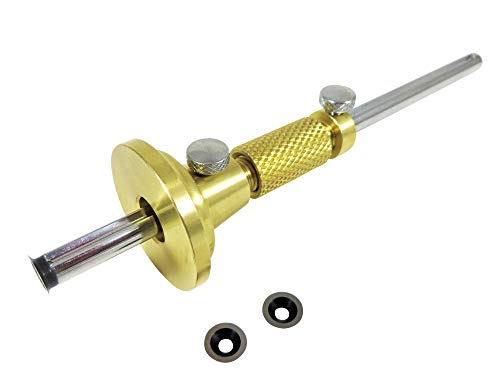
Taytools Double Cut Marking Gauge
Two stainless steel wheels split the job, one for scoring across the grain and one for cutting with it. Solid brass construction adds weight that steadies the cut. Owners like the dual scales and a thumb screw that grips without slipping.
Pros
- Two wheels match cut direction to grain
- Heavy brass body feels stable in hand
- Clean results on both cross and long grain
Cons
- Wheels are small and need periodic sharpening
- Thumb screw feels stiff until broken in

Shinwa Japanese Marking Gauge
A hardened steel pin and a lacquered wood beam give this classic Japanese gauge its traditional look and feel. Dovetail layout benefits most from the fine line the pin leaves. A thumbscrew locks the beam firmly once the setting is right.
Pros
- Leaves very fine, precise lines
- Traditional design suits hand-tool workflows
- Lock holds the beam without slipping
Cons
- Pin can tear wood if it dulls
- No built-in scale, so a ruler is needed
PEC Tools Marking Gauge
A hardened steel pin holds its edge through repeated dovetail layout work. Stainless steel forms the beam, so rust is less of a concern in a humid shop. Woodworkers favor the thin pin for the crisp line it leaves across tight joints.
Pros
- Sharp pin leaves clean, thin lines
- Stainless beam resists rust
- Fine adjustment knob dials in settings
Cons
- Can still tear difficult or figured grain
- Scale increments are small and hard to read

Woodriver Wheel Marking Gauge
A 1/4 inch wheel cuts smoothly at a price well below premium wheel gauges. Hardened steel forms the beam, with graduations etched directly into it. Users report the lock holds settings well, making it a solid entry into wheel-style gauges.
Pros
- Priced well below premium wheel gauges
- Wheel action stays smooth
- Scale is clear and easy to read
Cons
- Smaller wheel may wear faster over time
- Locking knob can loosen under heavy use
General Tools Marking Gauge
A simple steel pin and hardwood beam cover basic layout tasks without extra features. Job site users like that there is little to break or adjust. Its low price makes it an easy pick for a first marking gauge.
Pros
- Very inexpensive
- Straightforward to use with no learning curve
- Durable enough for job site conditions
Cons
- Pin can tear wood on cross-grain cuts
- Locking screw needs frequent retightening
How they compare
| # | Model | Wheel diameter | Best for | Score | Price |
|---|---|---|---|---|---|
| 1 | Veritas Wheel Marking Gauge | 1/2 inch | Best overall | 9.4 | Check price |
| 2 | Incra Precision Marking Gauge | Rack and pinion | Best for precision adjustments | 9.1 | Check price |
| 3 | Taytools Double Cut Marking Gauge | 2, one for cross-grain and one for with-grain | Best for dual grain marking | 8.8 | Check price |
| 4 | Shinwa Japanese Marking Gauge | Pin | Best traditional pin gauge | 8.6 | Check price |
| 5 | PEC Tools Marking Gauge | Pin | Best for dovetails | 8.4 | Check price |
| 6 | Woodriver Wheel Marking Gauge | 1/4 inch | Best value | 8.2 | Check price |
| 7 | General Tools Marking Gauge | Pin | Best budget | 8.0 | Check price |
How to pick the right one
Pin gauges vs. wheel gauges Pin gauges use a sharp point to score wood, while wheel gauges use a small circular blade instead. A wheel pushes through the fibers more easily and generally leaves a cleaner line on tricky grain. Pin gauges stay popular for the very fine line they leave once sharp, though a dull pin tears wood fast.
What to check on the beam and lock A sturdy beam, steel or hardwood, resists bending under repeated marking pressure. The head should slide smoothly along it and lock without slipping mid-cut. Some beams carry etched graduations for quick reference, though many woodworkers still verify settings against a separate ruler.
Which marking gauge gives the finest adjustment Rack-and-pinion systems, like the one on the Incra gauge, move the head in small, repeatable steps. Micro-adjustment knobs on premium wheel gauges offer similar control at a lower price. Basic pin gauges rely on sliding the beam by hand, which works fine for less exacting layout work.
Best marking gauges for dovetails and fine joinery Thin pin gauges, such as the Shinwa or PEC Tools models, leave the crisp line dovetail layout demands. A sharp wheel gauge works nearly as well and tears less on figured or cross grain. Either type needs regular sharpening to keep lines clean over months of shop use.
Frequently asked questions
What is the difference between a marking gauge and a mortise gauge?
A marking gauge scribes a single line with one pin or wheel. A mortise gauge adds a second pin or wheel, so it marks two parallel lines at once for mortise and tenon joints.
Can a marking gauge be used on metal?
Standard marking gauges are built for wood and will not hold an edge on metal. Scribing metal calls for a dedicated scribe or a carbide-tipped gauge instead.
How do you sharpen a wheel marking gauge?
Run a fine diamond file or stone along the wheel’s existing bevel angle until the edge feels sharp again. Some wheels, like the one on the Taytools gauge, are replaceable if sharpening no longer restores a clean cut.
What is the best marking gauge for dovetails?
Many woodworkers reach for a pin gauge, such as the Shinwa or PEC Tools models, because the thin pin leaves a precise line. A sharp wheel gauge is a solid alternative and tears less on cross grain.
Why does a marking gauge tear the wood instead of scoring it?
Tearing usually points to a dull pin or wheel, or marking straight across the grain. A wheel gauge generally handles cross-grain cuts better than a pin once both tools are equally sharp.
Are marking gauges with a built-in scale worth paying extra for?
A scale on the beam speeds up basic layout, though cutter offset still needs accounting for. Some woodworkers skip the built-in scale entirely and measure from a separate ruler instead.
Can the pin or wheel on a marking gauge be replaced?
Higher-end gauges, including several models here, sell replacement pins and wheels directly through the manufacturer. Budget gauges are often built as one assembly and are not designed for part swaps.
How do you set a marking gauge accurately?
Loosen the lock, slide the beam until the cutter lines up with a ruler at the target measurement, then tighten the lock fully. Check the setting again before the first cut, since a lock can shift slightly while tightening.
Do you need a marking gauge if you already own a combination square?
A combination square can strike a line, but repeating that same setting across several parts takes longer. A marking gauge locks one setting and repeats it instantly, which matters most for joinery work.
The verdict
Veritas Wheel Marking Gauge earns the top spot for a hardened steel wheel that scores cleanly with no tear-out and a lock that holds under pressure. Anyone building tight furniture joints should still consider the Incra gauge for its rack-and-pinion precision. Woodworkers on a tight budget get reliable results from the Woodriver wheel gauge instead.


