Rolling Mechanic Seats Ranked by Capacity and Storage
Traxion’s 2-100 ProGear balances a padded swivel seat with a removable tray for most home garages. Torin’s Big Red TR6350 matches that stability at a lower cost. Mechanics needing extra capacity for daily commercial bays should look at the Omega 91008, which adds a fifth caster and a reinforced frame.
Traxion’s 2-100 ProGear suits home mechanics who want a padded rolling seat with tool storage built in. Its swivel top and under-seat tray speed up routine repairs. Seat height stays fixed, so very tall mechanics may want the adjustable Sunex 8514 instead.
Weight ratings, caster counts, tray layouts and owner feedback on durability separated these seven picks. Garage size and daily use frequency guided which seat earned which category, from commercial bays to tight home spaces.
Our top picks

Traxion 2-100 ProGear Mechanic Seat
A padded swivel seat sits above a removable tool tray on the ProGear. Four heavy-duty casters roll smoothly across concrete and epoxy floors. Loaded trays do not destabilize the frame, according to owner reports.
Pros
- Casters roll smoothly across uneven garage floors
- Swivel top reaches multiple work angles fast
- Tray keeps sockets and wrenches within arm’s reach
Cons
- Seat height stays fixed, which limits taller mechanics
- Tray sits low, so small parts still require bending

Torin Big Red TR6350 Rolling Shop Seat
Molded foam padding and a wide four-caster base give the TR6350 its stability. Steel tube construction keeps cost down without cutting the load rating much. A small parts tray built into the base ships standard.
Pros
- Load rating stays high relative to the price point
- Wide base resists tipping during side-to-side reaches
- Foam seat holds its shape after daily use
Cons
- Casters run smaller than premium competitors
- Seat height has no adjustment lever
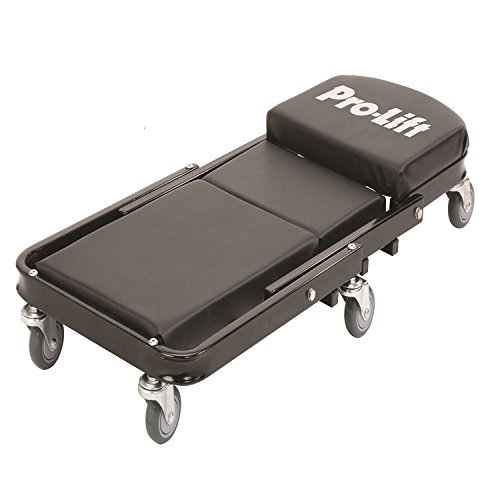
Pro-Lift C-2029D Rolling Creeper Seat
A padded seat, basic frame and four rolling casters make up the C-2029D. Skipping the tool tray found on pricier seats keeps the price down. Per the listing, the frame folds flat between jobs for storage.
Pros
- Price sits below tray-equipped competitors
- Folding frame stores flat against a wall
- Lightweight build moves easily between bays
Cons
- No built-in tray for parts or sockets
- Weight rating trails heavy-duty rolling seats
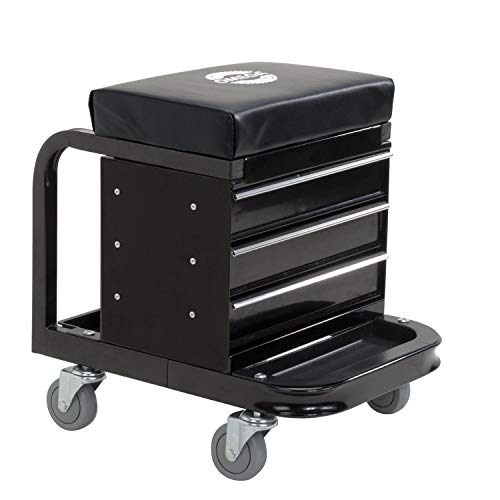
Omega 91008 Rolling Shop Stool
Reinforced steel tubing gives the 91008 a weight rating above typical rolling seats. Five casters spread the load rather than the four found elsewhere. Larger mechanics report it holds up under repeated daily use.
Pros
- Weight rating leads the rolling seats compared here
- Five-caster base resists tipping under load
- Reinforced frame withstands daily shop use
Cons
- Extra weight makes it harder to carry upstairs
- Larger footprint needs more clearance in tight bays
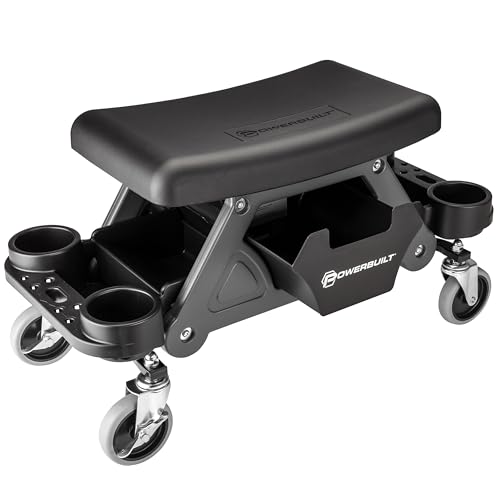
Powerbuilt 620423 Rolling Shop Seat with Tray
A deep, segmented tray beneath the seat separates sockets from small fasteners on the 620423. Four locking casters hold the seat in place once positioned under a vehicle. Extended sitting comfort comes from a padded, contoured top, per the listing.
Pros
- Segmented tray organizes small parts better than a flat shelf
- Locking casters hold position under a vehicle
- Contoured seat top reduces pressure during long jobs
Cons
- Tray depth limits larger tools like breaker bars
- Locking casters add a step versus simple rolling stools
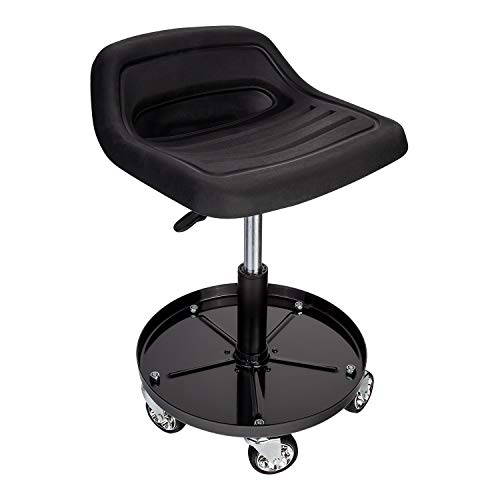
Sunex 8514 Rolling Shop Stool
Hand-crank height adjustment replaces the fixed frame found on most rolling stools. That range suits mechanics who alternate between engine bay and floor-level work. Four swivel casters keep the ride smooth across the shop floor.
Pros
- Height range covers multiple work positions in one seat
- Hand crank stays simpler than pneumatic mechanisms
- Swivel casters roll smoothly across concrete and epoxy
Cons
- Crank adjustment works slower than pneumatic lifts
- No under-seat tray for tools or hardware
FastTool Original ProSeat
Folding down to a slim profile lets the ProSeat hang on a wall hook or slide under a bench. A padded seat and four casters keep it functional despite the compact frame. Tool storage is limited to a small mesh pocket, according to the listing.
Pros
- Folds flat and hangs on a wall hook, freeing floor space
- Lightweight frame carries easily between vehicles
- Compact size fits garages with limited storage room
Cons
- Mesh pocket holds far less than a rigid tray
- Folding hinge adds a wear point versus rigid frames
How to pick the right one
What to look for in a mechanic creeper seat Weight capacity spans roughly 250 to 450 pounds across these seven seats. Caster count affects stability more than caster size alone, since four casters suit most floors while five spreads heavier loads. Padding ranges from thin vinyl to thick contoured foam. Under-seat trays vary too, from a shallow shelf to a segmented layout built for small parts.
Which seat handles heavier daily use Mechanics over 250 pounds, or anyone storing tools on the seat, need a higher-rated frame. Five casters and reinforced tubing let the Omega 91008 handle loads other seats skip. Spreading weight across more contact points also helps on uneven concrete. Larger frames trade some portability for that added capacity.
Tool tray layout and adjustable height options A segmented tray, like the one on the Powerbuilt 620423, keeps sockets separated from fasteners mid-job. Hand-crank adjustment, used on the Sunex 8514, lets one seat cover engine bay and floor-level tasks. Pneumatic adjustment moves faster but adds cost most budget seats skip. Mechanics who mostly sit at one height do fine with a fixed frame.
Best picks for small garages and tight storage Limited wall space favors a folding frame over a rigid one. Once folded, the FastTool Original ProSeat hangs on a wall hook and clears floor space between jobs. Pro-Lift’s C-2029D also folds flat, though it skips the wall-hook design. Either option beats storing a full-size rolling seat in a cabinet.
How they stack up
| # | Model | Weight capacity | Best for | Score | Price |
|---|---|---|---|---|---|
| 1 | Traxion 2-100 ProGear Mechanic Seat | 300 lb | Best Overall | 9.4 | Check price |
| 2 | Torin Big Red TR6350 Rolling Shop Seat | 350 lb | Best Value | 9.1 | Check price |
| 3 | Pro-Lift C-2029D Rolling Creeper Seat | 250 lb | Best Budget | 8.6 | Check price |
| 4 | Omega 91008 Rolling Shop Stool | 450 lb | Best for Heavy-Duty Use | 8.9 | Check price |
| 5 | Powerbuilt 620423 Rolling Shop Seat with Tray | 300 lb | Best for Tool Tray Storage | 8.7 | Check price |
| 6 | Sunex 8514 Rolling Shop Stool | 300 lb | Best Adjustable Height | 8.5 | Check price |
| 7 | FastTool Original ProSeat | 300 lb | Best Compact and Foldable | 8.2 | Check price |
Good to know
What weight capacity should a mechanic creeper seat have?
Match the rating to the heaviest user plus any tools carried on the tray. Most seats compared here run 250 to 350 pounds, while the Omega 91008 reaches 450 pounds.
Is a rolling shop seat better than a flat creeper for engine bay work?
Rolling seats work better above the vehicle, at fender or engine bay height. Flat creepers still win for sliding underneath a car, so many mechanics keep both.
How does a tool tray attachment help during repairs?
A tray under the seat keeps sockets, fasteners and small tools within reach without leaning over a bench. Segmented trays, like Powerbuilt’s, also stop parts from rolling together.
Can rolling mechanic seats handle uneven garage floors?
Four or five swivel casters roll over small cracks and epoxy seams without much resistance. Locking casters, found on the Powerbuilt model, keep the seat from drifting once positioned.
Is a foldable creeper seat worth it for a small garage?
Yes, if wall or under-bench storage matters more than a large built-in tray. The FastTool Original ProSeat trades tray space for a slim folded profile.
What is the difference between a shop stool and a mechanic creeper seat?
Shop stools usually skip the tool tray and stick to a padded seat with casters. Creeper seats add storage, and sometimes height adjustment, for shop-specific tasks.
Do adjustable height seats work for taller mechanics?
A hand-crank range, like the 14 to 20 inch span on the Sunex 8514, lets taller mechanics raise the seat instead of hunching over.
Which creeper seat holds up best under daily shop use?
Reinforced steel frames with five-caster bases, such as the Omega 91008, tend to outlast lighter budget frames in daily commercial bays.
Are five-caster seats more stable than four-caster models?
Extra contact points spread weight further and resist tipping during side reaches. That matters most for heavier mechanics or loaded trays, less so for light daily use.
What should home mechanics prioritize over commercial shops?
Home garages usually favor tray storage and comfort over raw weight capacity. Commercial bays lean toward higher ratings and reinforced frames built for constant rotation.
The verdict
Traxion’s 2-100 ProGear remains the strongest all-around pick, pairing a stable four-caster base with a usable tray for most home and shop garages. Mechanics over 250 pounds or running a commercial bay should choose the Omega 91008 instead, since its five-caster frame and higher weight rating handle heavier daily rotation. Anyone tight on storage space should skip both and pick the FastTool Original ProSeat, which folds flat and hangs on a wall hook.