Portable Mesh WiFi for Travel: Top Picks for On-the-Go Coverage
For most travelers, the TP-Link Deco X50-Outdoor stands out as the top pick because it offers weatherproof design and reliable coverage for RVs or campsites. Its main advantage is the ability to extend WiFi outdoors, but its main limitation is that it requires an Ethernet backhaul for best performance, which may not be available in all travel scenarios.
Traveling with multiple devices often means relying on weak hotel WiFi or spotty mobile hotspots. A portable mesh WiFi system can provide consistent coverage in RVs, vacation rentals, or even outdoor gatherings. These systems are designed to be easy to set up and pack down, offering a reliable connection wherever you go.
We compared several mesh systems that are compact enough for travel, yet powerful enough to cover a small to medium area. From rugged outdoor units to sleek indoor models, our list includes options for different travel styles. Whether you need to work remotely or stream movies, these systems can help.
The best picks, ranked

TP-Link Deco X50-Outdoor
The Deco X50-Outdoor is a weatherproof mesh unit that can withstand rain and extreme temperatures. It delivers strong WiFi for up to 3,000 square feet per unit, making it ideal for large campsites or RVs. Its IP65 rating ensures protection against dust and water jets.
Pros
- Weatherproof design for outdoor use
- WiFi 6 for faster speeds
- Easy setup with the Deco app
Cons
- Bulkier than indoor models
- Requires Ethernet for wired backhaul

ASUS ZenWiFi XD6
The ASUS ZenWiFi XD6 is a compact mesh system with a sleek design that blends into any decor. It offers tri-band WiFi 6 speeds and robust parental controls. Owners report easy setup and stable connections, making it a favorite for temporary setups in vacation homes.
Pros
- Tri-band provides dedicated backhaul
- Excellent parental controls
- Compact and stylish design
Cons
- Higher price point
- No outdoor rating

Google Nest Wifi Pro
Google Nest Wifi Pro offers a straightforward setup process through the Google Home app. It supports WiFi 6E and provides reliable coverage for small spaces. Its mesh system is easy to reconfigure, making it a good choice for frequent travelers who value simplicity.
Pros
- Very intuitive setup
- WiFi 6E for future-proofing
- Automatic updates
Cons
- No web interface for advanced settings
- Requires Google account

Amazon eero 6+
The eero 6+ is a dual-band mesh system that supports WiFi 6. It is known for its reliability and strong app support. With built-in Zigbee, it can act as a smart home hub, which is useful for travelers who carry smart devices. Setup is quick, and the system updates itself automatically.
Pros
- Acts as a smart home hub
- Self-updating and secure
- Affordable 3-pack option
Cons
- Limited advanced features
- Requires app for all management

Netgear Orbi WiFi 6 (RBK752)
The Netgear Orbi RBK752 is a tri-band mesh system that offers impressive coverage up to 5,000 square feet. It is ideal for larger rentals or when multiple floors need strong signals. Its dedicated backhaul ensures high speeds, but the units are larger and less portable than others.
Pros
- Very long range
- Fast speeds with dedicated backhaul
- Easy to add more satellites
Cons
- Units are bulky and heavy
- Expensive
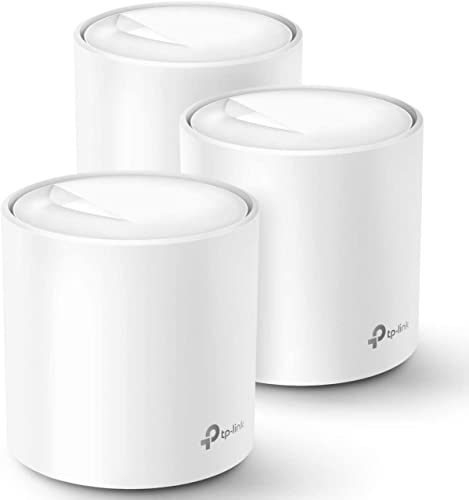
TP-Link Deco X20
The TP-Link Deco X20 offers dual-band WiFi 6 at a budget-friendly price. It is compact and easy to set up, making it a popular choice for travelers who need reliable coverage without breaking the bank. Its parental controls and antivirus features add value.
Pros
- Affordable WiFi 6
- Compact design
- Good parental controls
Cons
- No dedicated backhaul
- Performance drops with multiple walls

Linksys Velop MX4200
The Linksys Velop MX4200 is a tri-band WiFi 6 mesh system that offers high performance and a range of advanced features. It includes a USB port for sharing storage and supports Linksys Aware motion detection. Its setup is more involved, appealing to users who like tweaking settings.
Pros
- USB port for network storage
- Tri-band for better throughput
- Customizable via web interface
Cons
- Setup process is more complex
- Larger footprint
The lineup, side by side
| # | Model | Coverage | Best for | Score | Price |
|---|---|---|---|---|---|
| 1 | TP-Link Deco X50-Outdoor | Up to 3,000 sq ft per unit | RV and camping trips | 9.4 | Check price |
| 2 | ASUS ZenWiFi XD6 | Up to 5,500 sq ft for a 2-pack | Rental homes and apartments | 9.2 | Check price |
| 3 | Google Nest Wifi Pro | Up to 2,200 sq ft per router | Simple setup for non-tech users | 9.0 | Check price |
| 4 | Amazon eero 6+ | Up to 1,500 sq ft per unit | Travelers with Amazon Alexa | 8.8 | Check price |
| 5 | Netgear Orbi WiFi 6 (RBK752) | Up to 5,000 sq ft for a 2-pack | Large vacation homes | 8.7 | Check price |
| 6 | TP-Link Deco X20 | Up to 2,000 sq ft per unit | Budget travelers | 8.5 | Check price |
| 7 | Linksys Velop MX4200 | Up to 3,000 sq ft per unit | Tech-savvy travelers | 8.3 | Check price |
How to pick the right one
Common questions
Can I use a mesh WiFi system in a hotel room?
Yes, you can. Many mesh systems allow you to connect to the hotel’s Ethernet or WiFi and then broadcast your own secure network. However, some hotels may restrict this, so check their policy.
How do I set up a mesh system when traveling?
Most mesh systems have an app that guides you through setup. You typically connect the main node to your modem or the hotel’s Ethernet, then add satellites via the app. The entire process usually takes under 10 minutes.
Are mesh systems portable?
Some are more portable than others. Look for compact nodes that are easy to pack. Systems like the TP-Link Deco X20 or Google Nest Wifi are relatively small. Outdoor units like the Deco X50-Outdoor are bulkier but still manageable.
Do I need a mesh system if I only travel with one or two devices?
Maybe not. A single portable router might be enough. But if you have many devices or need coverage across multiple rooms, a mesh system ensures consistent connectivity.
Can I connect a mesh system to my mobile hotspot?
Yes, many mesh routers can be configured to connect to a mobile hotspot via WiFi or Ethernet. This is useful when no wired internet is available.
What is the difference between a travel router and a mesh system?
A travel router is a single device that creates a WiFi network. A mesh system includes multiple nodes that work together to extend coverage. For larger areas, mesh is better; for solo use, a travel router is simpler.
Do mesh systems work internationally?
Most mesh systems support universal voltage and work with different WiFi standards. However, you may need plug adapters. Also, ensure the system does not have region locks.
How do I secure my network when using a mesh system on the go?
Always change the default admin password and enable WPA3 encryption if available. Use a unique network name and consider setting up a guest network for other users.
The bottom line
For most travelers, the TP-Link Deco X50-Outdoor offers the best balance of durability and performance, especially if you spend time outdoors. If you need a system for indoor use and value ease of setup, the Google Nest Wifi Pro is a solid choice. For budget-conscious travelers, the TP-Link Deco X20 provides reliable coverage without straining your wallet.