Top Kid-Friendly Microscopes for Budding Scientists
The AmScope M30-ABS-KT50 is our top pick for most families because it offers a good balance of magnification range, durability, and included accessories at a reasonable price. It is best for kids ages 6 and up who are ready for a real microscope experience. Its main advantage is the all-metal body that withstands rough handling, but its limitation is that the lighting is basic and may not be sufficient for some specimens.
Introducing a child to the wonders of the microscopic world can spark a lifelong love of science. A good microscope for kids should be sturdy, simple to operate, and offer clear views of everyday objects like leaves, salt crystals, and fabric fibers.
With so many options available, from basic toy scopes to more advanced models, it can be tough to choose. We’ve compared the top contenders to help you find a microscope that matches your child’s age and curiosity, ensuring it gets used and enjoyed rather than gathering dust.
The best picks, ranked
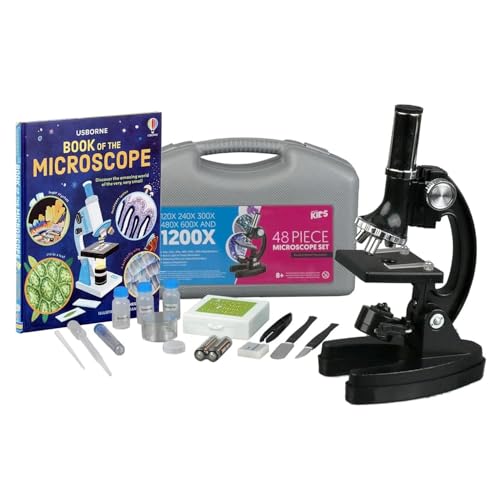
AmScope M30-ABS-KT50
This microscope features an all-metal body and a 360 degree rotatable monocular head. It offers three magnification levels (100x, 400x, and 1200x) and comes with a complete kit including blank slides, cover slips, and a brine shrimp hatchery. Parents report it holds up well to regular use, and kids find it easy to focus. The lower magnification is good for beginners, while higher powers allow for more detailed exploration.
Pros
- Durable metal construction
- Easy to focus and use
- Comes with a variety of accessories
Cons
- Basic LED lighting may be dim
- Requires AA batteries (not included)

Educational Insights GeoSafari Jr. Talking Microscope
This is not a traditional microscope but a talking learning toy that introduces young children to magnification and science facts. It features 20 slides with 60 high-quality images of animals and plants, and it speaks 100 fun facts and questions in either English or Spanish. Kids simply place a slide under the scope and press the button to hear information. It requires 3 AAA batteries, and it is designed to be easy for small hands to manipulate. It does not offer high magnification but is perfect for building foundational knowledge.
Pros
- Audio feature helps non-readers
- Bilingual learning
- Durable and kid-friendly design
Cons
- No actual magnification
- Batteries not included

NATIONAL GEOGRAPHIC Dual Microscope
This microscope offers two viewing modes: a compound microscope for up to 1200x magnification and a dissecting microscope for lower magnification (20x) to view larger specimens like rocks and insects. It comes with over 50 accessories including prepared slides, blank slides, tweezers, and a petri dish. The dual functionality allows kids to switch between exploring tiny cells and examining whole objects. It is recommended for ages 6 and up. Parents note that the lighting is decent and the focus knobs are smooth.
Pros
- Two scopes in one
- Large accessory set
- Suitable for varied specimens
Cons
- More complex for younger kids
- Requires batteries for light (not included)
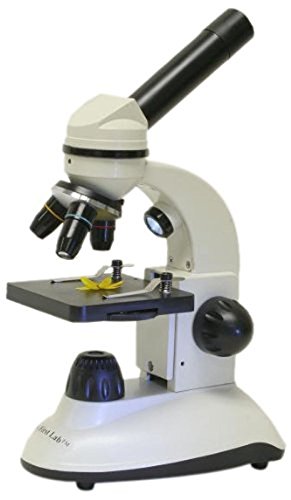
My First Lab Duo-Scope Microscope
My First Lab is a well-known brand in educational microscopes. This model can function as both a compound microscope (up to 640x) and a dissecting microscope (up to 25x). It features an LED light that can illuminate from above or below, and it has a sturdy metal arm. It includes a set of blank slides, cover slips, and a pipette. The 10x eyepiece and 4x, 10x, and 40x objectives provide clear images. It is designed for kids ages 7 and up and is often used in schools. Owners report that it is easy to focus and holds up well.
Pros
- Dual viewing modes
- Good optical clarity
- Durable construction
Cons
- Higher price point
- Batteries or AC adapter needed for LED (not included)

Carson MicroBrite Plus LED Pocket Microscope
The MicroBrite Plus is a compact and lightweight microscope that fits in a pocket. It offers a magnification range of 60x to 120x, which is enough to see cells, tiny insects, and fabric fibers. It runs on one AA battery and features an LED light for clear viewing. It is ideal for field trips, nature walks, or quick backyard investigations. Users praise its simplicity and portability. However, it is not suitable for high-power viewing and is best for casual exploration.
Pros
- Very portable and easy to carry
- Simple to use for all ages
- Affordable price point
Cons
- Limited magnification range
- No slides or accessories included
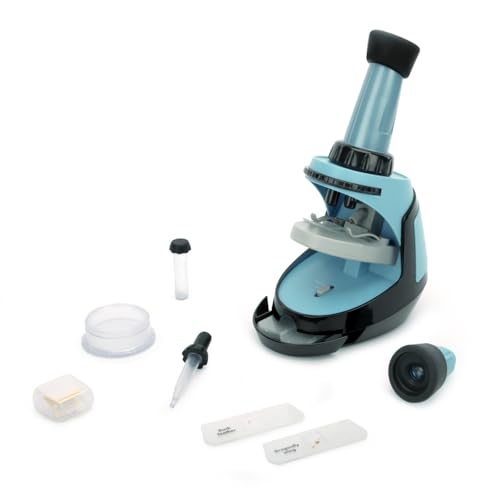
Educational Insights Nancy B’s Science Club Microscope and 22-Piece Activity Journal Set
This set combines a real microscope with a 22-piece activity journal and science accessories. The microscope offers 120x, 240x, and 480x magnification, and it is designed to be user-friendly for kids aged 8 and up. The activity journal is packed with experiments and blank pages for recording observations. The kit includes prepared slides, blank slides, tweezers, and a pipette. It is a great choice for children who like structured activities and want to document their discoveries. The microscope is lightweight but has a sturdy build.
Pros
- Comes with an engaging activity journal
- Good magnification range for kids
- Lightweight and portable
Cons
- Plastic body may be less durable
- Requires 2 AA batteries for light (not included)

Bysameyee Prepared Microscope Slides with Specimens
While not a microscope itself, this set of 48 prepared slides is a perfect companion for any microscope. It includes a wide variety of specimens such as plants, insects, and animal tissues. The slides are well-labeled and come in a protective box. This accessory pack is ideal for kids who have a microscope and want to explore a diverse range of specimens without the hassle of preparing their own. It is recommended for ages 5 and up. Parents appreciate the variety and quality of the slides.
Pros
- Wide variety of specimens
- Well-prepared and labeled
- Comes in a sturdy storage box
Cons
- Not a microscope itself
- Some slides may be too advanced for young kids
How they stack up
| # | Model | Magnification | Best for | Score | Price |
|---|---|---|---|---|---|
| 1 | AmScope M30-ABS-KT50 | 100x, 400x, 1200x | Overall best for kids age 6 and up | 9.4 | Check price |
| 2 | Educational Insights GeoSafari Jr. Talking Microscope | None (viewing images only) | Best for preschoolers ages 4 to 6 | 8.9 | Check price |
| 3 | NATIONAL GEOGRAPHIC Dual Microscope | 20x and 40x to 1200x | Best for kids interested in both macro and micro views | 9.1 | Check price |
| 4 | My First Lab Duo-Scope Microscope | 25x to 640x | Best for young scientists who want a real microscope with features | 9.2 | Check price |
| 5 | Carson MicroBrite Plus LED Pocket Microscope | 60x to 120x | Best for portable, on-the-go exploration | 8.6 | Check price |
| 6 | Educational Insights Nancy B’s Science Club Microscope and 22-Piece Activity Journal Set | 120x, 240x, 480x | Best for kids who enjoy guided experiments and journaling | 8.8 | Check price |
| 7 | Bysameyee Prepared Microscope Slides with Specimens | 48 | Best for adding a collection of slides to an existing microscope | 8.2 | Check price |
What to look for
Questions worth asking
What is the best microscope for a 5 year old?
For a 5 year old, the Educational Insights GeoSafari Jr. Talking Microscope is ideal. It is not a real microscope but a talking toy that introduces scientific concepts with images and facts. It is safe, easy to use, and engaging for young children.
What magnification is best for a kids microscope?
For kids, a magnification range of 100x to 400x is sufficient to see cells, tiny organisms, and details of everyday objects. Higher magnification like 1000x is often too difficult to use and may produce poor images without proper slide preparation. Look for microscopes with multiple objective lenses to give flexibility.
Can kids see bacteria with a beginner microscope?
Bacteria are extremely small and typically require at least 1000x magnification with oil immersion to see clearly. Most beginner microscopes for kids max out at 400x or 1200x but without oil immersion, bacteria appear as tiny dots. It is more practical for kids to observe larger specimens like cells, insect parts, and pond water organisms.
Are digital microscopes better for kids?
Digital microscopes connect to a screen, such as a computer or tablet, and display the image digitally. They can be easier for kids to use because they don’t have to squint into an eyepiece, and they allow taking photos and videos. However, they may have lower optical quality and can be more expensive. For very young children, a digital scope can be engaging, but traditional compound microscopes are still great for learning.
What is the difference between a compound microscope and a dissecting microscope?
A compound microscope uses multiple lenses to magnify thin specimens on slides and provides high magnification (up to 1000x). A dissecting microscope (or stereo microscope) offers lower magnification (10x to 40x) and is used to view larger, solid objects like insects, rocks, or flowers. Some kid microscopes, like the My First Lab Duo-Scope, combine both functions.
How do I help my child prepare a slide?
Start with a clean blank slide. Place a small sample, such as a thin slice of leaf or a drop of pond water, in the center. Add a drop of water if needed. Gently place a cover slip over the sample at an angle to avoid air bubbles. Blot any excess water. Then place the slide on the stage and secure with clips. Start with the lowest magnification and focus using the coarse knob, then fine-tune.
Are there any safety concerns with kids microscopes?
Most microscopes for kids are safe, but always supervise young children to prevent them from breaking slides or swallowing small parts. Ensure the microscope does not have any sharp edges. If the microscope uses a light source, it may require batteries; be cautious with battery usage. Also, some prepared slides may contain glass, so handle with care.
What should I look for in terms of lighting?
Good lighting is crucial for clear viewing. Many microscopes have mirror or LED lights. LED lights are brighter and more consistent. Some models offer both top and bottom illumination, which is useful for viewing both transparent slides and opaque objects. For kids, a built-in LED light powered by batteries or an AC adapter is convenient, but remember that batteries are often not included.
Can I use a regular microscope for kids with my smartphone?
Yes, you can use a smartphone adapter that fits over the eyepiece to take photos and videos. Some microscopes come with a phone mount. This is a great way to encourage kids to document their observations. Just make sure the microscope is stable and focus properly before attaching the phone.
What is the warranty on these microscopes?
Warranty terms vary by manufacturer. AmScope offers a limited lifetime warranty on many of their microscopes. Educational Insights typically provides a one-year warranty. Check the product listing for specific warranty information. It is always a good idea to understand the return policy in case of any issues.
Our pick
The AmScope M30-ABS-KT50 is the best choice for most families because it combines durability, ease of use, and a full kit at a moderate price. For younger children, the GeoSafari Jr. Talking Microscope is the best introduction. If you want a portable option for outdoor adventures, the Carson MicroBrite Plus is a compact winner. Ultimately, any of these microscopes will encourage scientific curiosity, but choose the one that matches your child’s age and interests.