Mini Food Processors for Fast Everyday Chopping
The Cuisinart DLC-2ABC Mini-Prep Plus takes the top spot for its reversible blade that both chops and grinds. The KitchenAid KFC3516 is the best value for its two speed control, and the BLACK and DECKER HC300 is the cheapest capable option for daily garlic and onion work.
For everyday chopping the Cuisinart DLC-2ABC Mini-Prep Plus is our first choice, with the KitchenAid KFC3516 as the value pick and the BLACK and DECKER HC300 for the smallest jobs. Each one handles the one onion, two cloves and handful of parsley tasks that make dragging out a full size processor feel absurd.
The catch with mini processors is that capacity numbers mislead. A four cup bowl is a dry capacity, and liquid ingredients cut the usable volume roughly in half before anything leaks past the lid. Blade shape also matters more at this size, because a small bowl gives ingredients nowhere to circulate. We compared bowl capacities, blade designs, motor ratings, control layouts and what owners report about lids leaking and bowls cracking after a year of use.
What we recommend

Cuisinart DLC-2ABC Mini-Prep Plus Food Processor
The reversible blade is the reason this model has stayed a kitchen standard for years, with a sharp edge for chopping vegetables and a blunt edge for grinding hard items like nuts and spices. The auto reversing SmartPower control means you switch modes with a button rather than flipping the blade mid task. The bowl is smaller than the listing suggests once you add liquid, which is the one thing to plan around.
Pros
- One blade handles chopping and grinding
- Simple two button operation
- Long track record and easy to find parts
Cons
- Usable capacity drops sharply with liquids
- Motor housing is bulkier than rivals
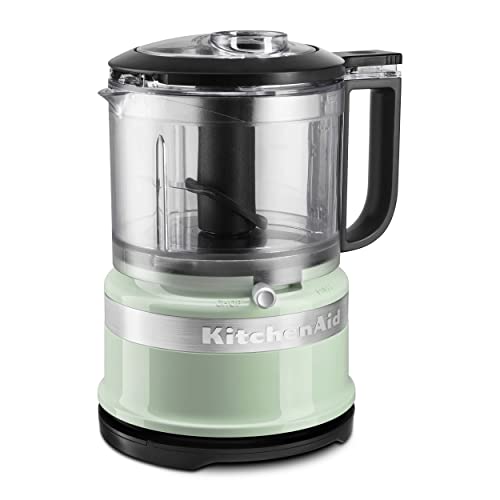
KitchenAid KFC3516 3.5 Cup Food Chopper
A slightly larger bowl than most mini choppers plus two speeds gives you more control over texture, which matters when the difference between salsa and puree is a few seconds. A drizzle spout in the lid lets you emulsify dressings without stopping the machine, something surprisingly few compact models offer. The body is heavier than the plastic competition and sits still on the counter as a result.
Pros
- Two speeds give real texture control
- Drizzle spout suits dressings and mayonnaise
- Heavy base does not walk on the counter
Cons
- Takes up more cupboard space
- Lid latch needs firm seating to start

Ninja Express Chop NJ110GR
Ninja’s stacked blade assembly reaches into more of the bowl at once, so onions and herbs break down in a couple of pulses rather than needing a scrape and restart. Operation is a simple press down on the lid, which means no separate switch to clean around. The blade assembly is sharp and awkward to wash by hand, so treat it carefully at the sink.
Pros
- Very fast on onions and herbs
- Fewer scrape downs needed
- Simple one press operation
Cons
- Blade stack is awkward to hand wash
- No speed control, only pulse
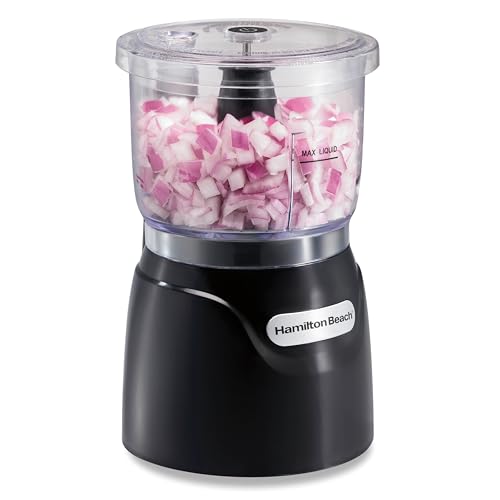
Hamilton Beach 72900 Fresh Chop Food Chopper
This one earns its place through simplicity, a three cup bowl, one button and very little to go wrong. It handles the daily jobs of chopping an onion or mincing garlic without occupying much cupboard space. Owners report the motor slows on hard items like parmesan or raw carrot, so keep it to softer ingredients and it performs reliably.
Pros
- Very small storage footprint
- Straightforward one button use
- Bowl and blade lift out for cleaning
Cons
- Struggles with hard cheese and raw carrot
- No variable speed

Chefman 4-Cup Electric Food Processor
Four cups is about as large as a mini processor gets before it becomes a full size machine, and that extra room means you can do a whole batch of salsa rather than two rounds. Stainless blades and a spatula in the box are useful inclusions. The wider bowl needs more scraping on small quantities, so it is the wrong choice if your typical job is two cloves of garlic.
Pros
- Largest capacity in this roundup
- Handles a full batch of dip or salsa
- Spatula included
Cons
- Poor at very small quantities
- Plastic body feels lighter than rivals
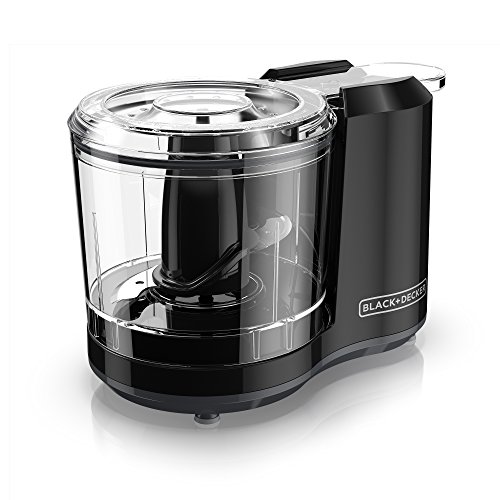
BLACK and DECKER HC300 1.5-Cup Electric Food Chopper
At one and a half cups this is the smallest electric option worth owning, and for garlic, shallots, chillies and small herb bunches it does the job for very little outlay. The bowl detaches for washing and the whole unit tucks into a drawer. Push it toward larger tasks and it stalls quickly, so buy it knowing exactly what it is for.
Pros
- Fits in a kitchen drawer
- Ideal for garlic, chilli and shallots
- Cheapest way into powered chopping
Cons
- Small motor stalls on anything firm
- Capacity is genuinely tiny

Fullstar Manual Hand Pull Food Chopper
A pull cord spins stacked blades, which sounds gimmicky and works better than expected on onions, garlic and soft herbs. There is no motor to burn out, nothing to plug in and it takes seconds to rinse, so it suits small kitchens, camping and dorm rooms. Hard vegetables need real effort and the texture is coarser than a powered processor delivers.
Pros
- No electricity or counter space needed
- Very quick to clean
- Nothing to burn out over time
Cons
- Hard vegetables take real effort
- Coarser, less even results
Compared at a glance
| # | Model | Bowl capacity | Best for | Score | Price |
|---|---|---|---|---|---|
| 1 | Cuisinart DLC-2ABC Mini-Prep Plus Food Processor | 3 cups | Best overall | 9.4 | Check price |
| 2 | KitchenAid KFC3516 3.5 Cup Food Chopper | 3.5 cups | Best value | 9.2 | Check price |
| 3 | Ninja Express Chop NJ110GR | 16 ounces | Best for speed | 9.0 | Check price |
| 4 | Hamilton Beach 72900 Fresh Chop Food Chopper | 3 cups | Best for small batches | 8.8 | Check price |
| 5 | Chefman 4-Cup Electric Food Processor | 4 cups | Best larger bowl | 8.6 | Check price |
| 6 | BLACK and DECKER HC300 1.5-Cup Electric Food Chopper | 1.5 cups | Best budget | 8.3 | Check price |
| 7 | Fullstar Manual Hand Pull Food Chopper | About 3 cups | Best without power | 8.0 | Check price |
How to choose
Capacity claims assume dry ingredients A three cup bowl holds three cups of loosely chopped vegetables, not three cups of soup or salsa. Once liquid is involved, the safe fill line drops to roughly half, and overfilling is the number one cause of leaks around the lid seal. If most of your work involves wet mixtures, size up a step, and if you mostly chop dry aromatics, a smaller bowl actually performs better because ingredients stay near the blade.
Blade design matters more than wattage In a small bowl, ingredients cannot circulate the way they do in a full size processor, so blade reach determines whether you get an even chop or a paste in the middle and chunks at the edge. Stacked multi level blades, as on the Ninja, cover more of the bowl. A reversible blade like the Cuisinart’s adds a second function, grinding hard items with a blunt edge that a sharp blade would simply skid off.
Think about how it comes apart Mini processors get used daily precisely because they are quick, and that advantage disappears if cleaning takes five minutes. Look for a bowl and blade that lift free of the motor housing and go in the dishwasher, and check whether the lid has recesses that trap garlic. Blades are sharp and awkward, so a design that lets you remove the blade before pouring out contents is a genuine safety feature.
Know when a mini processor is the wrong tool These machines chop, mince and make small batches of dip or dressing. They do not slice, shred, knead dough or handle a full recipe of hummus. Trying to force those jobs is how motors burn out and bowls crack. Based on specifications, none of the models here offer slicing discs or feed tubes, so if those matter, a full size processor is the honest answer.
Frequently asked questions
What size mini food processor should I buy?
Three to three and a half cups suits most households, handling an onion, a herb bunch or a small batch of dressing. Go smaller only if garlic and chilli are the main use, and larger if you regularly make dips for a family.
Can a mini processor crush ice or grind coffee?
Most cannot do either well. Ice damages blades not designed for it, and coffee grinds unevenly in a bladed bowl. The Cuisinart’s blunt grinding edge handles nuts and whole spices, which is the closest thing on offer here.
Why does mine leak around the lid?
Almost always overfilling with liquid. Keep wet mixtures to about half the stated capacity and check that the lid is seated fully before starting. A worn gasket is the other cause on older units.
Are the bowls and blades dishwasher safe?
Bowls, lids and blades usually are, while the motor base never is and should only be wiped. Check the manual, since some manufacturers recommend the top rack only to avoid warping.
Will it chop onions without turning them to mush?
Yes, if you pulse in short bursts rather than running continuously and cut the onion into rough quarters first. Continuous running is what produces watery mush.
Do I need one if I already own a blender?
They do different jobs. Blenders need liquid to circulate ingredients and produce a puree, while a food chopper gives a controlled dry chop. Owners report reaching for the chopper far more often for daily cooking.
Is a manual chopper worth considering?
For small kitchens, camping or anyone who hates cleaning motors, yes. A pull cord model handles onions and herbs well, though hard vegetables take effort and results are coarser.
How long do these machines usually last?
Owners report several years of regular use when they stay within intended tasks. Failures cluster around forcing hard ingredients through small motors and cracking bowls by prising lids off with force.
The verdict
The Cuisinart DLC-2ABC Mini-Prep Plus remains the mini processor we would buy, because the reversible blade covers both chopping and grinding and the design has proven itself over many years. Choose the KitchenAid KFC3516 if you want two speeds and a drizzle spout for dressings, or the BLACK and DECKER HC300 if garlic and shallots are the only jobs on the list.