Top Motherboards for Professional Workstations
For professionals who need maximum core support and connectivity, the ASUS ProArt X670E-Creator WiFi stands out as our top pick. It offers robust power delivery, dual 10G LAN, and extensive I/O for creative and engineering workloads. Its primary limitation is the high cost and complexity for those not requiring its advanced features.
Professional workloads demand motherboards that offer stability, high core counts, and reliable connectivity. Whether you are rendering 3D scenes, compiling code, or analyzing massive datasets, the foundation of your system matters.
We compared current models from ASUS, MSI, Gigabyte, and ASRock to help you choose a board that won’t bottleneck your productivity. Each option here supports the latest CPUs and offers features like 10G Ethernet, multiple M.2 slots, and robust power phases.
Our top picks

ASUS ProArt X670E-Creator WiFi
This ATX board pairs the X670E chipset with 16+2 power stages, delivering stable power for 16-core CPUs. It includes dual 10G LAN, Wi-Fi 6E, and four M.2 slots with heatsinks. Owners report excellent stability during long renders and heavy multitasking.
Pros
- Dual 10G Ethernet for fast network transfers
- Robust power delivery for high-end CPUs
- Extensive rear I/O with USB4 and 10G ports
Cons
- High price point
- No PCIe 5.0 M.2 slot on all four slots

MSI MEG X670E ACE
With a 22+2 phase VRM, this E-ATX board handles the most demanding Ryzen 9 CPUs with ease. It offers dual 10G LAN, Wi-Fi 6E, and PCIe 5.0 slots. Users appreciate the clear CMOS button and debug LED for troubleshooting.
Pros
- Massive VRM for stable overclocking
- Dual 10G LAN for network heavy tasks
- Excellent thermal design with large heatsinks
Cons
- E-ATX size may not fit standard cases
- Very expensive

Gigabyte B650E AORUS Master
This ATX board offers PCIe 5.0 for GPU and one M.2 slot, plus 16+2+2 phase VRM. It includes 2.5G LAN, Wi-Fi 6E, and USB-C. Owners report solid performance for content creation without the high price of X670E boards.
Pros
- PCIe 5.0 support for future GPUs
- Lower cost than X670E boards
- Good VRM for Ryzen 9 CPUs
Cons
- Only one PCIe 5.0 M.2 slot
- No 10G LAN
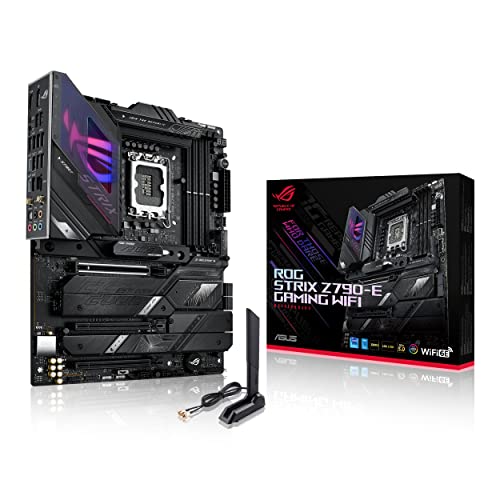
ASUS ROG Strix Z790-E Gaming WiFi II
Designed for LGA1700, this board supports DDR5 and offers 16+1 power stages. It includes Wi-Fi 7, 2.5G LAN, and five M.2 slots. Users find the BIOS user-friendly and the board stable for video editing and software development.
Pros
- Wi-Fi 7 for future proofing
- Five M.2 slots for ample storage
- Strong power delivery for i9 CPUs
Cons
- No 10G LAN
- PCIe 5.0 only on first slot

ASRock X670E Taichi Carrara
This E-ATX board sports a marble finish and 24+2 phase VRM. It offers dual 10G LAN, Wi-Fi 6E, and a spacious layout. Owners report excellent performance, but the high price and niche design limit its appeal.
Pros
- Unique aesthetic with premium finish
- Dual 10G LAN
- High-end VRM for extreme CPUs
Cons
- Very expensive
- E-ATX form factor limits case compatibility

MSI PRO Z790-P WiFi
A more affordable Z790 option that still supports DDR5 and has good connectivity. It includes 2.5G LAN, Wi-Fi 6E, and four M.2 slots. It lacks some premium features but provides stable performance for everyday professional tasks.
Pros
- Lower price point
- Good VRM for i7/i9
- Plenty of M.2 slots
Cons
- No 10G LAN
- Less premium components

Gigabyte TRX50 AERO D
This E-ATX board is built for Threadripper 7000 series, with 8-channel DDR5 and massive power delivery. It includes dual 10G LAN, Wi-Fi 6E, and multiple PCIe 5.0 slots. Ideal for heavy 3D rendering and scientific computing.
Pros
- Supports up to 96-core Threadripper
- 8-channel memory for massive bandwidth
- Dual 10G LAN for fast data transfer
Cons
- Requires Threadripper CPU, very expensive
- E-ATX form factor
Compared at a glance
| # | Model | Chipset | Best for | Score | Price |
|---|---|---|---|---|---|
| 1 | ASUS ProArt X670E-Creator WiFi | AMD X670E | Creative professionals using AMD Ryzen 7000 series | 9.4 | Check price |
| 2 | MSI MEG X670E ACE | AMD X670E | Overclockers and power users needing extreme VRM | 9.2 | Check price |
| 3 | Gigabyte B650E AORUS Master | AMD B650E | Professionals on a budget needing PCIe 5.0 | 9.0 | Check price |
| 4 | ASUS ROG Strix Z790-E Gaming WiFi II | Intel Z790 | Intel professionals with 13th or 14th gen CPUs | 9.1 | Check price |
| 5 | ASRock X670E Taichi Carrara | AMD X670E | Aesthetic builds with premium features | 8.8 | Check price |
| 6 | MSI PRO Z790-P WiFi | Intel Z790 | Budget-conscious Intel professionals | 8.5 | Check price |
| 7 | Gigabyte TRX50 AERO D | AMD TRX50 | Workstations using AMD Threadripper | 9.3 | Check price |
What matters most
Common questions
What is the difference between X670E and B650E chipsets?
X670E is the top-tier AMD chipset, offering more PCIe lanes, more USB ports, and often dual chipset design. B650E is more budget-friendly but still supports PCIe 5.0 for GPU and one M.2 slot. For professionals with high-end Ryzen 9 CPUs and multiple expansion cards, X670E is preferable.
Do I need a Threadripper motherboard for professional work?
Only if you require extremely high core counts (beyond 16 cores) and massive memory bandwidth. Threadripper platforms support up to 96 cores and 8-channel memory, which is beneficial for tasks like 3D rendering, video editing, and scientific simulations. For typical office work or coding, a high-end consumer CPU is often sufficient.
Can I use ECC memory on consumer motherboards?
Most consumer AMD boards support ECC memory with Ryzen CPUs, but Intel consumer boards do not officially support ECC. For guaranteed ECC support, you need a workstation platform like Threadripper or Xeon. ECC memory helps prevent data corruption in critical professional workloads.
How many M.2 slots do I need?
For professional use, having at least two M.2 slots is recommended so you can run a fast boot drive and a separate storage drive. Many high-end boards offer four or five slots, allowing for RAID setups or additional storage. Consider future expansion when choosing a board.
Is 10G LAN necessary?
10G LAN is beneficial if you frequently transfer large files over a local network, such as video projects or backups. If your network infrastructure does not support 10G, you will not see a benefit. For many professionals, 2.5G LAN is sufficient, but 10G future-proofs your system.
What form factor should I choose?
ATX is the most common and offers a good balance of expansion slots and case compatibility. E-ATX boards are larger and provide more features but require a case that supports them. Micro-ATX is compact but may have fewer slots. For professional workstations that may need multiple GPUs or add-on cards, ATX or E-ATX is recommended.
How important is the BIOS for professional stability?
A stable and feature-rich BIOS is crucial for professionals who rely on system uptime. Look for boards from reputable manufacturers with a history of regular BIOS updates. Features like BIOS flashback allow you to update without a CPU, which is handy when using newer CPUs.
Can I use a workstation motherboard for gaming?
Yes, workstation motherboards often have high-end features that benefit gaming as well, such as fast networking and multiple PCIe slots. However, they may lack some gaming-specific features like RGB lighting or audio enhancements. They are generally more expensive, so for pure gaming, a gaming-oriented board is often more cost-effective.
Our take
For most professional users building an AMD system, the ASUS ProArt X670E-Creator WiFi is the best choice due to its balance of performance, connectivity, and stability. If you need extreme core counts and memory bandwidth for heavy rendering or simulation, invest in the Gigabyte TRX50 AERO D with a Threadripper CPU. For those on Intel, the ASUS ROG Strix Z790-E Gaming WiFi II offers excellent features for 13th and 14th gen processors. Ultimately, prioritize your CPU choice first, then select a board that supports the features you need without overspending on unnecessary extras.