Top Motherboards for Gaming, Work, and Every Budget
The MSI MAG B650 Tomahawk WiFi stands out as the top overall motherboard for most builders, offering a balanced mix of features, performance, and price. It supports AMD’s latest Ryzen 7000 series CPUs, features PCIe 5.0 for next-gen GPUs and SSDs, and has robust VRM cooling for sustained workloads. Its main limitation is the lack of PCIe 5.0 M.2 slots, which some high-end users might want.
Choosing the right motherboard is critical for your PC build. It determines which CPU you can use, how much RAM you can install, and what expansion options you have. With so many chipsets and form factors, it can be overwhelming.
We’ve analyzed the specifications and user feedback for a range of motherboards to help you decide. Whether you’re building a budget PC, a gaming rig, or a workstation, this roundup has a board for you.
Before you buy
The best picks, ranked

MSI MAG B650 Tomahawk WiFi
The MSI MAG B650 Tomahawk WiFi is a feature-rich ATX board for AMD Ryzen 7000 series processors. It offers solid VRM cooling, PCIe 5.0 support for graphics cards, and a comprehensive rear I/O panel. Owners report stable performance and easy BIOS navigation.
Pros
- Excellent VRM cooling for overclocking
- WiFi 6E and 2.5G LAN included
- Plenty of USB ports on rear
Cons
- No PCIe 5.0 M.2 slot
- Limited RGB headers
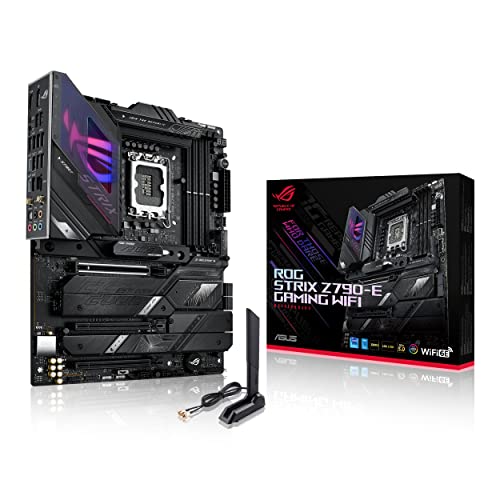
ASUS ROG Strix Z790-E Gaming WiFi II
The ASUS ROG Strix Z790-E is a high-end ATX board for Intel Core 14th and 13th gen CPUs. It features robust power delivery, PCIe 5.0 for both GPU and M.2, and premium audio. Users appreciate the BIOS options and overclocking headroom.
Pros
- Top-tier VRM for heavy overclocking
- PCIe 5.0 M.2 slot with heatsink
- SupremeFX audio quality
Cons
- Expensive
- Large E-ATX size may not fit all cases

Gigabyte B650 Aorus Elite AX
The Gigabyte B650 Aorus Elite AX delivers strong performance at a lower price point. It supports DDR5, PCIe 5.0 for graphics, and comes with WiFi 6E. It’s a popular choice for mid-range AM5 builds, with users praising its thermal performance.
Pros
- Great price-to-features ratio
- Solid VRM and heatsink design
- Plenty of connectivity
Cons
- Only one PCIe 5.0 M.2 slot
- BIOS updates needed for newer CPUs

ASUS ROG Strix B650E-F Gaming WiFi
The ASUS ROG Strix B650E-F is a premium AM5 board with PCIe 5.0 support for both GPU and M.2. It offers excellent power delivery and a comprehensive feature set, including WiFi 6E and 2.5G LAN. Users find it ideal for demanding builds.
Pros
- PCIe 5.0 for both GPU and SSD
- Excellent VRM and cooling
- Rich BIOS options
Cons
- Pricey for B650 chipset
- Limited USB ports on rear

MSI MEG X670E ACE
The MSI MEG X670E ACE is a flagship E-ATX motherboard for AMD Ryzen 7000 series. It features a massive 24+2 phase VRM, PCIe 5.0 slots, and 10G LAN. It’s designed for extreme overclocking and heavy workloads, but comes at a premium price.
Pros
- Unmatched VRM capability
- 10G LAN and WiFi 6E
- Plenty of M.2 slots with heatsinks
Cons
- Very expensive
- E-ATX form factor requires a large case

ASRock B650M Pro RS WiFi
The ASRock B650M Pro RS WiFi is an affordable micro ATX board for AM5 CPUs. It includes WiFi 6, PCIe 4.0 support, and a clean design. It’s a great choice for budget builds where overclocking isn’t a priority.
Pros
- Low cost for AM5 platform
- WiFi and Bluetooth included
- Good for compact builds
Cons
- Limited PCIe 5.0 support
- VRM may run hot with high-end CPUs

Gigabyte B760M DS3H DDR4
The Gigabyte B760M DS3H DDR4 is an entry-level micro ATX board for Intel 12th/13th gen CPUs. It supports DDR4 memory, which is cheaper, and offers basic features. It’s ideal for budget office or budget gaming builds.
Pros
- Very affordable
- DDR4 memory compatibility saves money
- Compact size fits small cases
Cons
- No PCIe 5.0 support
- Basic audio and LAN
How they compare
| # | Model | Socket | Best for | Score | Price |
|---|---|---|---|---|---|
| 1 | MSI MAG B650 Tomahawk WiFi | AM5 | Best overall for most builders | 9.4 | Check price |
| 2 | ASUS ROG Strix Z790-E Gaming WiFi II | LGA 1700 | Best for Intel 13th/14th gen gaming | 9.2 | Check price |
| 3 | Gigabyte B650 Aorus Elite AX | AM5 | Best value for AM5 | 9.0 | Check price |
| 4 | ASUS ROG Strix B650E-F Gaming WiFi | AM5 | Best for AMD enthusiasts | 9.1 | Check price |
| 5 | MSI MEG X670E ACE | AM5 | Best for high-end AM5 builds | 8.8 | Check price |
| 6 | ASRock B650M Pro RS WiFi | AM5 | Best budget AM5 micro ATX | 8.5 | Check price |
| 7 | Gigabyte B760M DS3H DDR4 | LGA 1700 | Best budget Intel build | 8.2 | Check price |
Common questions
What is the difference between B650 and X670E chipsets?
B650 is a mainstream chipset for AMD AM5 that supports PCIe 5.0 for graphics but typically only PCIe 4.0 for M.2 storage. X670E is the top-end chipset with full PCIe 5.0 support for both graphics and M.2, plus more USB and SATA ports, and better power delivery for overclocking. For most users, B650 is sufficient.
Should I buy a motherboard with DDR4 or DDR5 memory?
DDR5 is the newer standard, offering higher speeds and bandwidth. It is more expensive, but prices have dropped. If you’re building a new system, DDR5 is a good future-proof choice. However, if you’re on a strict budget or reusing DDR4 RAM, some boards still support DDR4, such as the Gigabyte B760M DS3H DDR4.
Do I need a motherboard with built-in WiFi?
Not necessarily. If you can connect via Ethernet, built-in WiFi is not essential. However, built-in WiFi saves you from buying a separate adapter and is convenient if your router is far from your PC. Many boards include WiFi antennas, which are easy to install. If you prefer, you can add a USB WiFi adapter later.
What is the best motherboard for a gaming PC?
For gaming, the best motherboard depends on your CPU. For AMD, the MSI MAG B650 Tomahawk WiFi is a top choice for its balance of features and price. For Intel, the ASUS ROG Strix Z790-E Gaming WiFi II is excellent for high-end gaming. Both support PCIe 5.0 and fast DDR5 memory.
Can I use an Intel CPU on an AMD motherboard?
No, Intel and AMD processors use different sockets and are not interchangeable. Intel CPUs require LGA 1700 boards (like B760 or Z790), while AMD CPUs require AM5 boards (like B650 or X670E). Always match the socket.
What does the chipset do?
The chipset manages communication between the CPU, memory, storage, and peripherals. It provides features like PCIe lanes, USB ports, SATA ports, and overclocking support. Higher-end chipsets like X670E and Z790 offer more lanes and advanced features, but for most users, B650 or B760 is enough.
How many M.2 slots do I need?
Most users need at least one M.2 slot for a fast NVMe SSD. Some boards have two or more, allowing for multiple SSDs. If you plan to add more storage later, look for boards with at least two M.2 slots. The MSI MEG X670E ACE has four M.2 slots, but that’s overkill for most.
Is overclocking worth it?
Overclocking can boost CPU performance, but it’s not necessary for most users. Modern CPUs already boost automatically. If you’re into overclocking, you need a board with good VRMs and a chipset that supports it, like Z790 for Intel and X670E for AMD. Overclocking also requires better cooling and power supply.
What is the difference between ATX and micro ATX?
ATX boards are larger (12 x 9.6 inches) and have more expansion slots, typically 7 PCIe slots. Micro ATX boards are smaller (9.6 x 9.6 inches) and have fewer slots, usually 4. They fit in smaller cases. For most builds, ATX offers more flexibility, but micro ATX is great for compact builds.
Do all motherboards support RGB lighting?
Most modern motherboards have RGB headers for connecting RGB fans and strips. Some have built-in RGB lighting. However, the software to control RGB varies by brand. Asus uses Aura Sync, MSI uses Mystic Light, Gigabyte uses RGB Fusion, and ASRock uses Polychrome. Check compatibility if you want to sync everything.
Final word
For most builders, the MSI MAG B650 Tomahawk WiFi is the best motherboard. It offers a great mix of performance, features, and value for AMD Ryzen 7000 series CPUs. If you are building an Intel system, the ASUS ROG Strix Z790-E Gaming WiFi II is a premium choice, but it is pricey. For budget-conscious builders, the Gigabyte B650 Aorus Elite AX is a solid pick for AM5, while the Gigabyte B760M DS3H DDR4 is the go-to for economical Intel builds. Evaluate your needs and choose accordingly.