Nonstick Cookware Sets Compared for Everyday Cooking
The T-fal Ultimate is our top overall nonstick cookware set for its durable coating, even heating and strong value. The All-Clad HA1 leads on build quality with hard-anodized construction, while the GreenPan Rio offers a ceramic coating for cooks avoiding traditional nonstick.
If you want one nonstick set to outfit a kitchen, the T-fal Ultimate is the best all-around value, with the All-Clad HA1 for build quality and the GreenPan Rio for a ceramic alternative.
Nonstick sets are tricky because coating longevity varies enormously between brands, piece counts can inflate with lids counted as items, and higher heat limits are easy to overlook until a coating fails early. We compared published coating types, construction, oven ratings and long-run owner reports to rank sets on what matters most: how long the nonstick lasts, how evenly each pan heats, and whether the piece count reflects real usable cookware.
The best picks, ranked

T-fal Ultimate Hard Anodized Nonstick Cookware Set
The T-fal Ultimate pairs a hard-anodized body with a durable multilayer nonstick and the brand’s signature heat indicator that owners find genuinely useful for preheating. Reviewers report even heating and a coating that lasts longer than cheaper sets with proper care. The handles are riveted, so a few owners note they can loosen after years of heavy use.
Pros
- Durable multilayer nonstick coating
- Heat indicator aids preheating
- Even heating across the base
Cons
- Riveted handles can loosen over years
- Oven limit lower than bare metal pans

All-Clad HA1 Hard Anodized Nonstick Cookware Set
The All-Clad HA1 set brings a heavy hard-anodized body with a bonded stainless base that works on induction, which owners say heats evenly and feels far sturdier than budget sets. The higher oven rating adds versatility for finishing dishes. It costs well above mass-market options, and the thick pans are noticeably heavier to handle.
Pros
- Heavy durable induction-ready build
- High oven-safe temperature
- Even heating with minimal hot spots
Cons
- Costs much more than rivals
- Thick pans are heavy to lift

GreenPan Rio Ceramic Nonstick Cookware Set
The GreenPan Rio uses a ceramic nonstick that owners choose to avoid traditional PTFE coatings, and reviewers say it releases food well when new. The lightweight aluminum body heats quickly and the set is affordable for a ceramic option. Ceramic coatings generally lose slickness sooner than PTFE, so gentle heat and careful utensils matter more here.
Pros
- Ceramic coating free of PTFE and PFOA
- Lightweight and quick to heat
- Affordable for a ceramic set
Cons
- Ceramic slickness fades sooner
- Lower oven-safe temperature
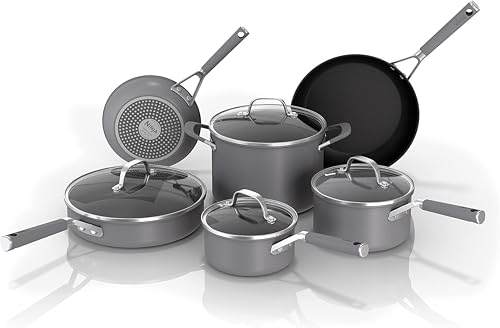
Ninja Foodi NeverStick Cookware Set
The Ninja Foodi NeverStick set uses a coating baked into a textured surface that owners report resists chipping and flaking longer than standard nonstick. Reviewers like the heavy build and the higher oven rating for finishing dishes. The pans are heavier than budget aluminum sets and, like all nonstick, still respond best to gentle heat and soft utensils.
Pros
- Coating resists chipping and flaking
- Heavy durable construction
- High oven-safe temperature
Cons
- Heavier than budget aluminum sets
- Still needs soft utensils to last
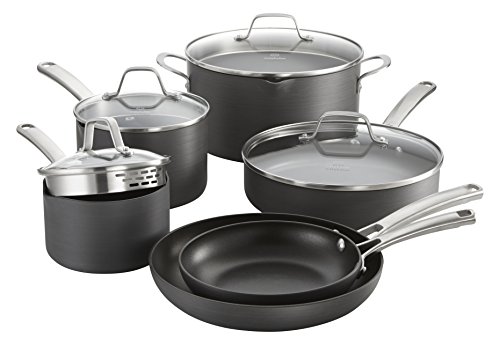
Calphalon Classic Nonstick Cookware Set
The Calphalon Classic set features a dual-layer nonstick and measuring marks inside the pans that owners find handy for portioning. Reviewers praise the sturdy hard-anodized build and long tapered handles that stay cool on the stovetop. It carries a mid-range price and the darker interior can make it harder to judge browning at a glance.
Pros
- Sturdy hard-anodized construction
- Handles stay cool on the stove
- Interior measuring marks are handy
Cons
- Dark interior hides browning
- Mid-range price for the count

Cuisinart Advantage Nonstick Cookware Set
The Cuisinart Advantage set is a lightweight color-coded aluminum collection that owners buy for a full kitchen at a low price. Reviewers say the nonstick releases eggs and pancakes well when new and the pans are easy to lift and store. The thinner aluminum can develop hot spots and the coating is best preserved with low to medium heat.
Pros
- Affordable full assortment
- Lightweight and easy to store
- Good release when new
Cons
- Thin body can develop hot spots
- Low oven-safe temperature

Rachael Ray Cucina Nonstick Cookware Set
The Rachael Ray Cucina set stands out for its colorful enamel exteriors and rubberized dual-riveted handles that owners find comfortable and secure. Reviewers say the nonstick releases well early on and the styling brightens a kitchen. The coating is on the thinner side, so it benefits from low to medium heat and soft utensils to last.
Pros
- Comfortable grippy handles
- Attractive enamel color options
- Good early nonstick release
Cons
- Thinner coating needs gentle heat
- Piece count includes utensils
Compared at a glance
| # | Model | Construction | Best for | Score | Price |
|---|---|---|---|---|---|
| 1 | T-fal Ultimate Hard Anodized Nonstick Cookware Set | Hard-anodized aluminum | Best overall | 9.3 | Check price |
| 2 | All-Clad HA1 Hard Anodized Nonstick Cookware Set | Hard-anodized with steel base | Best premium | 9.1 | Check price |
| 3 | GreenPan Rio Ceramic Nonstick Cookware Set | Aluminum body | Best ceramic | 8.9 | Check price |
| 4 | Ninja Foodi NeverStick Cookware Set | Hard-anodized aluminum | Best coating longevity | 8.8 | Check price |
| 5 | Calphalon Classic Nonstick Cookware Set | Hard-anodized aluminum | Best for durability | 8.7 | Check price |
| 6 | Cuisinart Advantage Nonstick Cookware Set | Aluminum body | Best value | 8.6 | Check price |
| 7 | Rachael Ray Cucina Nonstick Cookware Set | Hard enamel aluminum | Best design | 8.5 | Check price |
What to look for
How we chose these cookware sets We ranked these sets by comparing published coating types, construction and oven ratings against the durability patterns that show up across long-term owner reports rather than a single stovetop test. We weighted how long each coating stays slick, how evenly the pans heat, handle comfort and whether the advertised piece count reflects usable cookware instead of counting lids and tools as items.
Coating types and longevity Traditional multilayer nonstick from T-fal and Ninja tends to stay slick longer, while ceramic coatings like GreenPan appeal to cooks avoiding PTFE but generally lose their release sooner. Every set here is PFOA-free, and the biggest longevity factor is how you treat it. Match the coating to whether you prioritize lifespan or a PTFE-free surface.
Heat, weight and oven safety Hard-anodized sets from All-Clad, Calphalon and Ninja run heavier but heat more evenly and tolerate higher oven temperatures, some to 500 F. Lightweight aluminum sets are easier to handle and cheaper but can develop hot spots and cap out around 350 F. Check the oven rating if you plan to start dishes on the stove and finish them under heat.
Care that extends coating life Nonstick lasts far longer with low to medium heat, soft silicone or wood utensils, and hand washing instead of the dishwasher. Overheating an empty pan is the fastest way to degrade any coating, ceramic or PTFE. Building these habits does more for longevity than the brand you choose, so factor upkeep into your decision.
Questions worth asking
Are nonstick cookware sets safe?
Every set here is made without PFOA, and modern coatings are considered safe for normal cooking at low to medium heat. Avoid overheating empty pans, which can degrade any coating, and use ventilation as a sensible precaution.
How long does nonstick coating last?
With gentle heat, soft utensils and hand washing, a quality coating commonly stays effective for several years. Cheaper thin coatings and ceramic surfaces tend to lose their slickness sooner, so care matters more than brand alone.
Is ceramic nonstick better than traditional nonstick?
Ceramic sets like the GreenPan Rio are free of PTFE and appeal to cooks who prefer that, but they generally lose their release faster. Traditional multilayer coatings usually stay slick longer, so the right choice depends on your priorities.
Can nonstick pans go in the oven?
Many can, but the limit varies. Lightweight sets often cap around 350 F, while hard-anodized options like the All-Clad HA1 and Ninja NeverStick reach 500 F. Always check the rating before finishing a dish under high heat.
Can I use metal utensils on nonstick cookware?
It is best to avoid metal, since it scratches and shortens the life of any coating. Silicone, nylon or wood utensils protect the surface and help the nonstick last several years longer.
Are nonstick sets dishwasher safe?
Some are labeled dishwasher safe, but owners and manufacturers widely recommend hand washing to preserve the coating. Dishwasher heat and detergent gradually dull the nonstick and can loosen riveted handles.
What piece count do I actually need for a nonstick set?
Focus on usable pans rather than the headline number, since lids and utensils often inflate the count. A set with a couple of fry pans, two saucepans and a stockpot covers most everyday cooking.
Do nonstick sets work on induction cooktops?
Only sets with a magnetic steel base, such as the All-Clad HA1, work on induction. Plain aluminum sets will not heat on induction, so confirm the base is induction compatible before buying if you have that cooktop.
Why does food start sticking to my nonstick pan?
Sticking usually signals a worn coating or cooking at too high a temperature. Using low to medium heat, a little oil and soft utensils slows wear, but a badly degraded coating means it is time to replace the pan.
Are expensive nonstick sets worth it?
Premium hard-anodized sets heat more evenly, feel sturdier and often carry higher oven ratings, which suits frequent cooks. Casual cooks are usually well served by a value set like the Cuisinart Advantage, so match the spend to your use.
Final word
For most kitchens the T-fal Ultimate is the nonstick cookware set that balances durable coating, even heat and sensible value. Cooks who want the sturdiest build and highest oven rating should step up to the All-Clad HA1, while the GreenPan Rio is the pick for anyone who wants a ceramic, PTFE-free surface.