6 Pacifier Shapes and Which Babies Tend to Prefer Them
Philips Avent Soothie Pacifier wins on hospital familiarity and a seamless one piece build. MAM Perfect Pacifier suits parents focused on dental development because of its thin flexible neck. Bibs Colour Pacifier gives babies who reject silicone a natural rubber alternative.
Hospitals hand out the Philips Avent Soothie more than any rival, so many newborns already accept its shape before leaving the building. MAM Perfect is the pick when orthodontic geometry matters most. Babies who refuse silicone outright often take natural rubber from Bibs instead.
No parent can predict which shape a baby will accept, which makes pacifier shopping mostly a guessing game. We compared nipple geometry, material, shield ventilation, construction type and age bands across seven models. Manufacturer guidance on cleaning, replacement schedules and orthodontic design shaped each entry.
Our top picks

Philips Avent Soothie Pacifier
A single piece of medical grade silicone forms the whole pacifier, leaving no joint where milk residue can collect. Many hospitals distribute this exact shape to newborns, so plenty of babies already accept it at home. An open shield lets a parent hold it steady during feeding cues.
Pros
- One piece build has no seams to trap residue
- Widely accepted by newborns already used to it
- Shield holds a finger for guiding it
Cons
- Round nipple is not orthodontically shaped
- Plain design with no decorative options

MAM Perfect Pacifier
A thinner neck than most pacifiers reduces pressure on developing gums and teeth. Because the nipple is symmetrical, it works no matter which way a baby takes it into their mouth. A self sterilising case doubles as a travel box and finishes a cycle in a microwave within minutes.
Pros
- Thin neck reduces pressure on gums
- Symmetrical shape works either way up
- Case sterilises in a microwave
Cons
- Assembled construction needs careful cleaning at the join
- Shield can leave marks on very young skin

Bibs Colour Pacifier
Natural rubber latex feels softer and warmer than silicone, which wins over some babies who reject every other option. A round cherry shaped nipple mimics a bottle teat more closely than orthodontic designs do. Rubber breaks down faster than silicone, so replacing it every few weeks is part of the routine.
Pros
- Softer feel wins over silicone refusers
- Round shape resembles a bottle teat
- Vented shield reduces skin irritation
Cons
- Latex needs replacing more often than silicone
- Not suitable where latex allergy is a concern
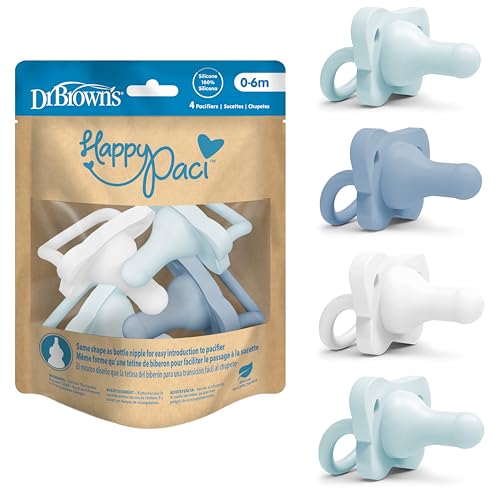
Dr. Brown’s HappyPaci Silicone Pacifier
This nipple mirrors the shape of the Dr. Brown’s bottle teat, cutting confusion for babies already using that system. One piece silicone construction removes joints entirely. A butterfly shield curves away from the nose, so breathing stays clear when a baby lies on its side.
Pros
- Shape matches Dr. Brown’s bottles
- Seamless one piece build
- Contoured shield clears the nose
Cons
- Only one size band available
- Less useful if you use another bottle brand

NUK Comfy Orthodontic Pacifier
NUK built its reputation on a flattened orthodontic nipple that sits under the tongue the way a bottle teat does during feeding. Multipacks put spares in the nappy bag, the car and every room, which matters more than any single feature. A heart shaped shield clears the nose while venting through side holes.
Pros
- Orthodontic shape backed by long use
- Multipacks keep spares everywhere
- Shield clears the nose comfortably
Cons
- Orientation matters, so it can go in upside down
- Assembled parts need thorough cleaning

Tommee Tippee Ultra-Light Silicone Pacifier
Weighing a fraction of a standard pacifier, this one is less likely to drag out of a sleeping baby’s mouth. Nothing needs disassembling at cleaning time, since the whole piece is one piece silicone. A sterilising pod included in the box also works as a carry case for outings.
Pros
- Light enough to stay put during sleep
- No seams or assembled joints
- Steriliser pod included for travel
Cons
- Small shield offers less lip clearance
- Plain look with limited colour choice

Itzy Ritzy Sweetie Soother
A large shield format suits babies once they start grabbing and holding things on their own. The shield loop takes a standard pacifier clip without the ring twisting, cutting down on floor drops. Coordinated colour sets mean losing one pacifier does not disrupt the whole pattern.
Pros
- Loop takes a clip without twisting
- Easy for older babies to grip and reinsert
- Sold in coordinated pairs
Cons
- Larger shield suits older babies more than newborns
- Silicone picks up lint from clothing
How to choose
What should you look for in a pacifier? Construction matters most for hygiene, and one piece silicone designs like the Philips Avent Soothie have no joint where milk residue can hide. Check the shield next. It should sit wider than a baby’s mouth, carry ventilation holes, and curve away from the nose. Nipple shape splits into round and orthodontic, and material into silicone or natural rubber latex. Size bands exist because a newborn nipple genuinely becomes too small by six months.
Which pacifier shape suits a newborn? Newborns tend to accept whatever shape resembles what they already feed from. Round nipples like the Soothie and the Bibs cherry shape sit closest to a bottle teat, explaining why hospitals distribute the Soothie so widely. Dr. Brown’s HappyPaci goes further and matches its own bottle nipple exactly. Orthodontic designs flatten on the underside to rest against the tongue, and MAM’s thin neck cuts pressure on teeth as they emerge.
Silicone versus natural rubber latex, which lasts longer? Silicone holds its shape for months, resists odour, and survives repeated boiling or steam sterilising. Natural rubber latex, used in the Bibs Colour pacifier, feels softer and warmer, and some babies accept it after rejecting every silicone option. Expect to replace rubber every few weeks rather than months, since it degrades faster. Latex allergy in infants is rare but is a genuine reason to stick with silicone.
How do you clean, replace and use a pacifier clip safely? Sterilise by boiling or steaming before first use, then wash daily afterward. MAM and Tommee Tippee both include cases that sterilise in a microwave, handy while travelling. Replace any pacifier showing tears, stickiness or a swollen nipple, and pull firmly on the nipple to test it before each use. Clips need a short ribbon and should attach to clothing only, never loop around the neck, and the Itzy Ritzy shield loop is shaped to take one without twisting.
Side by side
| # | Model | Material | Best for | Score | Price |
|---|---|---|---|---|---|
| 1 | Philips Avent Soothie Pacifier | Medical grade silicone, one piece | Best overall | 9.4 | Check price |
| 2 | MAM Perfect Pacifier | Thin flexible neck, symmetrical nipple | Best for dental development | 9.2 | Check price |
| 3 | Bibs Colour Pacifier | Natural rubber latex nipple | Best natural rubber | 9.0 | Check price |
| 4 | Dr. Brown’s HappyPaci Silicone Pacifier | One piece silicone | Best for newborns | 8.8 | Check price |
| 5 | NUK Comfy Orthodontic Pacifier | Flattened orthodontic nipple | Best value multipack | 8.6 | Check price |
| 6 | Tommee Tippee Ultra-Light Silicone Pacifier | Around 4 grams | Best lightweight | 8.3 | Check price |
| 7 | Itzy Ritzy Sweetie Soother | One piece silicone | Best for older babies | 8.0 | Check price |
Questions worth asking
What is the best pacifier for a newborn?
Philips Avent Soothie ranks highest here, largely because many hospitals distribute it and its one piece silicone shape is widely accepted from birth.
Are orthodontic pacifiers better for teeth?
Orthodontic designs flatten against the tongue to spread pressure evenly. MAM Perfect goes further with a thinner neck, which manufacturers link to reduced pressure on developing teeth.
Silicone or latex pacifier, which should I choose?
Silicone lasts longer, resists odour, and handles repeated sterilising without breaking down. Latex feels softer and warmer, which sometimes wins over a baby who refuses silicone entirely.
How often should you replace a pacifier?
Every one to two months for silicone, and more frequently for latex. Replace immediately if you notice tears, stickiness or a swollen nipple.
When should a baby stop using a pacifier?
Most guidance points to weaning between one and two years old. Prolonged use beyond that age is linked to dental changes.
How do you sterilise a pacifier?
Boil for around five minutes or run it through a steam steriliser. MAM and Tommee Tippee both include cases that finish a cycle in a microwave within minutes.
Are pacifier clips safe to use?
Short clips that attach to clothing are safe for daily use. Never use a cord long enough to loop around the neck, and check the stitching on any clip regularly.
What if my baby refuses every pacifier shape?
Try switching both material and shape at once rather than one at a time. Babies who reject silicone sometimes accept natural rubber, such as the Bibs Colour pacifier.
Can a pacifier be used alongside bottle feeding?
Yes, and matching shapes can reduce confusion. Dr. Brown’s HappyPaci mirrors that brand’s own bottle nipple for babies already using that feeding system.
Do multipacks matter for newborns?
They do in practice, since spares in the car, the nursery and the nappy bag prevent a lost pacifier from becoming a crisis. NUK’s multipack sizing covers several age bands at once.
The bottom line
Philips Avent Soothie remains the sensible starting point for a newborn, since hospital familiarity raises the odds of acceptance. Switch to MAM Perfect when orthodontic shape is the priority, and to Bibs Colour if silicone gets refused outright. Buy small quantities across two shapes rather than a large pack of one.