How to Pick a Paddleboard for Your First Season on the Water
Thurso Surf’s Waterwalker 132 leads for beginners thanks to a wide, stable deck built for early balance practice. Retrospec’s Weekender delivers similar stability for less money if you paddle occasionally. Larger riders should size up to Isle’s Pioneer, which carries more weight than standard beginner boards.
At 32 inches wide, Thurso Surf’s Waterwalker 132 beats most competing boards on stability, giving new paddlers a platform for learning balance before chasing speed or distance. Casual weekend paddlers can get nearly the same stability for less through Retrospec’s Weekender.
Width and thickness affect a beginner’s stability more than length ever does. We compared those dimensions against weight capacity and included accessories, like pumps and paddles, across seven current inflatable boards built for entry-level paddlers.
How to pick the right one
What Makes a Paddleboard Beginner-Friendly Width affects stability more than any other single dimension for new paddlers. Boards between 32 and 34 inches wide resist tipping better than narrower touring shapes. Six inches of thickness keeps the board rigid enough to avoid excessive flex underfoot. Weight capacity should leave a margin above rider weight, especially when carrying a paddle bag or child.
Choosing Based on Rider Size Riders over 200 pounds should prioritize boards like Isle’s Pioneer or iRocker’s All-Around, both rated above 400 pounds capacity. Lighter riders under 150 pounds have more flexibility, since even budget boards like Roc’s typically handle that weight range without sagging. Paddling with a child or dog aboard also pushes total weight higher than expected.
Balancing Stability Against Portability Wider, thicker boards resist tipping but weigh more when packed for transport. BOTE’s Breeze Aero trades some thickness for a lighter carry, appealing to paddlers without a vehicle rack. Stability-first paddlers should accept the extra bulk that comes with boards like iRocker’s All-Around.
Accessories That Matter for a Complete Setup Every board in this comparison ships with a hand pump, adjustable paddle, and ankle leash, covering the basics for a first outing. Deck bungee rigging and tie-down points matter for anyone bringing a dry bag, cooler, or phone case along. Removable fin setups, like Atoll’s, add flexibility as paddlers move from calm lakes to light river currents.
The best picks, ranked
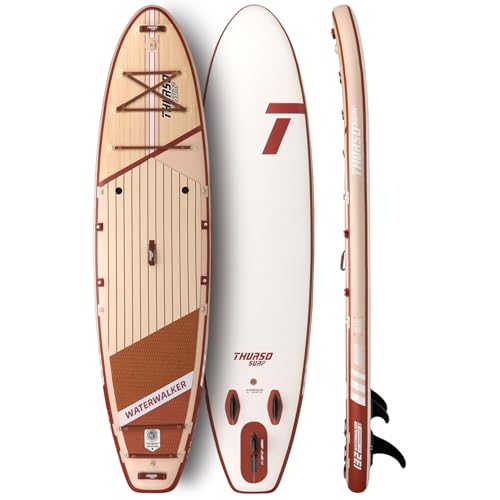
Thurso Surf Waterwalker 132
At 10 feet 6 inches long and 32 inches wide, this board holds 6 inches of thickness that resists flexing under moderate chop. Double-layer PVC construction balances rigidity against a manageable inflated weight. A pump, paddle, and leash come included, covering a full beginner setup without separate purchases.
Pros
- 32-inch width provides stability for first-time balance practice
- Double-layer PVC resists punctures better than single-layer boards
- Complete accessory kit avoids separate paddle or pump purchases
Cons
- Heavier inflated weight than narrower touring-style boards
- Wide deck reduces top speed compared to sleeker designs

Retrospec Weekender Inflatable Paddle Board
Thirty-one inches of width across a 10-foot-6-inch length gets close to Thurso Surf’s stability without matching its price. Single-layer military-grade PVC keeps the board lighter, trading some puncture resistance for easier transport. Bungee deck rigging holds a dry bag or small cooler on short lake outings.
Pros
- Lighter inflated weight eases carrying to and from the water
- Bungee deck rigging secures a dry bag for short outings
- Lower price than double-layer competitors with similar dimensions
Cons
- Single-layer PVC is less puncture-resistant than double-layer boards
- Weight capacity trails behind wider, thicker competitors

Roc Inflatable Stand Up Paddle Board
Ten feet long and 30 inches wide, this board runs narrower than premium competitors but stays adequate for calm lake conditions. Single-layer PVC keeps upfront cost low for paddlers unsure about committing to the sport. A basic accessory kit covers the essentials without the extras found on pricier boards.
Pros
- Lower price suits paddlers testing the sport before upgrading
- Includes a full accessory kit despite the budget positioning
- Compact carry bag simplifies storage and transport
Cons
- 30-inch width offers less stability than wider beginner boards
- Lower weight capacity limits use for larger riders

iRocker All-Around 10’6
Width reaches 33 inches here, among the widest in this comparison, prioritizing stability over speed for nervous first-time paddlers. Three-layer fusion construction adds rigidity beyond typical single or double-layer boards. That extra width does slow the board compared to narrower touring shapes.
Pros
- 33-inch width offers strong stability for nervous first-timers
- Three-layer construction adds rigidity over standard PVC
- 400-pound weight capacity accommodates larger riders or gear
Cons
- Extra width reduces glide speed compared to narrower boards
- Heavier packed weight makes solo transport more difficult

Atoll 11′ Inflatable Paddle Board
An 11-foot length splits the difference between compact beginner boards and longer touring shapes, handling calm lakes and light river currents alike. A 32-inch width keeps stability close to the Waterwalker’s. Removable center and side fins allow adjustment for different water conditions as paddlers gain experience.
Pros
- Removable fin setup adapts to lakes, rivers, or light waves
- 32-inch width keeps stability competitive with top picks
- Extra foot of length improves glide over shorter beginner boards
Cons
- Longer length is slightly harder to maneuver in tight spaces
- Higher price than similarly stable shorter boards

BOTE Breeze Aero Inflatable Paddle Board
Transport gets easier here, since this board prioritizes a lighter packed weight for paddlers without a roof rack or truck bed. Its 32-inch width maintains solid stability despite the lighter build. A built-in bottle opener and cooler tie-down cater to casual lake day use rather than serious training.
Pros
- Lighter packed weight simplifies solo carrying and loading
- 32-inch width keeps stability strong despite the lighter build
- Cooler tie-down and bottle opener suit casual lake outings
Cons
- Thinner 5-inch profile flexes more than 6-inch competitors
- Reinforced rails add some cost over basic single-layer boards

Isle Pioneer Inflatable Stand Up Paddle Board
Up to 435 pounds of capacity make this the highest-rated board here, suiting larger riders or those paddling with a child or dog aboard. A 34-inch width and 6-inch thickness resist sagging under heavier loads. That larger footprint does add some bulk to storage and transport compared to standard-size boards.
Pros
- 435-pound capacity suits larger riders or paddling with extra gear
- 34-inch width resists sagging under heavier loads
- Deck bag included for storing keys, phone, or snacks
Cons
- Larger footprint takes up more storage space when packed
- Wider board reduces maneuverability in narrow waterways
How they compare
| # | Model | Dimensions | Best for | Score | Price |
|---|---|---|---|---|---|
| 1 | Thurso Surf Waterwalker 132 | 10’6″ long, 32 inches wide, 6 inches thick | Best overall | 9.3 | Check price |
| 2 | Retrospec Weekender Inflatable Paddle Board | 10’6″ long, 31 inches wide, 6 inches thick | Best value | 9.0 | Check price |
| 3 | Roc Inflatable Stand Up Paddle Board | 10′ long, 30 inches wide, 6 inches thick | Best budget | 8.4 | Check price |
| 4 | iRocker All-Around 10’6 | 10’6″ long, 33 inches wide, 6 inches thick | Best for extra stability | 9.1 | Check price |
| 5 | Atoll 11′ Inflatable Paddle Board | 11′ long, 32 inches wide, 6 inches thick | Best for all-around versatility | 8.8 | Check price |
| 6 | BOTE Breeze Aero Inflatable Paddle Board | 10’8″ long, 32 inches wide, 5 inches thick | Best for lightweight portability | 8.9 | Check price |
| 7 | Isle Pioneer Inflatable Stand Up Paddle Board | 11′ long, 34 inches wide, 6 inches thick | Best for larger paddlers | 9.0 | Check price |
Common questions
How wide should a paddleboard be for beginners?
Beginners generally do better on boards between 32 and 34 inches wide, since extra width improves side-to-side stability while learning to balance.
What weight capacity do I need for a paddleboard?
Choose a board rated at least 50 pounds above your body weight to account for paddling gear, a dry bag, or a child or pet riding along.
Are inflatable paddleboards good for beginners?
Yes, inflatable boards are generally more forgiving for beginners, since their softer deck cushions falls better than a rigid hard-shell board.
What length paddleboard is best for a beginner?
Most beginner boards run between 10 and 11 feet long, balancing stability with enough glide to avoid feeling sluggish on the water.
Can a heavier person use an inflatable paddleboard?
Yes, boards like Isle’s Pioneer and iRocker’s All-Around carry over 400 pounds, making them suitable options for larger riders.
How thick should a paddleboard be to avoid flexing?
Six inches of thickness is standard for beginner boards and generally resists noticeable flex under moderate weight and chop.
Do beginner paddleboards come with a paddle and pump included?
Most do. Every board compared here includes a hand pump and adjustable paddle, and most also include a leash and carry bag or backpack.
What is the difference between single-layer and double-layer paddleboard material?
Double-layer PVC resists punctures and holds its shape better under load, while single-layer PVC keeps the board lighter and more affordable.
Inflatable versus hard-shell paddleboard: which is better for a first-timer?
Inflatable boards pack smaller, cost less to ship, and forgive falls better, making them the more common starting point for beginners.
How long does it take to inflate a beginner paddleboard?
Most inflatable boards in this size range take 8 to 15 minutes with the included hand pump, depending on thickness and pump effort.
Our pick
Thurso Surf’s Waterwalker 132 earns the top recommendation for new paddlers thanks to its wide, stable deck and complete accessory kit. Larger riders or anyone paddling with extra gear should choose Isle’s Pioneer instead, since its 435-pound capacity outpaces every other board here. Paddlers on a tight budget who just want to try the sport can start with Roc’s board and upgrade later if they stick with it.


