Photo Scanners That Bring Old Prints Back to Life
The Epson Perfection V600 is the best all round photo scanner, handling prints, slides, and negatives with strong detail. The Canon CanoScan LiDE 400 is the value pick for prints, while the Epson FastFoto FF-680W is the fastest way to clear a large box of loose photos.
The scanners that stand out are the Epson Perfection V600, the Canon CanoScan LiDE 400, and the Epson FastFoto FF-680W. Between them they cover printed photos, 35mm slides, negatives, and fast batch scanning for anyone facing a big archive.
Picking a photo scanner is harder than it seems because the right one depends entirely on what you are scanning. We separated flatbed scanners that excel at film and delicate prints from fast feed scanners built for volume, and weighed resolution, dust and scratch tools, and how fiddly each one is to operate.
The top picks, ranked

Epson Perfection V600 Photo Scanner
The V600 is a flatbed that handles prints, slides, and negatives with high resolution and built in dust removal. Its balance of quality and price makes it the default choice for mixed home archives.
Pros
- Excellent all round quality
- Scans film and prints
- Effective dust removal
Cons
- Slower than feed scanners
- Film holders take practice

Canon CanoScan LiDE 400
This slim flatbed delivers high resolution print scans and draws power from a single cable, keeping the desk tidy. It is excellent for prints and documents, though it does not scan film.
Pros
- Great print quality for the price
- Compact single cable design
- Quick one touch buttons
Cons
- No film or slide support
- Basic bundled software

Epson FastFoto FF-680W
The FastFoto feeds a stack of loose prints and scans them in seconds each, capturing the front and any notes on the back. It is the answer to a shoebox of photos that would take days on a flatbed.
Pros
- Extremely fast batch scanning
- Captures backs of prints
- Wireless transfer
Cons
- Not for slides or negatives
- Risky for very fragile prints

Plustek OpticFilm 8200i SE
This dedicated film scanner captures 35mm slides and negatives at very high resolution with strong dust and scratch correction. Serious film archivists choose it for detail a flatbed cannot match.
Pros
- Outstanding film detail
- Strong dust correction
- High effective resolution
Cons
- Only handles 35mm film
- Slow frame by frame process
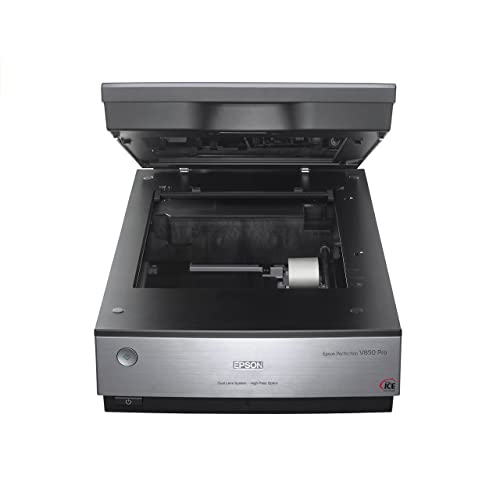
Epson Perfection V850 Pro
The V850 Pro is a high end flatbed with dual lenses and premium film holders for the best possible flatbed film scans. It is aimed at professionals and archivists who need maximum quality and volume.
Pros
- Top tier scan quality
- Handles many film formats
- Excellent film holders
Cons
- Expensive for home use
- Large desk footprint

Canon CanoScan LiDE 300
The LiDE 300 is an affordable flatbed for prints and documents that runs from one USB cable. It skips film scanning but covers everyday photo digitizing on a tight budget.
Pros
- Very affordable
- Simple to operate
- Compact and light
Cons
- No film support
- Lower resolution than the 400

Kodak Slide N Scan Film and Slide Scanner
This standalone device converts slides and negatives to digital files on its own screen without a computer. It is the simplest way to work through old slides, trading ultimate quality for convenience.
Pros
- No computer required
- Very easy to use
- Fast for casual archives
Cons
- Lower detail than flatbeds
- Limited editing control
The lineup, side by side
| # | Model | Type | Best for | Score | Price |
|---|---|---|---|---|---|
| 1 | Epson Perfection V600 Photo Scanner | Flatbed | Best overall | 9.4 | Check price |
| 2 | Canon CanoScan LiDE 400 | Flatbed | Best value | 9.0 | Check price |
| 3 | Epson FastFoto FF-680W | Sheet feed | Best for bulk photos | 9.1 | Check price |
| 4 | Plustek OpticFilm 8200i SE | Dedicated film scanner | Best for film and slides | 8.8 | Check price |
| 5 | Epson Perfection V850 Pro | Flatbed | Best for professionals | 8.7 | Check price |
| 6 | Canon CanoScan LiDE 300 | Flatbed | Best budget | 8.3 | Check price |
| 7 | Kodak Slide N Scan Film and Slide Scanner | Standalone film converter | Best for slides and negatives | 8.0 | Check price |
How to choose
Prints versus film need different tools A scanner built for printed photos is not the same as one built for slides and negatives. Film needs light to pass through it, so only scanners with a transparency unit or a dedicated film design can capture it. Match the scanner to whether you have prints, film, or both.
Resolution that actually matters Very high dpi numbers help most when scanning small originals like 35mm film, where you enlarge a tiny image a great deal. For standard printed photos, a moderate resolution already captures more than the print holds, so do not overpay for dpi you will never use on prints.
Speed versus quality tradeoff Flatbed scanners deliver the best quality but scan one image at a time, which is slow for large collections. Feed scanners like the FastFoto race through stacks of prints but cannot handle film and pose a small risk to fragile photos, so choose based on volume and condition.
Dust, scratch, and color tools Old photos and film collect dust and fade over time. Scanners with infrared dust removal and color restoration save hours of manual editing, and this feature matters far more on film than on prints. Check whether the model includes it if your originals are aged or damaged.
Common questions
Which scanner is best for old slides?
For the best detail a dedicated film scanner like the Plustek OpticFilm handles slides superbly, while the Epson V600 covers slides alongside prints. For fast easy results, the Kodak Slide N Scan works without a computer.
Can a photo scanner handle negatives too?
Only scanners with a transparency unit or dedicated film design can scan negatives. The Epson V600 and V850 Pro, the Plustek, and the Kodak all do, while the Canon LiDE models do not.
What resolution do I need for prints?
For standard printed photos a resolution around 600 dpi already captures full detail. Very high dpi matters mainly for small film originals that you plan to enlarge significantly.
How do I scan a large box of photos quickly?
A feed scanner like the Epson FastFoto scans about one print per second and captures the backs too. It is far faster than a flatbed for loose prints in good condition.
Will scanning damage fragile photos?
Flatbeds are gentle since the photo lies flat and still. Feed scanners pull prints through rollers, which can risk very old or brittle photos, so use a flatbed for anything fragile.
Do these remove dust and scratches?
Several include infrared dust and scratch removal, which is most effective on film. The Epson V600, V850 Pro, and Plustek offer it, saving a lot of manual cleanup.
Do I need a computer to scan?
Most flatbed and feed scanners connect to a computer, but the Kodak Slide N Scan works on its own with a built in screen and memory card, needing no computer at all.
Can I restore faded color?
Some scanner software includes color restoration that revives faded prints and film automatically. Results vary with the original, but it often improves badly faded images noticeably.
Final word
The Epson Perfection V600 is the scanner most people should buy because it captures prints, slides, and negatives with excellent detail and useful dust removal. Choose the Canon CanoScan LiDE 400 if you only scan prints and want to save money, or the Epson FastFoto FF-680W when speed through a large box of photos is the priority.