Exercise Wheels Sized Right for Hamsters, Rats and Hedgehogs
Niteangel’s Natural Wooden Exercise Wheel gives hedgehogs and larger rats the widest solid-surface track available. Hamster owners get quieter nights with the Kaytee Silent Spinner’s friction-reduced hub. Exotic Nutrition’s Wodent Wheel Senior adds extra diameter for rats that have outgrown standard hamster wheels.
Niteangel’s Natural Wooden Exercise Wheel gives hedgehogs and larger rats a wide, solid track their spine can handle without curving. Kaytee’s Silent Spinner keeps hamster cages quiet through the night using a friction-reduced hub. Exotic Nutrition’s Wodent Wheel Senior adds extra diameter specifically for rats, which need more room than hamsters to run upright.
Wheel size has to match an animal’s spine length, not just the space inside the cage, since an undersized wheel forces the back into a curve during running. We compared diameter, surface material and stated noise level, then weighed owner reports on how each wheel held up under nightly use.
The shortlist, ranked

Niteangel Natural Wooden Exercise Wheel
A 12 inch solid wood track avoids the wire-mesh foot injuries that hedgehogs and rats risk on cheaper wheels. The freestanding wooden stand needs no cage attachment, so it moves between enclosures easily. Hedgehog owners specifically cite the flat, splinter-free surface as the reason to skip metal wheels entirely.
Pros
- Solid surface protects feet from mesh injuries
- Freestanding design moves easily between cages
- Large enough for bigger small pets like rats
Cons
- Wood surface needs occasional cleaning to control odor
- Bulkier footprint than wire wheels

Kaytee Silent Spinner Exercise Wheel
A friction-reduced hub keeps nighttime running from waking the household, the top complaint owners raise about standard wire wheels. It mounts to wire cage sides or stands freely on its own base. Hamster and gerbil owners report years of quiet use before the bearing starts to wear.
Pros
- Noticeably quieter than mesh wire wheels
- Mounts to cage bars or stands freely
- Sold in multiple sizes for different pets
Cons
- Smaller sizes fit too tight for adult rats
- Plastic track can crack under heavy chewing
Exotic Nutrition Wodent Wheel Senior
An 11 inch diameter with a solid, curved plastic track gives rats and larger hamsters room to run without arching their spine. A rear guard blocks tails from getting caught, a common injury on open wheels. Rat owners recommend the Senior size over the standard Wodent Wheel for that extra diameter.
Pros
- Diameter sized correctly for adult rats
- Tail guard prevents a common wheel injury
- Sturdy stand resists tipping during use
Cons
- Bulkier than wheels built for hamsters
- Costs more than basic wire wheels
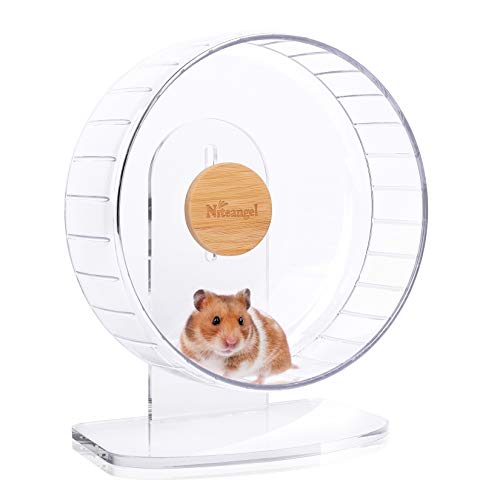
Niteangel Silent Runner Wheel
A solid running surface and enclosed hub cut noise at a lower price than premium wheels, fitting a single hamster or gerbil cage. It comes in multiple diameters for different pet sizes. Budget-focused owners describe it as a reliable step up from the stock wire wheels bundled with starter cages.
Pros
- More affordable than premium quiet wheels
- Multiple diameters cover different pet sizes
- Reasonably quiet given the lower price
Cons
- Smallest sizes do not suit rats
- Stand feels less stable than heavier models

Niteangel Large Hamster Silent Spinner Wheel With Stand
An 8.5 inch wheel on a weighted stand suits Syrian hamsters, which need more diameter than dwarf breeds to run without curving their spine. The freestanding base skips cage-bar mounting entirely. Syrian hamster owners mention it fits standard enclosures without crowding other accessories.
Pros
- Diameter sized right for Syrian hamsters
- Weighted base resists tipping while in use
- Requires no cage-side mounting hardware
Cons
- Too large for dwarf hamster or mouse cages
- Takes up more floor space than mounted wheels

Exotic Nutrition Flying Saucer Exercise Wheel
A flat, spinning disc mounts near the top of the cage instead of standing on the floor, freeing up ground space for bedding and hides. The angled running surface suits smaller hamsters and mice best. Owners running small cages mention the saucer shape as a practical fit where a standing wheel would not clear the floor.
Pros
- Frees up floor space in small cages
- Compact shape suits travel or spare cages
- A novel design many pets adopt quickly
Cons
- Not suitable for rats or larger hamsters
- Some pets take longer to learn the angled motion

Kaytee Run-About Exercise Ball
A clear plastic ball lets a hamster or mouse explore rooms outside the cage under direct supervision, rather than running in place. Ventilation holes keep airflow steady during use. Owners treat it as an occasional supplement to an in-cage wheel, not a full replacement.
Pros
- Adds variety beyond an in-cage wheel
- Lets a pet explore outside the cage safely
- Easy to clean thanks to plastic construction
Cons
- Requires direct supervision the entire time
- Does not replace daily wheel access
Side by side
| # | Model | Diameter | Best for | Score | Price |
|---|---|---|---|---|---|
| 1 | Niteangel Natural Wooden Exercise Wheel | 12 inches | Best for hedgehogs | 9.3 | Check price |
| 2 | Kaytee Silent Spinner Exercise Wheel | 6.5 to 11 inches, size dependent | Best overall | 9.1 | Check price |
| 3 | Exotic Nutrition Wodent Wheel Senior | 11 inches | Best for rats | 8.9 | Check price |
| 4 | Niteangel Silent Runner Wheel | 5.5 to 8.5 inches, size dependent | Best value | 8.6 | Check price |
| 5 | Niteangel Large Hamster Silent Spinner Wheel With Stand | 8.5 inches | Best for large hamster breeds | 8.4 | Check price |
| 6 | Exotic Nutrition Flying Saucer Exercise Wheel | 6.5 inches | Best space-saving design | 8.2 | Check price |
| 7 | Kaytee Run-About Exercise Ball | 7 to 9 inches, size dependent | Best for supervised out-of-cage exercise | 8.0 | Check price |
What to look for
How to size a wheel to your pet’s spine An undersized wheel forces a running pet’s back into a C-shape, which vets link to spinal strain over time. Dwarf hamsters need at least 6.5 inches, Syrian hamsters need 8 inches, and rats or hedgehogs need 11 to 12 inches. Measure your pet’s body length before buying rather than guessing from the cage size.
Solid surface vs wire mesh Wire mesh wheels cost less but catch small feet and tails, a known cause of injury in hedgehogs and rats especially. Solid plastic or wood tracks, used across every wheel in this comparison, remove that risk entirely. Skip mesh wheels even when the price difference looks tempting.
Freestanding or cage-mounted, which fits your setup Freestanding wheels on a weighted base work in any enclosure, including glass tanks without wire sides. Cage-mounted wheels save floor space but only fit wire cages with matching bar spacing. Check your enclosure type first, since the wrong mounting style means returning the wheel.
Cutting noise for a bedroom-adjacent cage A worn or poorly built hub causes the clicking and squeaking that keeps owners awake at night. Silent-hub designs, like the Kaytee Silent Spinner and Niteangel Silent Runner, use enclosed bearings specifically to reduce that noise. Light lubrication on any wheel’s axle extends quiet running further.
Common questions
What size exercise wheel does a hamster need?
Dwarf hamsters need at least 6.5 inches in diameter, while Syrian hamsters need 8 inches or more. A wheel that is too small forces the spine to curve during running, which can cause long-term strain.
Can hedgehogs use a hamster exercise wheel?
Only if it measures at least 12 inches across with a solid, flat surface. Most hamster wheels run smaller and use wire mesh, both unsafe for a hedgehog’s larger body and sensitive feet.
Are wire mesh exercise wheels safe for small pets?
No, wire mesh catches small feet, toes and tails during running and is a known injury cause. Solid plastic or wood surfaces are now the safer standard across small pet wheels.
How do I stop a pet’s exercise wheel from squeaking?
Most squeaking traces back to a dry or worn hub bearing. A silent-hub wheel like the Kaytee Silent Spinner avoids this from the start, and light axle lubrication extends quiet running on any wheel.
Do rats need a bigger exercise wheel than hamsters do?
Yes, adult rats need at least 11 inches of diameter, nearly double what a dwarf hamster requires, since rats run considerably longer and heavier.
Is a flying saucer wheel as good as a standing wheel?
It works well for dwarf hamsters and mice in space-limited cages, but it does not suit rats or hedgehogs, which need the larger diameter only standing wheels provide.
Should an exercise wheel be freestanding or attached to the cage?
Freestanding wheels work in any enclosure, including glass tanks, and tend to feel more stable underfoot. Cage-mounted wheels save floor space but need wire bars spaced to fit the mount.
How often should small pets run on an exercise wheel?
Most small pets are nocturnal and will cover several miles nightly given free access. Leave the wheel available at all times rather than restricting access to set hours.
Exercise wheel vs exercise ball, which is better for a hamster?
A wheel supports nightly, unsupervised exercise inside the cage, while a ball like the Kaytee Run-About only works under direct supervision outside it. Most owners keep both, using the ball as an occasional supplement.
What is the best exercise wheel for a hedgehog?
The Niteangel Natural Wooden Exercise Wheel fits hedgehogs best at 12 inches across with a solid, splinter-free surface. Anything smaller or made of wire mesh risks injury to a hedgehog’s feet and spine.
The bottom line
Pick the Niteangel Natural Wooden Exercise Wheel for a hedgehog or a larger rat, since its wide solid track fits both safely. Hamster owners should default to the Kaytee Silent Spinner for its quiet hub and range of sizes. Skip any wire mesh wheel regardless of price, since the injury risk outweighs what it saves.