Fish Feeders vs Vacation Blocks: Which Fits Your Trip?
Fish Mate F14 suits owners who want a dependable rotating feeder for everyday aquarium use. EHEIM Twin fits tanks needing separate portion sizes for two feeding times. API Pond Vacation Fish Feeding Block works best for short weekend trips where batteries and wiring are not worth the setup.
Fish Mate F14 tops this roundup for aquarium owners who leave home for days at a stretch. A rotating drum with 14 separate compartments keeps feeding times consistent without daily refilling. Its size is the tradeoff, since the drum mounts above the tank rim and needs clearance from hoods or lights.
Deciding between an automatic feeder and a dissolving food block is not obvious. Battery feeders can jam or overfeed if portions run too high, while oversized blocks cloud water and spike ammonia in small tanks. Rankings below weigh feeding compartments, portion adjustability, battery type, dissolve time, and reliability patterns reported in owner feedback.
How to choose
What to Look for in a Portable Fish Feeder Portable fish feeding splits into two categories: automatic battery feeders and slow-release food blocks. Feeders dispense measured portions on a timer, which limits overfeeding risk. Blocks dissolve passively and need no power, but oversized ones foul water in small tanks. Check compartment count, portion adjustability, and battery type before choosing either option.
Automatic Feeders vs Vacation Food Blocks Battery feeders suit larger tanks and trips longer than a few days, since they replicate a normal feeding schedule. Food blocks work better for compact tanks and short absences, where setting up a feeder is not worth the effort. Combining both, a light feeder dose plus a small block, spreads the risk if one method fails. Tank size and trip length should drive this decision more than price.
Weekend Trips vs Longer Vacations A single vacation block often covers a two or three day trip without any setup. Longer absences, a week or more, call for a programmable feeder with several compartments or adjustable portions. Fish can safely skip meals for short stretches, so backup feeding during a weekend trip is often unnecessary. Extended trips raise the stakes, since a jammed feeder with no backup can mean days without food.
Feeding Pond Fish vs Indoor Aquarium Fish Pond feeders need weatherproof housing to survive rain, temperature swings, and direct sun. Fish Mate’s P7 addresses this with a sealed enclosure built for outdoor mounting. Indoor aquarium feeders instead prioritize a secure clip or snap fit to a glass rim. Pond fish also eat less in cooler water, so portion sizes may need seasonal adjustment.
The top picks, ranked
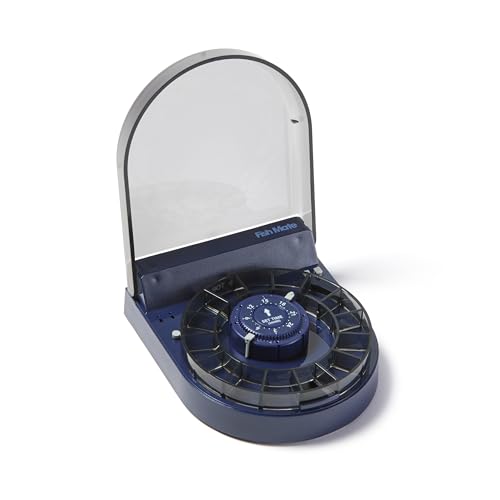
Fish Mate F14 Aquarium Fish Feeder
A 14 compartment drum rotates to release pre-measured food on a timer. Owners set 12, 24, or 48 hour intervals with a dial on the housing. Based on specifications, the drum clips directly onto most tank rims without extra hardware.
Pros
- Fourteen compartments cover roughly two weeks on the 24 hour setting
- Timer dial skips digital programming entirely
- Clip-on bracket fits a wide range of rim thicknesses
Cons
- Flake food can clump inside compartments in humid rooms
- Battery compartment sits exposed to splashes near the tank

EHEIM Twin Automatic Feeder
Two separate feed wheels run on independent timers in this model. Owners dial in a different portion size per chamber, useful for tanks holding fish with different appetites. According to the listing, the housing snaps onto glass rims from inside or outside.
Pros
- Two independent chambers allow different food types or portions
- Portion slider adjusts dispensed amount without swapping parts
- Snap-on mount fits rim thicknesses from thin to standard glass
Cons
- Two AA batteries drain faster than single chamber feeders
- Reloading both chambers takes longer than single hopper models

Zoo Med Automatic Fish Feeder
A rotating carousel dispenses food at set times through an adjustable slide. Portions scale from light to heavy with a simple lever move. Based on specifications, a single AA battery powers extended use between changes.
Pros
- Lower cost than most dual chamber or LCD feeders
- Slide adjustment simplifies portion changes
- Single AA battery keeps replacement costs down
Cons
- Carousel holds less food than larger drum style feeders
- Fine flake food can jam the dispensing slot

Hydor Smart & Easy Automatic Fish Feeder
An LCD screen sets up to four feeding times daily on this model. Owners dial in exact portion amounts rather than relying on a fixed compartment size. According to the listing, the display confirms each program setting before it locks in.
Pros
- LCD screen shows the current program at a glance
- Four daily feedings suit fish needing smaller, frequent meals
- Digital portion dial offers finer control than mechanical slides
Cons
- LCD screens draw more battery power than dial timers
- Menu navigation takes longer to learn than single dial feeders

API Pond Vacation Fish Feeding Block
This slow-dissolving block releases food gradually over several days. No wiring or batteries are involved, which suits short trips where setting up a feeder is not worth the effort. Owners report it performs best in smaller tanks, not large ponds, despite the pond branding.
Pros
- No batteries or programming needed before leaving
- Simple to place and remove without tools
- Good backup option alongside an automatic feeder
Cons
- Oversized blocks for the tank size can cloud water
- Not a substitute for daily feeding on trips longer than a few days
Tetra Vacation Slow Release Fish Food Block
This gel block releases food slowly as it dissolves in the tank. It requires no equipment beyond dropping the block in before departure. Based on specifications, matching block size to tank volume matters more than trip length for keeping water clear.
Pros
- Lowest cost entry point into portable fish feeding
- No setup, batteries, or mounting hardware required
- Works as an emergency backup for feeder failures
Cons
- Oversized blocks raise ammonia levels in smaller tanks
- Portions cannot be adjusted once the block is placed

Fish Mate P7 Pond Fish Feeder
This model adapts Fish Mate’s rotating drum design for outdoor ponds. A weatherproof housing protects the battery and timer from rain and splashing. Seven compartments cover about a week of daily feedings on the 24 hour setting.
Pros
- Weatherproof housing withstands outdoor exposure to rain
- Seven compartments handle roughly a week between refills
- Mounting design suits open pond edges rather than glass rims
Cons
- Fewer compartments than the F14 mean more frequent refills
- Not intended for indoor aquarium rims despite the similar mechanism
Side by side
| # | Model | Feeding Compartments | Best for | Score | Price |
|---|---|---|---|---|---|
| 1 | Fish Mate F14 Aquarium Fish Feeder | 14 | Best overall | 9.4 | Check price |
| 2 | EHEIM Twin Automatic Feeder | 2 independent chambers | Best for precise portion control | 9.1 | Check price |
| 3 | Zoo Med Automatic Fish Feeder | Rotating carousel, multiple compartments | Best value | 8.8 | Check price |
| 4 | Hydor Smart & Easy Automatic Fish Feeder | LCD screen | Best for programmable scheduling | 8.6 | Check price |
| 5 | API Pond Vacation Fish Feeding Block | Slow-dissolving block | Best for short weekend trips | 8.4 | Check price |
| 6 | Tetra Vacation Slow Release Fish Food Block | Slow release gel block | Best budget and simplest option | 8.2 | Check price |
| 7 | Fish Mate P7 Pond Fish Feeder | 7 | Best for outdoor ponds | 8.0 | Check price |
Common questions
How long can fish go without food?
Most healthy adult fish tolerate 7 to 10 days without feeding, since they slow their metabolism. Younger or smaller fish handle shorter gaps, closer to 3 to 5 days. A feeder or food block still reduces stress on fish and owners during any trip beyond a few days.
Do vacation fish food blocks cloud the water?
They can, especially when a block is sized for a larger tank than the one it sits in. Manufacturers list a tank size range on packaging, so matching that guidance matters. Removing uneaten block pieces after the trip also helps water clarity.
How do automatic fish feeders work?
A timer triggers a rotating drum or wheel to release one measured portion at set intervals. Battery-powered units like the Fish Mate F14 use a dial to set 12, 24, or 48 hour cycles. Digital models such as the Hydor Smart & Easy allow multiple programmed times per day instead of a fixed interval.
How many days will an automatic feeder last?
Duration depends on compartment count and feeding frequency, not just battery life. A 14 compartment feeder set to once daily lasts about two weeks before needing a refill. Feeding twice daily cuts that runtime roughly in half.
Are fish feeding blocks safe for every fish?
Most blocks work fine for common community fish, but some species are sensitive to ingredients in gel-based blocks. Bottom feeders and slow eaters may miss out if faster fish consume the block first. Checking the label against a tank’s specific fish is worth the extra minute.
Can an automatic feeder work on a pond?
Standard aquarium feeders are not built for outdoor exposure and can short out in rain. Pond-specific models like the Fish Mate P7 use weatherproof housings designed for that environment. Mounting on an open pond edge also differs from clipping onto a glass aquarium rim.
What happens if an automatic feeder jams?
A jam usually means fish get no food until the next check-in, which can span days on a long trip. Clumped flake food in humid rooms is a common cause of jamming. Pairing a feeder with a backup food block reduces the risk of a total miss.
How much food should a feeder dispense per feeding?
A portion small enough for fish to finish within a few minutes is the general target. Overfilling a compartment or block leaves leftover food fouling the water. Adjustable models let owners scale portions down for smaller tanks or fewer fish.
Our take
Fish Mate F14 earns the top spot for most aquarium owners, thanks to its 14 compartment capacity and flexible timer intervals that suit trips from a few days to two weeks. Owners wanting finer portion control across two feeding times should look at the EHEIM Twin instead. Anyone leaving for just a weekend, or wanting a no-battery backup, is better served by the Tetra Vacation Slow Release Fish Food Block.