Portable Battery Testers for Home Garages Worth Buying
For most home garages, the FOXWELL BT100 Plus is the top pick. It delivers professional grade diagnostics at a fair price. It tests 6V and 12V batteries, plus cranking and charging systems. Its clear screen and simple controls make it approachable for beginners. The main limitation is that it lacks a built in printer, but that is rarely needed at home.
A dead battery is a common frustration for car owners. A portable battery tester helps you diagnose the problem before you buy a replacement. It can save you time and money by identifying whether the battery or the alternator is at fault.
Modern battery testers are compact and easy to use. They work with various battery types, including standard flooded, AGM, and lithium. Some also test the charging system and starter motor. This guide compares the best portable models for home garages.
Before you buy
What we recommend

FOXWELL BT100 Plus Car Battery Tester
The FOXWELL BT100 Plus is a versatile tester that handles 6V and 12V batteries. It supports standard flooded, AGM, spiral wound, and gel batteries. Owners appreciate its accurate readings and straightforward interface. It also tests cranking and charging systems. The device is compact and fits easily in a glove box.
Pros
- Tests both 6V and 12V batteries
- Simple three button operation
- Includes alternator and starter tests
Cons
- No wireless connectivity
- Lacks a built in printer

Ancel BA101 Professional Battery Load Tester
The Ancel BA101 is an affordable option that still delivers reliable results. It tests 12V batteries with capacities from 100 to 2000 CCA. It also checks the alternator and starter. The large backlit screen shows results clearly, even in dim garages. Many owners find it easy to navigate with the two button interface.
Pros
- Very affordable
- Clear display
- Simple two button operation
Cons
- No 6V testing
- Limited to 12V batteries

Schumacher BT-100 Digital Battery Tester
The Schumacher BT-100 is a straightforward load tester that has been a garage staple for years. It displays battery voltage and condition on an analog meter. It works with 6V and 12V batteries, both conventional and AGM. Owners like its rugged build and no nonsense operation. It does not test charging systems, but for basic battery checks it is hard to beat.
Pros
- Durable construction
- Tests 6V and 12V
- No complex settings
Cons
- No charging system test
- Analog display less precise

Motopower MP0515A 12V Car Battery Tester
The Motopower MP0515A is a compact tester that easily fits in a pocket. It runs on a 9V battery, so you can test batteries anywhere without external power. It works with 12V batteries and shows voltage and estimated CCA. Owners appreciate its low price and simple operation. It is not as advanced as others, but it is perfect for quick checks.
Pros
- Ultra portable design
- No need for AC power
- Very easy to use
Cons
- Only 12V batteries
- No cranking or charging tests

Quicklynks Battery Tester 12V 1000-2000 CCA Load Tester
The Quicklynks tester is built for batteries with high CCA ratings, up to 2000. It tests 12V batteries and also functions as a load tester. It features a large display that is easy to read. The included carrying case protects it in a garage environment. Owners report accurate readings for trucks and SUVs.
Pros
- Handles high CCA batteries
- Includes a protective case
- Accurate for large vehicles
Cons
- No 6V support
- More expensive than basic models
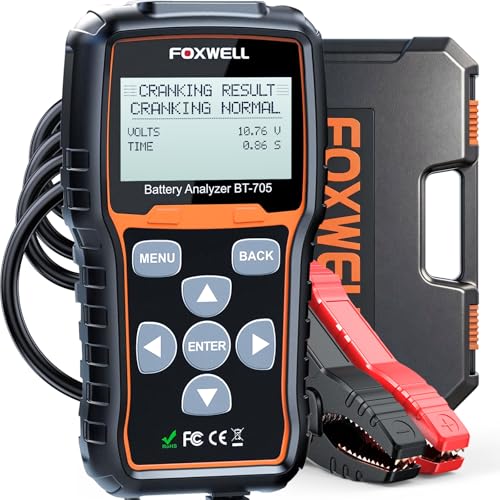
FOXWELL BT705 Car Battery Tester 12V
The FOXWELL BT705 is a step up from the BT100 Plus. It adds Bluetooth connectivity and a smartphone app. You can view detailed reports and history on your phone. It tests 12V batteries and supports AGM, gel, and EFB types. It also provides a comprehensive system test including starter and alternator. The app is intuitive and adds convenience.
Pros
- Bluetooth app for detailed data
- Tests multiple battery types
- Includes system test
Cons
- More expensive
- Requires app to use full features

AstroAI Battery and Alternator Tester Mini
The AstroAI Mini is a simple device that plugs into your car’s 12V socket. It shows battery voltage and alternator output in real time. It is not a load tester, but it is excellent for monitoring system health. Owners find it handy for diagnosing charging problems. Its small size makes it a great addition to any garage.
Pros
- Very affordable
- Instant voltage readings
- Monitors alternator output
Cons
- No load testing capability
- Only works when plugged into vehicle
How they stack up
| # | Model | Voltage support | Best for | Score | Price |
|---|---|---|---|---|---|
| 1 | FOXWELL BT100 Plus Car Battery Tester | 6V and 12V | Overall best for most home garages | 9.4 | Check price |
| 2 | Ancel BA101 Professional Battery Load Tester | 12V | Budget friendly for basic needs | 8.8 | Check price |
| 3 | Schumacher BT-100 Digital Battery Tester | 6V and 12V | Simple and reliable for standard cars | 8.6 | Check price |
| 4 | Motopower MP0515A 12V Car Battery Tester | 12V | Compact and travel friendly | 8.4 | Check price |
| 5 | Quicklynks Battery Tester 12V 1000-2000 CCA Load Tester | 12V | Heavy duty testing and larger batteries | 8.7 | Check price |
| 6 | FOXWELL BT705 Car Battery Tester 12V | 12V | Advanced diagnostics with app integration | 9.0 | Check price |
| 7 | AstroAI Battery and Alternator Tester Mini | 12V socket | Quick voltage checks and alternator output | 8.0 | Check price |
Questions worth asking
Can a portable battery tester test a dead battery?
Most portable battery testers require a minimum voltage to perform a test. If the battery is completely dead, the tester may not be able to give a reading. Some testers have a ‘dead battery’ mode that can assess if the battery can accept a charge. For best results, charge the battery fully before testing.
What is CCA and why is it important?
CCA stands for Cold Cranking Amps. It measures a battery’s ability to start an engine in cold temperatures. A higher CCA rating means more starting power. When you test a battery, the tester compares the measured CCA to the rated CCA to determine health. This is a key indicator of battery condition.
How often should I test my car battery?
It is a good idea to test your battery twice a year, especially before winter and summer. Extreme temperatures can affect battery performance. If you notice slow cranking or dimming lights, test the battery immediately. Regular testing can help you avoid unexpected breakdowns.
Are all battery testers compatible with AGM batteries?
No, not all testers support AGM (Absorbent Glass Mat) batteries. AGM batteries have different characteristics than traditional flooded batteries. When buying a tester, check the specifications to ensure it lists AGM as a supported type. Many modern testers do support AGM, but some budget models do not.
Can a battery tester diagnose alternator problems?
Yes, many battery testers also test the charging system. They measure the alternator output while the engine is running. If the voltage is too low or too high, the tester will indicate a problem. This feature is valuable for a complete electrical system check.
What is the difference between a load tester and a conductance tester?
A load tester applies a heavy load to the battery and measures how the voltage drops. This mimics the strain of starting. A conductance tester uses electronic signals to measure the battery’s ability to conduct current. Conductance testers are faster and do not require charging the battery first, making them more popular for portable use.
Do I need a battery tester if I have a multimeter?
A multimeter can measure voltage, but it cannot assess the battery’s condition under load. A battery that shows 12.6 volts when idle may still be weak when starting. A dedicated battery tester applies a load or uses conductance to give a more accurate health reading. For serious diagnostics, a battery tester is recommended.
Can I test a lithium battery with a standard car battery tester?
Most standard car battery testers are not designed for lithium batteries. Lithium batteries have different voltage and charging profiles. Some advanced testers have a lithium setting. Check the product specifications to see if lithium is supported. If not, using a standard tester could give inaccurate results or damage the battery.
Are expensive battery testers worth the extra cost?
Expensive testers often offer more features, such as Bluetooth connectivity, larger displays, and support for more battery types. They may also have higher accuracy and build quality. For a home garage, a mid range model usually provides all the necessary functions. Choose one that fits your budget and the types of vehicles you maintain.
Our pick
For the best combination of features, accuracy, and value, the FOXWELL BT100 Plus is our clear recommendation. It covers all essential tests and supports both 6V and 12V batteries. If you need Bluetooth and app integration, the FOXWELL BT705 is a worthy upgrade. For a budget option, the Ancel BA101 offers dependable performance without breaking the bank.