Portable Polishers That Deliver Showroom Shine
For most professionals and serious enthusiasts, the Griot’s Garage G9 is the best portable polisher. It offers a smooth, powerful 900-watt motor with a 9mm orbit, perfect for paint correction and finishing. Its main limitation is the lack of a built-in speed dial on the tool; speed is controlled via the trigger, which takes some getting used to.
Achieving a flawless, mirror-like finish requires more than elbow grease. A quality portable polisher can make the difference between a professional result and unsightly swirl marks.
We analyzed specifications and owner feedback to bring you a curated list of the best portable professional car polishing machines. These tools balance power, control, and portability for both experts and dedicated hobbyists.
What we recommend

Griot’s Garage G9 Random Orbital Polisher
The Griot’s G9 is a favorite among detailers for its powerful 900-watt motor, low vibration, and excellent dust control. It features a 9mm orbit for effective correction and finishing. Owners report it runs smoothly even at low speeds, making it forgiving for beginners.
Pros
- Powerful and smooth operation
- Low vibration reduces fatigue
- Excellent dust collection
Cons
- Speed control via trigger not dial
- No carrying case included

ShineMate Shine-ORB651 Polisher
The ShineMate ORB651 offers a 7.5-amp motor and a 5-inch backing plate at an affordable price. It features a 12mm orbit for aggressive cutting. Users find it lightweight and easy to control, though it is a bit louder than premium models.
Pros
- Great value for money
- Lightweight and maneuverable
- Effective correction power
Cons
- Noisy operation
- Vibration noticeable at high speeds

DeWalt DWP849X Variable Speed Polisher
For professionals needing aggressive cutting, the DeWalt DWP849X is a powerful 10-amp rotary polisher with variable speed control from 0 to 3500 RPM. It features a spiral bevel gear design for quiet operation. However, it requires skill to avoid burning paint.
Pros
- High torque for heavy correction
- Durable construction
- Variable speed trigger
Cons
- Steep learning curve
- Not for beginners due to paint burn risk

Rupes BigFoot LHR15 Mark III
The Rupes LHR15 Mark III is a benchmark in the detailing world. It has a 15mm orbit for fast correction and a powerful brushless motor that runs cool. The ergonomic design reduces fatigue, and owners report minimal vibration. It is pricey but delivers exceptional results.
Pros
- Fast material removal
- Low vibration and noise
- Top-tier build quality
Cons
- High price
- Large orbit may be too aggressive for some finishes

Porter-Cable 7424XP Random Orbit Polisher
The Porter-Cable 7424XP is a legendary polisher known for its reliability and ease of use. It has a 6-amp motor and 5-inch backing plate, with a 8mm orbit. Many users have owned theirs for years without issues. It is not the most powerful, but it gets the job done for light to medium correction.
Pros
- Proven durable design
- Easy to control
- Great for beginners
Cons
- Less power than newer models
- No dust collection shroud

Maxshine M314S Dual Action Polisher
The Maxshine M314S offers a 12mm orbit and a 7-amp motor at a wallet-friendly price. It is lightweight and includes a durable carrying case. Owners report smooth operation and good paint correction ability, though some find it slightly less refined than premium brands.
Pros
- Affordable with good features
- Includes carrying case
- Effective dual action
Cons
- Plastic housing feels less robust
- Slightly noisy
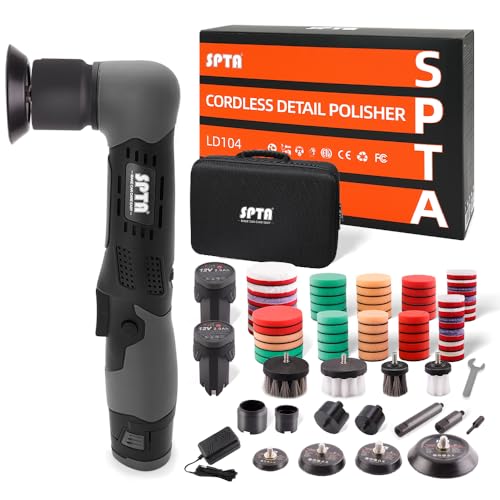
TECCPO 12V Cordless Polisher
The TECCPO cordless polisher offers true portability with a 12V battery that delivers up to 40 minutes of runtime. It is ideal for small jobs and tight spaces. Owners appreciate the convenience, but note it lacks power for heavy correction and the battery takes time to charge.
Pros
- Cordless convenience
- Lightweight for one-hand use
- Good for spot detailing
Cons
- Limited runtime
- Not for full car polishing
The lineup, side by side
| # | Model | Motor | Best for | Score | Price |
|---|---|---|---|---|---|
| 1 | Griot’s Garage G9 Random Orbital Polisher | 900-watt | Best overall for balanced power and smooth operation | 9.4 | Check price |
| 2 | ShineMate Shine-ORB651 Polisher | 7.5-amp | Best budget option for beginners | 8.7 | Check price |
| 3 | DeWalt DWP849X Variable Speed Polisher | 10-amp | Best for heavy-duty rotary polishing | 9.0 | Check price |
| 4 | Rupes BigFoot LHR15 Mark III | Brushless | Best premium professional choice | 9.3 | Check price |
| 5 | Porter-Cable 7424XP Random Orbit Polisher | 6-amp | Best classic reliable workhorse | 8.9 | Check price |
| 6 | Maxshine M314S Dual Action Polisher | 7-amp | Best for price-to-performance ratio | 8.8 | Check price |
| 7 | TECCPO 12V Cordless Polisher | 12V | Best cordless for portability | 8.0 | Check price |
Before you buy
Good to know
What is the difference between a rotary and a dual action polisher?
A rotary polisher spins the pad in a single direction, which allows for aggressive paint correction but can cause swirl marks if not used properly. A dual action polisher oscillates the pad in a random pattern, reducing the risk of holograms and swirls, making it safer for beginners and for removing fine scratches and applying wax.
Can a portable polisher be used for applying wax or sealant?
Yes, almost any polisher can be used to apply wax or sealant. Use a soft finishing pad and set the speed to a low setting. This method ensures an even, thin layer and saves time compared to hand application.
How do I choose the right pad for my polisher?
Select pads based on the job. Cutting pads are firm and used for heavy defect removal; polishing pads are medium for light compounding; finishing pads are soft for applying sealants or final polish. Always match the pad size to your backing plate.
Is it safe to use a polisher on a car with clear coat?
Yes, but you must use a dual action or random orbital polisher with moderate pressure and proper technique. Rotary polishers can burn through clear coat if left in one spot. Always test on an inconspicuous area first.
What speed should I use for polishing?
For dual action polishers, use speed 3-4 for polishing and 5-6 for cutting. For rotary polishers, start at 1000-1500 RPM and increase as needed. Always follow the product instructions for polish and pad compatibility.
How long does it take to polish a car with a portable polisher?
For a standard sedan, a full polish can take 2-4 hours depending on the condition of the paint and the type of polisher. Using a larger orbit DA can speed up the process. Practice improves efficiency.
Do I need to use a polishing compound with a polisher?
Yes, polishing compounds contain abrasives that remove imperfections. Choose a compound based on the severity of defects. For light swirls, a fine polish is enough; for deep scratches, a cutting compound may be required.
Can I use my polisher on other surfaces like glass or metal?
Yes, with appropriate pads and compounds, you can polish glass, metal, and even plastic headlights. Ensure you use the correct pad and polish for the surface to avoid damage.
What safety equipment should I wear when polishing?
Wear safety glasses to protect from splashes, a dust mask to avoid inhaling polish dust, and gloves to keep your hands clean. If using a rotary polisher, avoid loose clothing that could get caught.
How do I prevent swirl marks when polishing?
Use a dual action or random orbital polisher with a soft foam pad. Keep the pad flat and move it slowly in overlapping passes. Always clean the pad frequently and use a high-quality polish. Avoid excessive pressure.
The verdict
For most users, the Griot’s Garage G9 is the best portable professional car polishing machine because it offers a rare mix of power, smoothness, and reliability at a reasonable price. If you need maximum cutting ability and have experience, the Rupes BigFoot LHR15 is worth the investment. For those on a budget, the ShineMate ORB651 provides solid performance without breaking the bank.



