Which Power Rack Actually Fits Your Garage Gym
The Titan Fitness T-3 Series balances steel gauge, capacity, and attachment support for most home gyms. Budget shoppers should check the Body-Solid GPR378, while lifters chasing heavy singles get more from the Rep Fitness PR-5000’s full westside spacing and 1,000-pound rating.
Steel gauge, rated weight capacity, and floor space demands decide most of what makes a power rack good for a home gym. Titan Fitness T-3 Series, Body-Solid GPR378, and Rep Fitness PR-5000 lead this list for different reasons, from all-around build quality to raw capacity. Folding and short-height options round out the field for garages with tighter dimensions.
A westside-spaced, 11-gauge frame at one price point can outperform a heavier-looking cage with wider hole spacing, which makes side by side shopping tricky. We compared publicly listed steel gauge, capacity ratings, footprint, and attachment compatibility, alongside owner feedback patterns, rather than marketing claims.
How to pick the right one
What does a power rack actually do for a home gym Four uprights, safety pins, and a pull-up bar surround the lifter, unlike a squat stand’s two-post design. Safety arms or straps catch a failed rep at any bar height, which matters most for solo training. Most home models also accept lat pulldown, dip, and cable attachments, turning one frame into a multi-station gym.
Weight capacity and steel gauge, what the numbers mean Steel gauge uses a lower number for thicker tubing, so 11-gauge resists flex better than 12-gauge under heavy bar loads. Capacity ratings across this list range from 800 to 1,000 pounds, covering bar weight plus spotter arm stress. Powerlifters chasing 500-plus pound squats should lean toward the 1,000-pound rated frames.
Why westside hole spacing speeds up training Gaps tighten to 1 inch near bench and shoulder height with westside spacing, letting lifters fine-tune pin position without an inch of slack. Standard 2-inch spacing works fine for squats and rack pulls, where exact bar height matters less. Some racks add westside spacing only near the bench zone, saving cost while still solving the main pain point.
Footprint, ceiling height, and folding racks for tight garages Roughly 45 to 50 inches of both width and depth, plus 24 inches of clearance behind for pull-ups, fits a typical power rack. Ceilings under 84 inches often rule out full-height cages, making short racks or folding models the practical choice. Folding wall-mounted racks reclaim floor space entirely when not in use, at the cost of needing a reinforced wall stud for mounting.
The shortlist, ranked

Titan Fitness T-3 Series Power Rack
11-gauge steel uprights carry a 1,000-pound rated capacity, giving room to grow as strength increases. Westside-style hole spacing near the bench and shoulder zones speeds up plate-loaded transitions. Dual pull-up bars plus compatibility with lat pulldown and dip attachments turn one frame into a genuine home gym hub.
Pros
- Handles heavy squat and bench loads without flex
- Westside spacing speeds up pin adjustments
- Accepts lat pulldown, dip and cable attachments
Cons
- Larger footprint than compact racks
- Assembly takes longer than smaller cages

Body-Solid GPR378 Power Rack
12-gauge steel rated to 800 pounds covers most home lifters without commercial pricing. Standard 2-inch hole spacing keeps the frame simple to adjust between exercises. A single fixed pull-up bar and integrated weight storage posts round out a compact, practical setup.
Pros
- Built-in weight plate storage pegs
- Solid capacity for the price point
- Straightforward bolt-together assembly
Cons
- No westside spacing near bench zone
- Single pull-up bar grip position only

Rep Fitness PR-5000 Power Rack
This rack matches premium commercial rigs with the same 11-gauge steel and 1,000-pound capacity, built for lifters chasing heavy singles. Westside hole spacing runs the full length of the uprights, not just the bench zone. Optional monolift arms and a wider stance add stability under maximal loads.
Pros
- Full-length westside spacing for any bar height
- Optional monolift arms for heavy squats
- Wider footprint adds stability at max loads
Cons
- Takes up more garage floor space
- Monolift arms sold as separate add-on

PRx Performance Profile Squat Rack
Folding flat against a wall shrinks this rack’s working depth to about 4 inches when not in use. It still carries a 1,000-pound rated capacity thanks to 11-gauge steel construction. Owners report it as the go-to pick for shared garages or multi-use rooms.
Pros
- Folds flat to reclaim garage floor space
- Rated capacity matches full-size racks
- Wall-mounted design frees up parking or storage room
Cons
- Requires solid wall stud mounting
- No standard pull-up bar included on base model
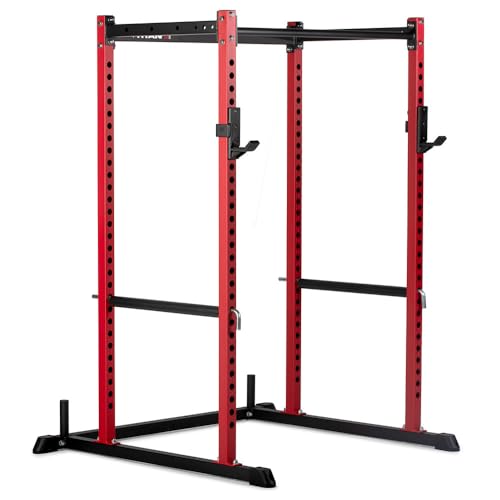
Titan Fitness T-2 Series Short Power Rack
Standing about 80 inches tall, this rack clears garage rafters and door tracks that stop full-height cages cold. The same 11-gauge steel and 1,000-pound capacity carry over from Titan’s taller models. A single pull-up bar and westside spacing near the bench zone round out the shortened frame.
Pros
- Clears low garage ceilings and door tracks
- Same capacity rating as full-height versions
- Westside spacing at common bench heights
Cons
- Shorter frame limits pull-up bar clearance for taller users
- Fewer hole positions overall than tall models

Valor Fitness BD-7 Power Rack
A roughly 47 by 47 inch footprint lets this rack fit corners and small garage bays other cages can’t. 12-gauge steel still holds an 800-pound rated capacity, plenty for most strength programs. Standard hole spacing and a single pull-up bar keep the design simple for first-time rack owners.
Pros
- Compact footprint suits small garage bays
- Lower cost of entry for first-time buyers
- Simple standard hole spacing throughout
Cons
- No westside spacing for fast pin changes
- Less clearance for spotter arms at full depth
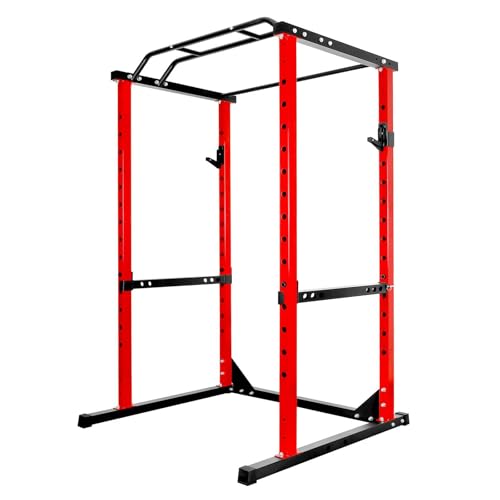
Fitness Reality X-Class Olympic Power Cage
A 12-gauge steel frame rated to 800 pounds brings power cage training to tighter budgets. Standard 2-inch hole spacing and a single multi-grip pull-up bar cover squats, bench, and rack pulls. Weight storage pegs come included for plate organization, according to the listing.
Pros
- Lowest entry point among rated power cages here
- Multi-grip pull-up bar covers wide and neutral grips
- Weight storage pegs included
Cons
- 800 lb capacity caps out below premium racks
- No westside spacing near bench zone
How they stack up
| # | Model | Steel gauge | Best for | Score | Price |
|---|---|---|---|---|---|
| 1 | Titan Fitness T-3 Series Power Rack | 11-gauge | Best overall | 9.4 | Check price |
| 2 | Body-Solid GPR378 Power Rack | 12-gauge | Best value | 9.1 | Check price |
| 3 | Rep Fitness PR-5000 Power Rack | 11-gauge | Best for heavy lifters | 8.8 | Check price |
| 4 | PRx Performance Profile Squat Rack | 11-gauge | Best folding rack | 8.5 | Check price |
| 5 | Titan Fitness T-2 Series Short Power Rack | 11-gauge | Best for low garage ceilings | 8.3 | Check price |
| 6 | Valor Fitness BD-7 Power Rack | 12-gauge | Best for small garage gyms | 8.1 | Check price |
| 7 | Fitness Reality X-Class Olympic Power Cage | 12-gauge | Best budget | 8.0 | Check price |
Questions worth asking
What is the difference between a power rack and a squat stand?
A power rack has four connected uprights forming a full cage, with safety pins or arms on all sides. A squat stand uses two independent posts, offering a smaller footprint but less catch protection on a failed rep.
How much weight capacity do I need for a home gym power rack?
An 800-pound rated capacity covers most lifters, including bar weight, plates, and spotter arm stress. Lifters working toward 400-plus pound squats or deadlifts should choose a 1,000-pound rated, 11-gauge frame for margin.
What is westside hole spacing and does it matter?
Westside spacing tightens hole gaps to 1 inch near bench and shoulder height instead of the standard 2 inches. It matters most for benching, where a half-inch of slack can change bar path comfort.
Can a power rack fit in a garage with a low ceiling?
Short power racks around 80 inches tall are built for garages with low rafters or door tracks. Folding wall-mounted racks avoid the ceiling issue entirely, since they store flat against the wall.
Are folding power racks as sturdy as fixed racks?
Folding models like the PRx Performance Profile Squat Rack use the same 11-gauge steel and can carry the same 1,000-pound rating as fixed cages. Sturdiness depends more on wall stud mounting quality than on the folding mechanism itself.
How much floor space does a power rack need?
Fixed racks in this comparison need about 45 to 50 inches of width and depth, plus room behind for pull-ups. Folding racks shrink to roughly 4 inches of depth when stored against a wall.
Do power racks come with a pull-up bar?
Most fixed power racks, including every full-size model here, include at least one pull-up bar as a standard crossmember. Folding wall-mounted racks sometimes skip the bar on base configurations to keep the folded profile thin.
Is 11-gauge or 12-gauge steel better for a power rack?
11-gauge steel is thicker and resists flex better under heavy squat and bench loads, common on 1,000-pound rated racks. 12-gauge steel costs less and still holds 800 pounds comfortably for most recreational lifters.
Which power rack is best for a small garage gym?
Compact frames like the Valor Fitness BD-7 fit roughly 47 by 47 inches, small enough for corners and tight garage bays while still holding an 800-pound rated capacity.
Our pick
Titan Fitness T-3 Series and Rep Fitness PR-5000 suit lifters who want long-term capacity headroom, while Body-Solid GPR378 and Fitness Reality X-Class cover tighter budgets. Low ceilings or shared floor space favor the Titan Fitness T-2 Series Short Power Rack or the PRx Performance Profile Squat Rack’s folding design.

