Precision Disc Sanders Built for Fine Work
For most precision work, the WEN 6321 stands out with its 12-inch cast iron table and adjustable miter gauge, offering accurate angle setups at a friendly price. Its main limitation is the 1/3 HP motor, which can bog down on heavy stock removal.
Precision disc sanders are essential for achieving flat, smooth surfaces and exact angles on small parts. Unlike belt sanders, they offer greater control and are ideal for finishing work.
We compared seven popular models, focusing on features that matter for precision: table stability, miter gauge accuracy, and vibration control. This roundup helps you pick a sander that matches your shop’s needs.
Our top picks

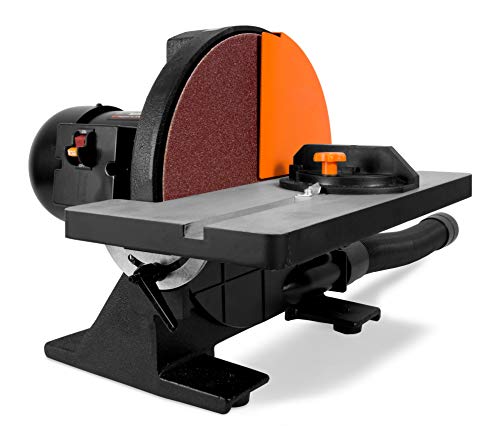
WEN 6321 12-Inch Variable Speed Disc Sander
The WEN 6321 offers a large 12-inch cast iron table and a variable speed dial (750 to 3450 RPM) for precise sanding. Its adjustable miter gauge and beveling table allow accurate angle work. Owners report smooth operation and good dust collection with the included dust port.
Pros
- Cast iron table minimizes vibration
- Variable speed for different materials
- Accurate miter gauge
Cons
- Motor may stall on heavy pressure
- Dust bag is small

POWERTEC 71006 6-Inch Disc Sander
A compact benchtop sander with a 6-inch disc, perfect for small workshops. It runs at a fixed 3450 RPM, which is suitable for most wood and soft metals. The aluminum table tilts 0-45 degrees, and the miter gauge has positive stops at common angles.
Pros
- Small footprint
- Affordable
- Easy to adjust table
Cons
- No variable speed
- Limited power for heavy sanding

Delta 31-196 12-Inch Disc Sander
Delta’s 12-inch sander features a powerful 3/4 HP motor and a large cast iron table that tilts both directions. It includes a miter gauge with cam-lock stops and a precision-fitted disc for minimal runout. Users appreciate its smooth operation and low vibration.
Pros
- High torque motor
- Table tilts both ways
- Minimal vibration
Cons
- Heavier and larger footprint
- More expensive

Jet JDS-12 12-Inch Disc Sander
The Jet JDS-12 is engineered for accuracy with a cast iron table, precision-ground miter gauge slots, and a quick-release miter gauge that locks at any angle. Its 1 HP motor provides consistent power, and the built-in dust collection keeps the workspace clean.
Pros
- Exceptional miter gauge accuracy
- Powerful motor
- Low vibration
Cons
- Premium price
- No variable speed
Shop Fox W1830 12-Inch Disc Sander
Shop Fox offers a 12-inch sander with a 1/2 HP motor and a cast iron table. It features a miter gauge with positive stops and an adjustable table angle. Users report it is well-built for the price and handles precision work effectively.
Pros
- Good build quality
- Accurate miter stops
- Reasonable price
Cons
- Motor could be stronger
- Dust collection could be better

Grizzly H7786 6-Inch Disc Sander
A simple, no-frills 6-inch sander from Grizzly, ideal for light sanding tasks. It has a 1/4 HP motor and a tilting table with a miter gauge. While not as robust as larger models, it suits hobbyists and small projects.
Pros
- Low cost
- Compact
- Simple to use
Cons
- Limited power
- Small table
Rikon 50-121 12-Inch Disc Sander
The Rikon 50-121 is known for its quiet motor and smooth running. It has a 12-inch disc and a 1/2 HP motor, with a tilting table and miter gauge. Owners appreciate the low noise level and accurate sanding capability.
Pros
- Quiet operation
- Smooth performance
- Good dust collection
Cons
- Miter gauge could be more precise
- Table locking knob is awkward
How to pick the right one
The lineup, side by side
| # | Model | Disc Size | Best for | Score | Price |
|---|---|---|---|---|---|
| 1 | WEN 6321 12-Inch Variable Speed Disc Sander | 12 inches | Best Overall | 9.4 | Check price |
| 2 | POWERTEC 71006 6-Inch Disc Sander | 6 inches | Best Compact Option | 8.7 | Check price |
| 3 | Delta 31-196 12-Inch Disc Sander | 12 inches | Best for Large Workpieces | 9.0 | Check price |
| 4 | Jet JDS-12 12-Inch Disc Sander | 12 inches | Best for Precision Angle Work | 9.2 | Check price |
| 5 | Shop Fox W1830 12-Inch Disc Sander | 12 inches | Best Value for Features | 8.9 | Check price |
| 6 | Grizzly H7786 6-Inch Disc Sander | 6 inches | Best for Hobbyists | 8.2 | Check price |
| 7 | Rikon 50-121 12-Inch Disc Sander | 12 inches | Best for Quiet Operation | 8.8 | Check price |
Questions worth asking
What is the difference between a disc sander and a belt sander?
A disc sander uses a circular abrasive disc rotating on a flat table, ideal for precise edge sanding and shaping small parts. A belt sander uses a continuous loop of abrasive, better for removing large amounts of material and sanding large surfaces. For precision work, disc sanders offer more control.
Can I use a disc sander for metal?
Yes, with the appropriate abrasive disc. Aluminum oxide discs work for both wood and metal, but for steel, you may need zirconia or ceramic discs. Lower speeds are recommended for metal to prevent heat buildup and disc wear.
What is the ideal speed for precision sanding?
Lower speeds (around 1500-2000 RPM) are better for precise control and preventing heat damage. Many sanders run at 1725 RPM, which is a good balance. Variable speed models allow you to adjust for different materials and finishes.
How do I maintain a disc sander?
Keep the table clean and free of dust. Regularly check the disc alignment and replace worn abrasive discs. Lubricate moving parts like the table tilt mechanism and miter gauge. Ensure the motor vents are clear of sawdust.
What safety gear should I use?
Always wear safety glasses to protect from flying debris. A dust mask or respirator is essential to avoid inhaling fine particles. Hearing protection may be needed for louder models. Avoid loose clothing and tie back long hair.
Can I sand curves on a disc sander?
Yes, the flat table allows you to sand straight edges and gentle curves. For inside curves, you may need to use the edge of the disc or a spindle sander. Practice on scrap to develop control.
What is the best abrasive grit for finishing?
For fine finishing, use higher grits like 220 or 320. Coarser grits (60-80) are for rapid stock removal. Many users keep multiple discs of different grits and change them as needed.
How do I achieve a square edge?
Ensure the table is square to the disc. Use a try square to check alignment. Sand gently with even pressure, moving the workpiece across the disc. A miter gauge helps maintain perpendicular edges.
What is runout and why does it matter?
Runout refers to the wobble of the disc as it spins. Excessive runout causes uneven sanding and poor accuracy. Precision sanders have minimal runout, often achieved through balanced discs and quality bearings.
Can I use a disc sander for sharpening tools?
Yes, with a fine-grit disc, you can sharpen chisels and plane blades. However, heat can ruin the temper of the steel, so use light pressure and keep the tool moving. Some prefer a slow-speed grinder for sharpening.
The bottom line
For most precision work, choose the WEN 6321 for its balance of features, accuracy, and value. If you need the highest precision for professional work, invest in the Jet JDS-12 for its superior miter gauge and motor. For small shops on a budget, the POWERTEC 71006 offers surprising capability.