Top Tier Motherboards for Serious Builds
The ASUS ROG Maximus Z790 Hero leads our list for Intel builders, offering a superb balance of connectivity, power delivery, and overclocking tools. For AMD enthusiasts, the ASUS ROG Crosshair X670E Hero is equally impressive, but it comes at a higher cost. The Gigabyte Z790 Aorus Master provides excellent value with its 10GbE networking, though its BIOS can be less intuitive for beginners.
Premium motherboards are the backbone of a high performance PC. They offer robust power delivery, advanced connectivity, and features that cheaper boards lack. Choosing the right one can be overwhelming with so many options available.
We looked at the specifications and community feedback for the top contenders. Our goal is to help you find a board that fits your needs without overspending. Below are our picks for the best premium motherboards on the market today.
How to choose
The shortlist, ranked
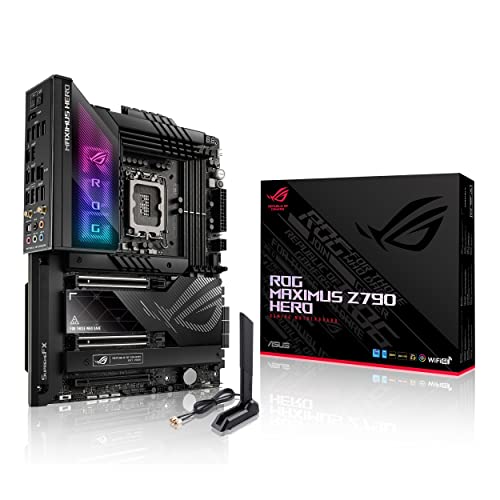
ASUS ROG Maximus Z790 Hero
A flagship Z790 board with a 20+1 power stage design, PCIe 5.0 support, and Wi-Fi 6E. It offers extensive USB ports and robust thermal solutions. Owners praise its stability during heavy overclocking sessions.
Pros
- Excellent VRM design for overclocking
- Plenty of USB 20Gbps ports
- Easy BIOS flashback and Q-Code display
Cons
- Expensive
- Only two PCIe x16 slots

ASUS ROG Crosshair X670E Hero
This X670E board features a 18+2 phase power solution, PCIe 5.0 for both GPU and M.2, and USB4 support. It includes robust cooling and a user friendly BIOS. Users note its premium build quality and high performance.
Pros
- Supports PCIe 5.0 on both M.2 and GPU
- Integrated USB4 ports
- Great for memory overclocking
Cons
- High price
- No 10GbE LAN

Gigabyte Z790 Aorus Master
A feature rich Z790 board with 10GbE LAN, Wi-Fi 6E, and a 20+1+2 phase VRM. It offers flexible PCIe 5.0 M.2 slots and a comprehensive thermal design. Owners value its future proof networking.
Pros
- 10GbE networking is a standout feature
- Excellent VRM cooling
- Dual PCIe 5.0 M.2 slots
Cons
- BIOS interface can be complex
- Large form factor may limit case choices

MSI MEG X670E ACE
The MEG X670E ACE comes with a 22+2 phase VRM, PCIe 5.0 support, and 10GbE LAN. It features a sleek design with a large heatsink array. Users report stable performance under demanding loads.
Pros
- Massive VRM for extreme overclocking
- 10GbE LAN included
- Tool free M.2 installation
Cons
- Very expensive
- Only one PCIe x16 slot

ASRock X670E Taichi Carrara
This X670E board features a marble style design with a 24+2 phase power system. It offers PCIe 5.0 support and includes a 5GbE LAN. Its striking appearance sets it apart from typical black boards.
Pros
- Unique marble design
- High end VRM
- Good selection of USB ports
Cons
- No 10GbE LAN
- Design may not appeal to everyone

Gigabyte B650E Aorus Master
A B650E board that still offers PCIe 5.0 for M.2 and GPU, 2.5GbE LAN, and a solid 16+2+2 phase VRM. It provides many premium features at a more accessible price point. Owners appreciate the balance of cost and performance.
Pros
- Lower cost than X670E boards
- PCIe 5.0 support
- Good audio solution
Cons
- No 10GbE LAN
- Fewer USB ports than flagships

MSI MEG Z790 Godlike
The Z790 Godlike is MSI’s top tier Intel board with a 26 phase VRM, 10GbE LAN, and a dynamic dashboard. It supports PCIe 5.0 and comes with a host of extras. This board is for those who want no compromises.
Pros
- Extreme power design
- Built in dynamic dashboard
- Includes Wi-Fi 6E and 10GbE
Cons
- Very high cost
- Overkill for most users
Side by side
| # | Model | Socket | Best for | Score | Price |
|---|---|---|---|---|---|
| 1 | ASUS ROG Maximus Z790 Hero | LGA 1700 | Intel Core i9 and i7 overclockers | 9.6 | Check price |
| 2 | ASUS ROG Crosshair X670E Hero | AM5 | AMD Ryzen 7000 series enthusiasts | 9.5 | Check price |
| 3 | Gigabyte Z790 Aorus Master | LGA 1700 | Power users needing high speed networking | 9.2 | Check price |
| 4 | MSI MEG X670E ACE | AM5 | AMD builders who want extreme power delivery | 9.1 | Check price |
| 5 | ASRock X670E Taichi Carrara | AM5 | Builders seeking a unique aesthetic | 8.8 | Check price |
| 6 | Gigabyte B650E Aorus Master | AM5 | AMD users who want premium features without the top price | 8.6 | Check price |
| 7 | MSI MEG Z790 Godlike | LGA 1700 | Enthusiasts who demand the absolute best | 9.0 | Check price |
Good to know
What is the difference between X670E and B650E?
X670E offers more PCIe lanes and USB ports, plus better power delivery. B650E still provides PCIe 5.0 but with fewer overall lanes. For most users, B650E is sufficient unless you need multiple high speed expansion cards.
Do premium motherboards improve performance?
They don’t increase FPS directly, but they allow for better overclocking and stability. This can lead to small performance gains. They also provide more connectivity options for storage and peripherals.
How much should I spend on a motherboard?
For a high end CPU, plan to spend between 300 and 600 dollars. Premium boards often cost more due to extra features. If you don’t need those features, a mid range board may be a better value.
Are premium motherboards worth it for gaming?
For gaming, a premium board may not give a noticeable FPS boost. However, they offer better audio and networking, which can improve your experience. They also support faster storage and more RAM.
What is PCIe 5.0 and do I need it?
PCIe 5.0 doubles the bandwidth of PCIe 4.0, allowing faster data transfer for GPUs and SSDs. Currently, few consumer devices use it, but it future proofs your system. If you plan to keep your motherboard for several years, it is a good investment.
Can I use a premium motherboard with a mid range CPU?
Yes, you can use a premium board with a mid range CPU. This allows you to upgrade your CPU later without changing the motherboard. However, you may not utilize all the features immediately.
What is the best brand for premium motherboards?
ASUS, MSI, Gigabyte, and ASRock all produce quality premium boards. Each has its own strengths in BIOS and features. It often comes down to personal preference and which board has the features you need.
How important is VRM quality?
VRM quality is crucial for stable power delivery, especially when overclocking. A good VRM runs cooler and provides cleaner power. Premium boards typically have higher phase counts and better components.
What is the difference between DDR4 and DDR5?
DDR5 is the newer standard with higher speeds and better bandwidth. It requires a compatible CPU and motherboard. Premium boards now support DDR5 exclusively, so you must choose accordingly.
Can I use an Intel CPU on an AMD motherboard?
No, Intel CPUs are only compatible with Intel chipsets and sockets. AMD CPUs require AMD boards. They are not interchangeable.
The bottom line
For most high end builders, the ASUS ROG Maximus Z790 Hero is the best choice for Intel, while the ASUS ROG Crosshair X670E Hero is the top pick for AMD. If you want to save money without sacrificing essential features, consider the Gigabyte B650E Aorus Master. It offers a premium experience at a lower cost.