Battery Testers Shops and Serious DIYers Rely On
The Autel MaxiBAS BT506 gives shops full battery and charging system diagnostics with cloud reporting. Topdon’s BT200 covers most of the same ground for less, and the FOXWELL BT705 stands out for its built-in thermal printer when customers need a paper report.
A battery can read a normal resting voltage and still fail to crank a cold engine, which is why voltage alone does not confirm battery health.
Conductance testing, printed reporting, and starter or alternator diagnostics separate basic testers from shop-grade ones, so we compared feature sets and accuracy claims across tools built for different use cases.
What we recommend

Autel MaxiBAS BT506
The BT506 tests battery health, starter draw, and alternator output in one tool, then syncs results to Autel’s cloud reporting app. Shops use it to generate customer-facing reports without a separate printer.
Pros
- Covers battery, starter, and alternator in one device
- Cloud reporting simplifies customer documentation
- Works across 6V and 12V systems
Cons
- Higher price than single-purpose testers
- App dependency for full reporting features

Topdon BT200 Battery and Electrical System Analyzer
Topdon’s BT200 covers conductance testing, cranking system checks, and charging system analysis on a color screen without needing a smartphone app. It targets shops that want BT506-style coverage at a lower entry price.
Pros
- Full battery and system testing without an app requirement
- Lower price than premium diagnostic testers
- Built-in screen shows results without a phone
Cons
- No built-in printer for paper reports
- Screen resolution is basic compared to premium tools
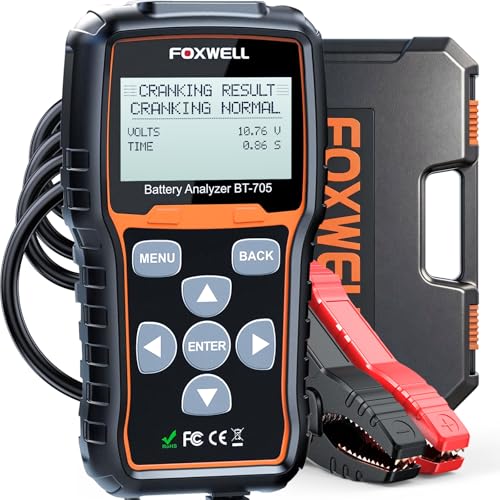
FOXWELL BT705 Battery Tester
FOXWELL added a thermal printer directly into the BT705, which lets a shop hand a customer a printed test result on the spot. It handles 12V and 24V systems, covering light trucks in addition to standard passenger vehicles.
Pros
- Built-in printer skips the need for a separate device
- Covers 24V systems for trucks and commercial vehicles
- Touchscreen simplifies menu navigation
Cons
- Printer paper is an ongoing consumable cost
- Bulkier than pocket-size testers

KONNWEI KW600 Digital Battery Tester
The KW600 sticks to core conductance testing and CCA verification without extra system diagnostics, keeping the price low for occasional home use. Its digital display shows voltage, CCA, and a pass or fail health rating directly.
Pros
- Low price for basic conductance testing
- Simple readout with clear pass or fail indication
- Compact size for glovebox storage
Cons
- No 24V or commercial vehicle support
- Lacks starter or alternator diagnostics

Schumacher BT100 12V Battery Load Tester
Unlike the conductance testers on this list, the BT100 applies an actual amp draw load to the battery, which some shops still prefer for verifying performance under real demand. It works well alongside a conductance tester rather than replacing one.
Pros
- Load testing verifies performance under real amp draw
- Simple analog gauge needs no calibration app
- Durable design suited to repeated shop use
Cons
- No digital data logging or printed reports
- Manual load testing takes longer than conductance testing

Ancel BA101 12V Automotive Battery Tester
The BA101 gives home mechanics a straightforward conductance test with CCA and voltage readouts on a bright LCD screen. It skips shop-oriented extras like printing or cloud sync, keeping the interface simple for occasional use.
Pros
- Simple interface suited to occasional home checks
- Backlit screen readable in a dim garage
- Affordable for a single-vehicle household
Cons
- Limited to 12V passenger vehicle batteries
- No advanced system diagnostics

Innova 3721 Battery and Charging System Monitor
Innova’s 3721 focuses heavily on charging system performance, flagging alternator ripple and voltage regulation issues that a basic battery test can miss. It suits drivers chasing intermittent electrical problems rather than a simple battery health check.
Pros
- Detects alternator ripple issues beyond basic voltage checks
- Clear icon-based status display
- Useful for diagnosing intermittent electrical faults
Cons
- Less thorough on pure battery conductance testing
- No printed or cloud reporting option
The lineup, side by side
| # | Model | Test method | Best for | Score | Price |
|---|---|---|---|---|---|
| 1 | Autel MaxiBAS BT506 | Conductance analysis | Best overall | 9.5 | Check price |
| 2 | Topdon BT200 Battery and Electrical System Analyzer | Conductance analysis | Best value | 9.1 | Check price |
| 3 | FOXWELL BT705 Battery Tester | Conductance analysis | Best for auto shops | 9.0 | Check price |
| 4 | KONNWEI KW600 Digital Battery Tester | Conductance analysis | Best budget | 8.3 | Check price |
| 5 | Schumacher BT100 12V Battery Load Tester | Carbon-pile load test | Best for load testing | 8.6 | Check price |
| 6 | Ancel BA101 12V Automotive Battery Tester | Conductance analysis | Best for DIY home use | 8.4 | Check price |
| 7 | Innova 3721 Battery and Charging System Monitor | Voltage and ripple analysis | Best for charging system diagnostics | 8.5 | Check price |
What matters most
Why conductance testing beats a simple voltmeter A voltmeter only shows resting voltage, which can look normal on a dying battery. Conductance testers measure internal plate condition, catching batteries that will fail under load despite a normal voltage reading.
When a load tester still makes sense Some shops keep a carbon-pile load tester like the Schumacher BT100 alongside a conductance tester to confirm real-world amp draw performance, especially on older or rebuilt batteries.
Shop features vs home features Printed reports, cloud sync, and 24V truck support matter for shops handing results to customers. Home users mostly need accurate CCA and voltage readings without the added cost of reporting hardware.
Diagnosing beyond the battery A dead battery is sometimes a symptom of a failing alternator or starter draw issue. Testers like the Autel MaxiBAS BT506 and Innova 3721 check the wider charging and cranking system, not just the battery itself.
Common questions
What is the difference between a conductance tester and a load tester?
A conductance tester analyzes the battery’s internal plates electronically, while a load tester applies an actual amp draw to see how the battery performs under real demand.
Can a battery tester also test the alternator?
Some models, including the Autel MaxiBAS BT506 and Innova 3721, include charging system tests that check alternator output and ripple in addition to battery health.
Do I need a professional battery tester for home use?
A basic conductance tester like the Ancel BA101 or KONNWEI KW600 covers most home needs; full diagnostic suites are more useful for shops testing many vehicles.
Why did my battery pass a voltage test but still fail to start the car?
Resting voltage does not reveal internal plate condition. A conductance or load test can catch a weak battery that a simple voltmeter reading misses.
Do battery testers work on 24V truck systems?
Not all of them. The FOXWELL BT705 and Autel MaxiBAS BT506 support 24V systems, while budget testers are usually limited to 12V passenger vehicles.
Is a printed battery test report necessary?
For shops handing results to customers, yes, it adds credibility. For personal use, an on-screen digital reading is enough.
How accurate are handheld conductance testers?
Reputable brands report accuracy comparable to shop-grade equipment when used correctly, though results can vary slightly by battery chemistry and age.
What CCA reading indicates a battery needs replacement?
This varies by battery rating, but most testers flag a result significantly below the battery’s rated CCA as a fail or replace recommendation.
The bottom line
The Autel MaxiBAS BT506 is the strongest overall pick for a shop that wants battery, starter, and alternator diagnostics in one connected tool. Budget-conscious shops should look at the Topdon BT200, which covers similar ground without the app dependency. Home mechanics who just need a reliable CCA and voltage check are better served by the simpler Ancel BA101 than by paying for shop-level reporting features they will not use.