Top Bookshelf Speakers for Critical Listening
For professional use, the KEF Q150 Meta stands out as the top pick, offering exceptional imaging and a neutral sound profile that suits mixing and critical listening. Its coaxial driver ensures a coherent soundstage, but it may require a subwoofer for deep bass extension.
Bookshelf speakers for professional use demand accuracy, detail, and reliability. Whether you are mixing tracks, editing video, or enjoying high-resolution audio, the right pair reveals nuances that consumer speakers miss.
This roundup covers a range of models from budget-friendly options to high-end monitors. We examined specifications and owner feedback to identify the strongest contenders for professional settings.
What to look for
The top picks, ranked

KEF Q150 Meta
The KEF Q150 Meta features a 5.25-inch Uni-Q coaxial driver that aligns tweeter and woofer for a point-source sound. Owners report precise stereo imaging and a smooth, detailed treble. The Meta material reduces distortion, making it a reliable choice for nearfield monitoring.
Pros
- Exceptional imaging and soundstage
- Low distortion due to Meta material
- Compact design fits any desk
Cons
- Bass extension limited without sub
- Requires quality amplification

Yamaha HS5
Yamaha HS5 powered studio monitors are a staple in project studios. They deliver a flat, uncolored frequency response that reveals flaws in a mix. The room control and high trim switches help tailor the sound to your space.
Pros
- Flat frequency response ideal for mixing
- Room control adjustments
- Trusted by audio professionals
Cons
- Bass response is thin without sub
- Hiss may be audible at high volume

Kali Audio LP-6 V2
The Kali Audio LP-6 V2 offers a 6.5-inch woofer and a coaxial midrange/tweeter design. It provides high SPL capability with minimal distortion, making it suitable for dynamic music production. The boundary EQ switches adapt to placement.
Pros
- Powerful output for larger rooms
- Coaxial design improves phase alignment
- Versatile EQ settings
Cons
- Larger footprint than 5-inch models
- Slightly colored midrange

KRK Rokit 5 G4
KRK Rokit 5 G4 powered speakers feature a Kevlar woofer and a DSP-driven EQ with 25 graphic EQ settings. They offer a punchy sound that many producers enjoy, and the built-in limiter protects the drivers.
Pros
- Extensive EQ control via DSP
- Kevlar woofer provides durability
- Front-firing bass port for flexible placement
Cons
- Sound signature is not perfectly flat
- Some users report a hiss at idle

JBL 306P MkII
JBL 306P MkII is a powered studio monitor with a 6.5-inch woofer and a waveguide tweeter. It delivers a wide sweet spot and impressive low-end extension for its size. The rear panel includes input sensitivity and EQ controls.
Pros
- Deep bass response for a bookshelf size
- High SPL capability
- Image waveguide improves off-axis response
Cons
- Bulky design
- Power switch on rear is inconvenient

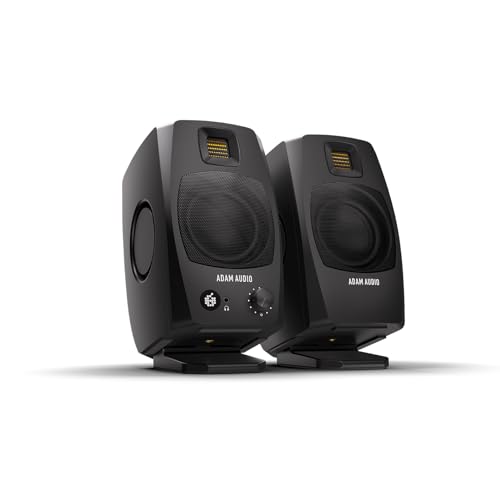
Adam Audio T5V
Adam Audio T5V features the U-ART ribbon tweeter, which produces crisp, detailed highs without fatigue. The 5-inch woofer provides a balanced midrange, and the rear panel offers room tuning filters.
Pros
- Ribbon tweeter for exceptional high-frequency clarity
- Compact and well built
- Low distortion at high SPL
Cons
- Bass response is limited
- Ribbon tweeter can be too revealing for some sources
Genelec 8010A
Genelec 8010A is a professional-grade active monitor known for its incredibly accurate sound in a tiny enclosure. It includes smart active circuitry and can be paired with a subwoofer for fuller sound. Ideal for mobile engineers.
Pros
- Excellent accuracy in a small footprint
- Rugged aluminum casing
- Professional connectivity options
Cons
- Very limited low-end without sub
- Premium price for size
How they compare
| # | Model | Driver | Best for | Score | Price |
|---|---|---|---|---|---|
| 1 | KEF Q150 Meta | 5.25 in Uni-Q coaxial | Accurate imaging and balanced sound | 9.4 | Check price |
| 2 | Yamaha HS5 | 2-way bi-amp powered | Flat response for mixing | 9.2 | Check price |
| 3 | Kali Audio LP-6 V2 | 6.5 in | High output and low distortion | 9.0 | Check price |
| 4 | KRK Rokit 5 G4 | 5 in Kevlar | Modern features and sound customization | 8.8 | Check price |
| 5 | JBL 306P MkII | 6.5 in | Deep bass and high output | 8.6 | Check price |
| 6 | Adam Audio T5V | 5 in | Precise high-frequency detail | 8.5 | Check price |
| 7 | Genelec 8010A | 3 in | Ultra-compact precision monitoring | 8.4 | Check price |
Good to know
What is the difference between bookshelf speakers and studio monitors?
Studio monitors are designed to have a flat frequency response to reveal the true sound of recordings. Bookshelf speakers often have a colored or enhanced response for consumer listening. For professional work, monitors are preferred, but many high-end bookshelf speakers approach flat response.
Do professional bookshelf speakers require an amplifier?
Passive models require an external amplifier, while active models have built-in amplification. Active monitors are common in studios because they simplify setup and are optimized for accuracy.
How much power do I need for nearfield listening?
For nearfield use at a desk, 30 to 50 watts per channel is usually sufficient. Higher power gives more headroom for dynamic peaks without distortion.
Can I use home theater bookshelf speakers for professional audio?
Home theater speakers often boost bass and treble for entertainment, which can mislead your mixing decisions. It is better to use speakers with a neutral response for professional audio work.
What is a coaxial speaker design?
A coaxial speaker places the tweeter at the center of the woofer, so sound radiates from a single point. This improves imaging and phase coherence, which is beneficial for critical listening.
Should I buy a subwoofer with my bookshelf speakers?
If your speakers have limited bass extension and you work with bass-heavy music, a subwoofer can help you hear the low end accurately. However, integrating a subwoofer requires proper crossover settings.
How important is the listening position?
The ideal listening position is the apex of an equilateral triangle with the speakers. Your ears should be at tweeter height. This ensures you hear the correct stereo image and frequency balance.
Are more expensive speakers always better?
Not necessarily. Expensive speakers often use higher-quality components and better construction, but the best choice depends on your room, your work, and your taste. Some budget models offer exceptional accuracy.
What is the benefit of a ribbon tweeter?
Ribbon tweeters are lightweight and respond quickly, producing very detailed and transparent high frequencies. They also have wide horizontal dispersion, which can create a larger sweet spot.
Can I use professional bookshelf speakers for casual listening?
Yes, they work well for music and movies, but they may sound less flattering than consumer speakers because they reveal flaws. Many listeners appreciate the honesty, though some prefer a more colorful sound.
The bottom line
After comparing these models, the KEF Q150 Meta is the best overall for professional use due to its exceptional clarity and imaging. However, if you need active monitors with a flat response for a tight budget, the Yamaha HS5 is an excellent choice. For those who require deep bass and high output, the Kali Audio LP-6 V2 delivers. For ultra-portable and precise monitoring, consider the Genelec 8010A. The right pick ultimately depends on your specific needs, but the KEF offers the best combination of accuracy and versatility for most professionals.