Professional Circuit Testers That Electricians Actually Rely On
For professional electricians, the Klein Tools NCVT-3 leads as the top pick. This non-contact voltage tester offers dual-range detection and a bright flashlight, making it ideal for quick troubleshooting. However, it lacks a backlit display, which may be a minor inconvenience in dark panels.
Professional circuit testers are essential for electricians, maintenance technicians, and serious DIYers. They verify power presence, check continuity, and ensure safety before working on electrical systems.
This roundup reviews top models that meet rigorous standards. We considered factors like voltage range, safety ratings, build quality, and additional features such as flashlight and backlit displays.
The top picks, ranked

Klein Tools NCVT-3 Non-Contact Voltage Tester
The Klein Tools NCVT-3 is a favorite among professionals. It detects low and standard voltage, features a bright LED flashlight, and has a rugged design. Users appreciate its reliability and clear audio and visual alerts.
Pros
- Dual-range detection for low and standard voltage
- Bright flashlight aids in dark areas
- Rugged build withstands job site drops
Cons
- No backlit display
- Requires batteries, not included

Fluke T130 Voltage and Continuity Tester
Fluke is synonymous with professional quality. The T130 offers voltage detection up to 690V AC/DC, continuity and resistance testing, and a backlit display. Its rugged, waterproof casing ensures longevity. Owners report accurate readings and dependable performance.
Pros
- Measures both AC and DC voltage
- Continuity and resistance functions
- Backlit display for dim conditions
Cons
- Higher price point
- Bulkier than non-contact testers
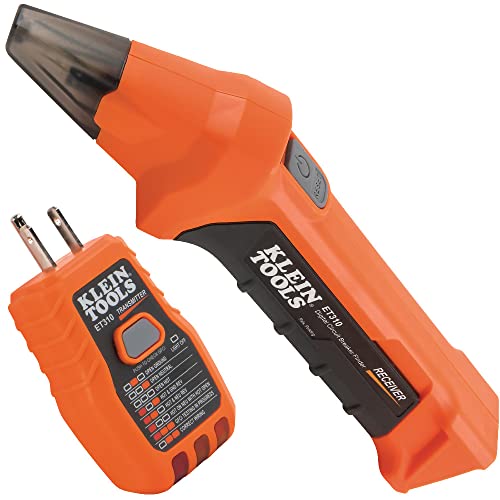
Klein Tools ET310 AC Circuit Breaker Finder and Tester
This Klein Tools model combines circuit testing with breaker identification. It sends a signal to locate the correct breaker quickly. Electricians find it indispensable for panel work. The set includes transmitter and receiver, both ruggedly built.
Pros
- Saves time locating breakers
- Accurate signal transmission
- Durable construction
Cons
- Limited to 120V circuits
- Requires several batteries

Fluke T+ PRO Electrical Tester
The Fluke T+ PRO is a top-tier tester offering voltage, continuity, and resistance checks with a backlit display. It features a flashlight and a low impedance input to prevent ghost voltages. Users in industrial environments trust its accuracy.
Pros
- Eliminates ghost voltage readings
- Bright flashlight and display
- High safety rating for industrial use
Cons
- Expensive
- No non-contact detection

Sperry Instruments GFI6302 GFCI Outlet Tester
Specialized for GFCI outlets, the Sperry GFI6302 tests wiring and GFCI trip function. It features a large LCD and indicates correct wiring. Ideal for residential and commercial inspections. Users find it straightforward and reliable.
Pros
- Clear LCD readout
- Tests GFCI functionality
- Compact and easy to use
Cons
- Only for 120V outlets
- Not for general voltage testing

Klein Tools NCVT1P Voltage Tester
The Klein NCVT1P offers reliable non-contact voltage detection at an affordable price. It has a compact design and audio visual indicators. Many professionals keep one as a backup. However, it lacks the dual range and flashlight of higher models.
Pros
- Budget-friendly
- Compact and pocket-sized
- Clear alerts
Cons
- No flashlight
- Single voltage range

Fluke 117 Electricians True RMS Multimeter
The Fluke 117 is a true RMS multimeter with built-in non-contact voltage detection. It measures AC/DC voltage, resistance, continuity, and frequency. Its AutoVolt function eliminates guesswork. Electricians praise its accuracy and durability.
Pros
- Versatile multimeter functions
- Non-contact voltage detection
- True RMS for accurate readings
Cons
- More expensive than basic testers
- May be overkill for simple tasks
Side by side
| # | Model | Voltage Range | Best for | Score | Price |
|---|---|---|---|---|---|
| 1 | Klein Tools NCVT-3 Non-Contact Voltage Tester | 12 to 1000V AC | Dual-range voltage detection with flashlight | 9.4 | Check price |
| 2 | Fluke T130 Voltage and Continuity Tester | 6 to 690V AC/DC | Comprehensive testing with continuity | 9.2 | Check price |
| 3 | Klein Tools ET310 AC Circuit Breaker Finder and Tester | Circuit tester and breaker finder | Identifying specific breakers | 9.0 | Check price |
| 4 | Fluke T+ PRO Electrical Tester | AC/DC voltage up to 600V | Advanced features for industrial settings | 9.1 | Check price |
| 5 | Sperry Instruments GFI6302 GFCI Outlet Tester | GFCI and wiring tester | GFCI outlet testing | 8.8 | Check price |
| 6 | Klein Tools NCVT1P Voltage Tester | 50 to 1000V AC | Budget-friendly non-contact testing | 8.5 | Check price |
| 7 | Fluke 117 Electricians True RMS Multimeter | AC/DC voltage, resistance, continuity, frequency | Multimeter with non-contact voltage | 9.3 | Check price |
Before you buy
Frequently asked questions
What is the difference between a non-contact voltage tester and a multimeter?
A non-contact voltage tester detects the presence of voltage without touching wires. A multimeter measures specific voltage, current, or resistance values. Professionals use both for different purposes.
What does CAT rating mean on a circuit tester?
CAT rating indicates the tester’s safety level for transient voltage spikes. CAT IV is highest for utility connections, CAT III for distribution, CAT II for outlets. Always use a tester with appropriate rating for your work.
Can a circuit tester detect DC voltage?
Some testers like the Fluke T130 and Fluke 117 measure both AC and DC voltage. Non-contact testers typically detect AC only. Check specifications before purchasing.
How often should a professional circuit tester be calibrated?
It depends on usage. Many manufacturers recommend annual calibration. If you drop the tester or suspect inaccuracy, calibrate immediately. Some testers have self-test features.
Are all circuit testers safe for live circuits?
Yes, most are designed for live testing, but you must follow safety guidelines. Use insulated gloves and proper PPE. Always verify the tester works on a known live circuit before use.
What is ghost voltage and why does it matter?
Ghost voltage is a false reading caused by capacitive coupling in nearby wires. Testers with low impedance (like Fluke T+ PRO) ignore ghost voltages. This prevents misdiagnosis.
Can I use a GFCI tester on non-GFCI outlets?
Yes, you can test wiring, but the GFCI trip function will not work. It will show correct wiring or faults. For GFCI outlets, press the test button to ensure it trips.
What is the best budget professional circuit tester?
The Klein Tools NCVT1P is a reliable budget option. It offers non-contact detection up to 1000V and is compact. However, it lacks extra features like a flashlight.
Do circuit testers require batteries?
Most do. Non-contact testers typically use AAA or 9V batteries. Some multimeters have built-in rechargeable batteries. Always keep spares.
Which brand is most trusted among electricians?
Fluke and Klein Tools are highly trusted. Fluke is known for accuracy and durability. Klein Tools offers great value and job site reliability. Many professionals use both.
The verdict
For most professional electricians, the Fluke T130 is the best investment because it combines accurate voltage detection with continuity and resistance testing in a rugged package. If you need non-contact testing with flashlight, choose the Klein Tools NCVT-3. For those on a budget, the Klein NCVT1P is a solid backup. Avoid buying a tester without proper safety ratings.