How Tour-Level Golf Clubs Differ From Everyday Sets
Titleist T100 Irons win on tour-level shot control for players who already shape trajectory. TaylorMade’s Stealth 2 Driver adds carbon-face distance off the tee. Callaway Apex Pro Irons suit golfers who shape shots deliberately, thanks to forged 1025 steel and tungsten weighting in the long irons.
Titleist T100 Irons top this comparison for players who already control trajectory and want tour-level forged feedback. The compact head rewards center-face contact but forgives less than a game-improvement iron.
Shaft flex, clubhead material and set composition vary widely across professional-grade clubs, and changing any one spec shifts performance at a given swing speed. We compared listed specifications, set makeup and owner feedback on feel and dispersion to match each pick to a specific type of player.
The top picks, ranked

Titleist T100 Irons
T100 pairs a forged dual-cavity design with a compact, blade-like profile favored on major tours. Tungsten weighting in the toe and sole lowers the center of gravity for a controlled, mid-high trajectory. Titleist sells it as a 4-PW seven-iron set with steel shafts stock.
Pros
- Compact shape supports deliberate shot shaping and trajectory control
- Owners confirm a soft forged feel even on mishits
- Spin stays consistent across the face at tour level
Cons
- Smaller sweet spot demands consistent ball striking
- Steel-shaft-only stock build limits swing-speed flexibility

TaylorMade Stealth 2 Driver
Stealth 2 combines a 60X Carbon Twist Face with a titanium ring frame that keeps mass low and back in the head. An adjustable hosel shifts loft across a 2-degree range, and the stock shaft is a Fujikura Ventus Red. TaylorMade sells it as a standalone driver, not part of an iron set.
Pros
- Carbon face trims weight for faster ball speed on center hits
- Adjustable loft sleeve lets fitters dial in launch and spin
- A left-handed configuration is available
Cons
- Standalone purchase adds to the cost of a full bag
- Twist Face forgiveness drops on extreme toe misses

Callaway Apex Pro Irons
Apex Pro irons use a forged 1025 mild carbon steel body in a compact shape built for players who shape shots intentionally. Internal tungsten weighting sits low in the long irons for penetrating flight without visual bulk. Callaway ships the set as 4-PW, seven clubs, with steel shafts standard.
Pros
- Thin top line and minimal offset suit better players
- Tungsten weighting keeps long-iron flight penetrating
- Forged feedback stays consistent across the face
Cons
- Forgiveness trails cavity-back distance irons
- Tighter dispersion requires a repeatable strike

Mizuno JPX923 Tour Irons
Mizuno Grain Flow Forges these irons from 1025E mild carbon steel in a single-piece process used across its tour lineup. The compact, minimal-offset head favors workability over a wide forgiveness margin. Stock sets run 5-PW plus a gap wedge, eight clubs, with steel shafts.
Pros
- Single-piece forging feels notably soft at impact, per owners
- Compact blade shape rewards center-face contact with tight dispersion
- Minimal offset suits players who prefer a traditional look
Cons
- Smaller head profile forgives less on off-center hits
- Stock shaft options stop at Regular and Stiff flex

PING i230 Irons
The i230 uses a forged hollow-body construction with an elastomer insert behind a 431 stainless steel face, widening forgiveness without enlarging the head. A tungsten toe weight raises MOI in a compact iron. PING sells it as a 4-PW set, seven clubs, with steel shafts stock.
Pros
- Elastomer insert adds forgiveness in a compact profile
- Tungsten toe weighting raises MOI over PING’s smaller-profile irons
- Custom fitting covers a wide range of swing speeds
Cons
- Hollow-body build feels firmer than a fully forged blade
- Graphite requires a custom order beyond the stock steel shaft
Cobra King Forged Tec Irons
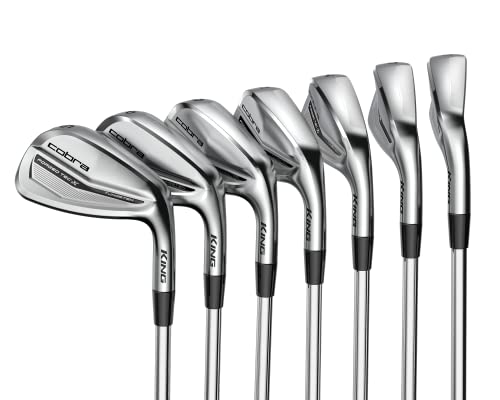
King Forged Tec irons pair a forged 8620 carbon steel body with a PWRSHELL face insert for added ball speed in a players-distance iron. Hollow construction adds forgiveness while keeping a thinner top line than typical game-improvement irons. Cobra offers 5-PW plus a gap wedge, eight clubs, with steel or graphite shafts.
Pros
- PWRSHELL face adds ball speed versus a fully forged design
- Graphite shaft option suits moderate swing speeds
- Top line stays thinner than most game-improvement irons
Cons
- X-Stiff flex is not offered for faster swing speeds
- Distance-oriented design trades off some shot-shaping feedback

Wilson Staff Model Blade Irons
Wilson forges these irons from 8620 carbon steel into a traditional muscle-back shape with minimal offset. The compact head and thin sole suit players who prioritize feedback over forgiveness. Wilson ships the set as 3-PW, eight clubs, with steel shafts standard.
Pros
- Muscle-back shape gives direct feedback on strike location
- Priced lower than comparable tour-level forged sets
- Thin top line and minimal offset match a traditional look
Cons
- Least forgiving option here on toe or heel mishits
- Long irons need faster, more consistent swing speeds to launch
How to choose
What Makes a Golf Club Set Professional-Caliber Professional-caliber clubs use forged carbon steel or titanium heads instead of cast alloys, letting makers shape a thinner, more compact profile. Compact heads shrink the sweet spot but give skilled players sharper feedback on strike location. Sets at this level typically run 4-PW or 5-PW, with wedges bought separately and a driver purchased on its own. Shaft options usually stop at Regular through X-Stiff, skipping the Senior and Ladies flex found on game-improvement lines.
How Do Forged Irons Differ From Cast Game-Improvement Irons? Forging shapes a single steel billet under pressure, producing a denser, more consistent grain structure than casting molten metal into a mold. Owners of forged sets like the T100 and JPX923 Tour often describe the impact feel as softer through the hands. Cast heads leave more room for internal cavity weighting, which raises forgiveness on off-center hits. Hollow-body forged designs like the PING i230 and Cobra King Forged Tec split the difference, adding a face insert for extra ball speed.
Matching Shaft Material and Flex to Swing Speed Steel shafts weigh more than graphite and transmit more feedback, which is why five of the seven sets here ship with steel as stock. Faster swing speeds generally call for Stiff or X-Stiff flex to keep the face from closing early at impact. Graphite stays available on the Cobra King Forged Tec, and as a custom option on several other sets, for players wanting less overall weight. A driver shaft, like the Fujikura Ventus Red on the Stealth 2, gets built and tuned separately from iron shafts for a longer, faster swing.
When a Blade-Style Iron Makes Sense Over a Players-Distance Iron A muscle-back blade like the Wilson Staff Model Blade suits golfers who already strike the ball consistently near center. Players still working on contact often get more from a hollow-body design like the i230 or King Forged Tec, which adds forgiveness without a bulky game-improvement look. Low-handicap players who shape shots on demand tend to prefer the Apex Pro or T100 for their compact shape and workability. Anyone buying a driver separately from an iron set should confirm loft and shaft match their current swing speed before combining brands.
Side by side
| # | Model | Shaft material | Best for | Score | Price |
|---|---|---|---|---|---|
| 1 | Titleist T100 Irons | Steel (True Temper Dynamic Gold stock) | Best overall | 9.4 | Check price |
| 2 | TaylorMade Stealth 2 Driver | Graphite (Fujikura Ventus Red stock) | Best for distance | 9.2 | Check price |
| 3 | Callaway Apex Pro Irons | Steel (KBS Tour stock) | Best for shot workability | 9.0 | Check price |
| 4 | Mizuno JPX923 Tour Irons | Steel (Dynamic Gold 105 stock) | Best forged feel | 8.8 | Check price |
| 5 | PING i230 Irons | Steel (AWT 2.0 stock) | Best for forgiveness among players irons | 8.6 | Check price |
| 6 | Cobra King Forged Tec Irons | Steel or graphite (KBS or UST Mamiya options) | Best value | 8.3 | Check price |
| 7 | Wilson Staff Model Blade Irons | Steel (KBS Tour stock) | Best budget | 8.0 | Check price |
Questions worth asking
What are the best golf clubs for a scratch golfer?
Scratch golfers typically choose compact, forged irons like the Titleist T100 or Callaway Apex Pro for shot-shaping control, paired with a driver such as the TaylorMade Stealth 2 fitted to their swing speed.
Which golf club set do most tour pros actually use?
Tour bags vary by player, but forged players irons such as Titleist’s T100 line and Mizuno’s JPX Tour series show up often because of their compact shape and consistent forged feel.
How much does clubhead material affect ball flight?
Clubhead material shifts weight distribution and face flex. Forged carbon steel gives a softer, lower-launching feel, while a titanium and carbon-composite driver head like the Stealth 2 raises ball speed on center strikes.
Can a mid-handicap player use professional-level irons?
Mid-handicap players can, but compact heads like the T100 or Wilson Staff Model Blade forgive less on mishits than a hollow-body option such as the PING i230 or Cobra King Forged Tec.
Is a forged iron better than a cast iron for feel?
Owners generally report a softer impact feel from forged irons, since single-piece forging creates a denser, more uniform grain structure than casting.
What flex shaft do professional golfers use?
Most players irons here offer Stiff and X-Stiff as the stock or upgrade flex, matched to faster swing speeds, with Regular flex available for moderate speeds.
Golf clubs vs golf club sets, what’s the difference for buyers?
A single club, like the Stealth 2 driver, gets bought and fitted on its own, while a set such as the Apex Pro irons ships as a matched run of 4-PW or 5-PW clubs built with one shaft type throughout.
Is graphite or steel better for professional irons?
Steel is the stock choice on most players irons in this comparison, since it adds feedback and weight consistency. Graphite remains available as a custom option for lower overall swing weight.
How many clubs come in a typical professional iron set?
Most sets here run seven or eight clubs, spanning 4-PW or 5-PW with a gap wedge. Wilson’s Staff Model Blade extends to eight clubs by starting at the 3-iron.
The verdict
Titleist T100 Irons make the default pick for players who already shape shots and want tour-level forged feedback in a 4-PW set. Golfers chasing more ball speed off the tee should pair them with the TaylorMade Stealth 2 Driver rather than a stock offering. Anyone still building consistent contact will get more from the PING i230’s hollow-body forgiveness than from a traditional blade like the Wilson Staff Model Blade.