Hiking Backpacks Compared by Suspension, Torso Fit, and Load
Osprey Atmos AG 65 leads this comparison for its Anti-Gravity suspension and steady multi-day carry. Gregory Baltoro 65 suits hikers who routinely carry loads past 40 pounds, since its harness adjusts on the fly. REI Co-op Flash 55 fits thru-hikers who prioritize a lighter base weight over structure.
Osprey Atmos AG 65 suits multi-day hikers who want steady back ventilation from a proven Anti-Gravity suspension, though its frame ships in only three fixed sizes instead of infinite adjustment.
Frame type, torso fit, and back-panel design change how a load feels more than liters alone, so ranking by capacity would miss the real differences. We compared published specs, frame construction, torso adjustability, and back-panel ventilation across current Amazon listings, then grouped each pack by the hiking style it fits best.
How to pick the right one
How Many Liters Does a Multi-Day Hike Need? A one or two night weekend trip usually fits in 35 to 50 liters. Three to five day trips push most hikers toward 55 to 65 liters, the range covered by the Atmos AG 65, Baltoro 65, and Aura AG 65 here. Winter camping or shared gear like a tent often needs 65 liters or more. Thru-hikers who resupply often carry less volume, which keeps packs like the REI Co-op Flash 55 near 55 liters despite covering many days on trail.
Internal Frame vs External Frame Backpacks Internal frame packs, like the Atmos AG 65 and Baltoro 65, hug the body and stay stable on uneven, off-trail ground. External frame packs, such as the Kelty Trekker 65, expose more of the back to open air and transfer weight well on established trails. Lashing bulky items like sleeping pads outside the main compartment comes easier with an external frame. Most hikers now pick internal frames for versatility, though external frames still suit hot-weather trail hiking with heavy, dense loads.
Why Torso Length and Adjustability Matter Weight shifts onto the shoulders instead of the hips when a pack does not match torso length. Gregory’s Response A3 suspension on the Baltoro 65 adjusts on the fly with a rear ratchet, useful for households sharing one pack. Osprey ships the Atmos AG 65 and Aura AG 65 in fixed sizes instead, so buyers measure torso length before ordering. Budget packs like the Teton Sports Scout 3400 use one fixed torso, which fits average-height hikers but limits very short or tall frames.
Which Backpacks Handle Hot Climates Best? Back panels that press directly against the body tend to trap heat and sweat on warm days. Deuter solves this on the Futura Air Trek 50+10 with a trampoline-style mesh that creates an air gap along the spine. Osprey’s Anti-Gravity panels on the Atmos AG 65 and Aura AG 65 use a similar suspended mesh approach. Foam back panels pressed against the body, common on budget models, run warmer on long summer climbs.
The top picks, ranked

Osprey Atmos AG 65
Osprey builds the Atmos AG 65 around Anti-Gravity suspended mesh, a curved wire frame, and a ventilated hip belt. Three fixed torso sizes mean buyers pick S, M, or L to match their frame. Osprey aims this 65 liter pack at three to five day trips.
Pros
- Anti-Gravity mesh lifts the pack off the back for airflow
- Adjustable hip belt and shoulder straps fine-tune the fit
- Rain cover and trekking pole loops come included
Cons
- Fixed frame sizes skip in-between adjustment
- Heavier than ultralight packs at the same capacity

Gregory Baltoro 65
Gregory centers the Baltoro 65 on its Response A3 suspension, letting hikers ratchet torso length while the pack stays loaded. A dual-density hip belt and lumbar pad spread weight across the hips. Loads well above what lighter packs here can handle stay comfortable on this frame.
Pros
- Torso length adjusts without taking the pack off
- Rotating, contoured hip belt improves load transfer
- Removable top lid doubles as a small day pouch
Cons
- Heaviest pack in this lineup, working against ultralight goals
- Wider profile can feel bulky on narrow trails
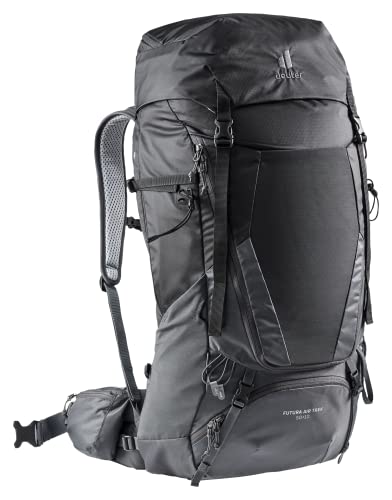
Deuter Futura Air Trek 50+10
Deuter’s Aircomfort trampoline mesh suspends the Futura Air Trek 50+10 away from the back for constant airflow. VariQuick lets owners slide the shoulder harness up or down to match torso length without tools. An extendable top collar adds room on longer trips.
Pros
- Mesh back panel cuts sweat buildup in warm weather
- VariQuick adjustment needs no tools
- Extendable top collar adds capacity for longer trips
Cons
- Mesh gap adds distance between pack and back, affecting balance under heavy loads
- Fewer external attachment points than expedition packs

Osprey Aura AG 65
Aura AG 65 shares the Atmos AG 65’s Anti-Gravity mesh frame but scales it to a shorter torso range and narrower shoulder harness. Osprey offers it in XS, S, and M frame sizes. A removable top lid and rain cover support multi-day trips.
Pros
- Women’s-specific harness and hip belt curve reduce chafing
- Anti-Gravity back panel matches the ventilation of the Atmos
- Sized frame options fit shorter torso lengths
Cons
- No larger frame sizes for taller hikers
- Weighs about the same as the men’s version despite the narrower size range
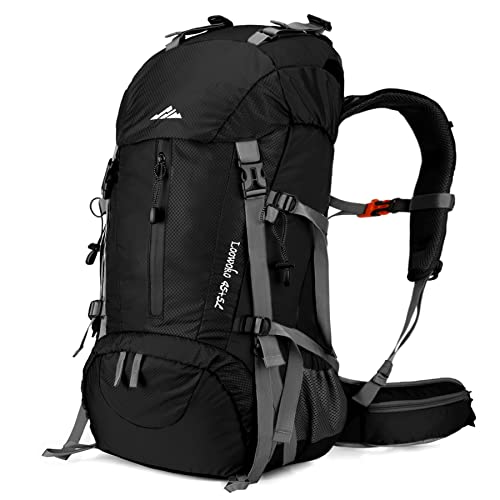
REI Co-op Flash 55
REI Co-op strips the Flash 55 to a removable frame sheet and two aluminum stays, cutting weight to roughly 2 lbs 10 oz. Hook-and-loop backing lets hikers fine-tune torso length in small increments. A rolltop closure and side compression straps keep the load compact.
Pros
- One of the lightest packs here at a full 55 liters
- Removable frame sheet doubles as a sit pad
- Rolltop closure sheds ounces versus a lidded design
Cons
- Thinner hip belt padding than the Baltoro or Atmos AG
- Less structure for loads over about 35 lbs

Kelty Trekker 65
Kelty keeps the Trekker 65 on an external aluminum frame, exposing the pack body to open air along the back. Weight transfers efficiently onto the hip belt on established trails thanks to the rigid frame. Multiple external lash points hold a sleeping bag, pad, or tent poles.
Pros
- Open frame ventilates better than most internal-frame packs
- External lash points simplify strapping bulky gear outside the pack
- Rigid frame handles heavy, dense loads well on smooth trails
Cons
- Wider frame catches on brush and tight switchbacks
- Less stable than internal frames on uneven, off-trail terrain

Teton Sports Scout 3400
Teton Sports builds the Scout 3400 around roughly 55 liters on an internal frame with a fixed torso length. A padded hip belt and included rain cover round out this entry-level pack. First-time overnight and weekend hikers make up its target audience, not multi-week trips.
Pros
- Rain cover and hydration sleeve add value for new hikers
- Padded hip belt and lumbar support suit a first pack
- Multiple external pockets allow quick access to gear
Cons
- Fixed torso length will not fit every body
- Suspension and fabric feel less refined than premium brands under heavy loads
How they stack up
| # | Model | Capacity | Best for | Score | Price |
|---|---|---|---|---|---|
| 1 | Osprey Atmos AG 65 | 65 liters | Best overall | 9.4 | Check price |
| 2 | Gregory Baltoro 65 | 65 liters | Best for heavy loads and adjustable torso fit | 9.1 | Check price |
| 3 | Deuter Futura Air Trek 50+10 | 50+10 liters | Best ventilated back panel for hot climates | 8.8 | Check price |
| 4 | Osprey Aura AG 65 | 65 liters | Best women’s-specific fit | 8.6 | Check price |
| 5 | REI Co-op Flash 55 | 55 liters | Best for ultralight thru-hiking | 8.3 | Check price |
| 6 | Kelty Trekker 65 | 65 liters | Best external frame pack | 8.1 | Check price |
| 7 | Teton Sports Scout 3400 | 55 liters (3400 cu in) | Best budget | 8.0 | Check price |
Good to know
How many liters do I need for a 3 day hike?
Most hikers pack 55 to 65 liters for a three day trip, room enough for a tent, sleeping bag, food, and layers. Ultralight hikers with a smaller tent and quilt can go as low as 45 to 50 liters.
What is the difference between internal and external frame backpacks?
Internal frames sit close to the body and stay balanced on uneven ground. External frames use a rigid outer structure that ventilates better and carries heavy, dense loads more efficiently on established trails.
Which hiking backpack works best in hot weather?
Packs with a trampoline mesh back panel, such as the Deuter Futura Air Trek 50+10 or Osprey’s Anti-Gravity models, create an air gap that cuts sweat buildup compared to foam back panels.
Can you adjust torso length on a hiking backpack after buying it?
The Gregory Baltoro 65 uses a ratcheting harness that adjusts torso length on the fly. The Osprey Atmos AG 65 instead comes in fixed sizes that must be chosen before purchase.
Is a women’s-specific backpack necessary for female hikers?
Not required, but women’s-specific packs like the Osprey Aura AG 65 use a shorter torso range and narrower shoulder harness that fits many women more comfortably than a unisex frame.
How much weight can a 65 liter backpack carry comfortably?
Packs built around a sturdy suspension, such as the Gregory Baltoro 65, comfortably carry loads up to around 40 to 50 pounds. Lighter, frameless-style packs handle less before the fit degrades.
What is a good beginner hiking backpack?
The Teton Sports Scout 3400 offers a padded hip belt, included rain cover, and around 55 liters of space, a practical starting point for first overnight or weekend trips.
How much does an ultralight thru-hiking backpack weigh?
Ultralight packs like the REI Co-op Flash 55 weigh around 2 pounds 10 ounces by using a removable frame sheet and lighter fabrics, compared to 4 to 5 pounds for a standard internal frame pack.
Osprey Atmos vs Gregory Baltoro: which suspension fits heavier loads?
The Baltoro 65’s Response A3 suspension and dual-density hip belt handle loads past 40 pounds more comfortably. The Atmos AG 65 favors ventilation and a lighter build over maximum carrying capacity.
The bottom line
Osprey Atmos AG 65 earns the top recommendation here because its Anti-Gravity suspension balances ventilation, load transfer, and multi-day capacity better than the rest of this lineup. Hikers who regularly carry over 40 pounds should look at the Gregory Baltoro 65 instead, since its adjustable Response A3 suspension handles heavier weight more comfortably. Thru-hikers minimizing pack weight are better served by the REI Co-op Flash 55.