Top NAS Drives for Pros Who Need Serious Storage
The Synology DiskStation DS923+ is the top choice for most professionals because it offers a superb balance of performance, expandability, and the mature DSM operating system. Its main advantage is the combination of four drive bays, PCIe upgrade slot, and 10GbE ready networking, which makes it adaptable for growing teams. However, it lacks built-in 10GbE and requires additional drives for full performance, which can increase the initial investment.
Professional network attached storage (NAS) is no longer just a shared hard drive. It is the backbone of creative studios, small IT departments, and remote work setups that demand centralized, high-speed access to massive files. Whether you are editing 4K videos, managing a database, or backing up multiple workstations, a professional NAS must deliver reliability, speed, and scalability.
This roundup compares the most capable NAS units available today from trusted brands. We focused on models that offer at least four drive bays, support for SSD caching or 10GbE upgrades, and robust data protection features. Owners report that the right NAS can transform workflow efficiency, but choosing the wrong one can lead to bottlenecks and frustration.
Before you buy
What we recommend

Synology DiskStation DS923+
The Synology DS923+ is a powerful 4-bay NAS designed for small to medium businesses and creative professionals. It is powered by an AMD Ryzen R1600 dual-core processor and comes with 4GB ECC RAM, expandable to 32GB. It features two M.2 NVMe slots for SSD caching and a PCIe slot for adding a 10GbE network card. The DSM operating system is widely praised for its intuitive interface and extensive app ecosystem, making it easy to manage files, backups, and multimedia.
Pros
- Excellent DSM software with frequent updates
- Expandable memory and PCIe slot for 10GbE
- Efficient and quiet operation
Cons
- No built-in 10GbE (requires extra card)
- No SSD cache pre-installed
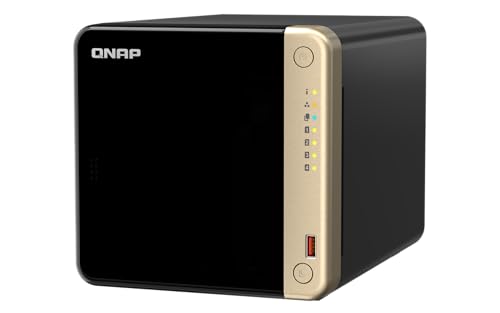
QNAP TS-464
The QNAP TS-464 is a 4-bay NAS with an Intel Celeron N5095 quad-core processor and 8GB RAM. It offers two 2.5GbE ports, two M.2 NVMe slots, and a PCIe Gen 3 slot for expansion. Its HDMI output allows direct display of media, and the QTS operating system provides robust virtualization and container support. This model is popular among video editors and home users who want a powerful all-in-one solution.
Pros
- Dual 2.5GbE ports for faster than gigabit
- HDMI output for direct media playback
- PCIe slot for 10GbE or extra M.2
Cons
- QTS interface can be cluttered for beginners
- CPU is not as powerful as Ryzen in DS923+
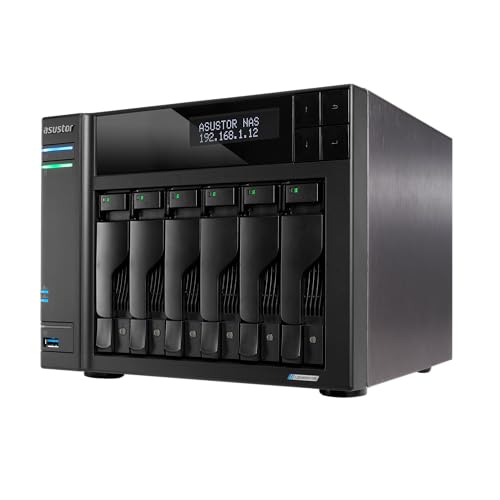
Asustor Lockerstor 6 Gen2 (AS6706T)
The Asustor Lockerstor 6 Gen2 is a 6-bay NAS designed for power users. It is equipped with an Intel Core i3-N305 processor (8 cores) and comes with 8GB dual-channel DDR4 memory. It features two 10GbE ports that are built-in, eliminating the need for an expansion card. The device supports M.2 NVMe caching and PCIe expansion, and its ADM 4.2 software is straightforward with a solid app suite. This NAS is ideal for video editing teams that require fast 10GbE connectivity for seamless collaboration.
Pros
- Two built-in 10GbE ports
- High capacity with 6 bays
- Powerful Intel processor for virtualization
Cons
- Higher price point
- ADM software has fewer third-party apps than DSM

Synology DiskStation DS1522+
The Synology DS1522+ is a 5-bay NAS that offers more drive bays than the DS923+ while retaining the same AMD Ryzen processor. It comes with 8GB ECC RAM, two M.2 NVMe slots, and a PCIe slot for 10GbE upgrades. Its 5-bay design allows for flexible RAID configurations, and the DSM operating system is a major plus for IT managers and creatives alike. This model is a step up for those who need additional storage without moving to a rackmount unit.
Pros
- Five bays for more storage flexibility
- ECC memory for data integrity
- Expandable with DX517 units up to 15 bays
Cons
- Only 1GbE ports (10GbE upgrade available)
- Performance is similar to DS923+ but costs more

QNAP TVS-672XT
The QNAP TVS-672XT is a 6-bay NAS with a unique feature: two Thunderbolt 3 ports. It is powered by an Intel Core i5-8400 processor, making it one of the fastest consumer NAS units. It comes with 8GB RAM (expandable to 64GB), dual 10GbE ports, and supports PCIe expansion. This model is designed for creative professionals using Macs, offering direct Thunderbolt connectivity for fast editing. However, it is an older model that may be harder to find, and it lacks M.2 NVMe slots.
Pros
- Thunderbolt 3 ports for Mac users
- Powerful desktop-class CPU
- Two built-in 10GbE ports
Cons
- No M.2 NVMe slots for caching
- Higher power consumption and noise

TerraMaster F4-424 Pro
The TerraMaster F4-424 Pro is a 4-bay NAS that offers impressive hardware for a lower price than its competitors. It is equipped with an Intel Core i3-N305 processor (8 cores) and 16GB DDR5 RAM, which is uncommon in this category. It has two 2.5GbE ports and allows for M.2 NVMe caching. The TOS operating system is user-friendly and includes many apps. While it lacks the polish of Synology’s DSM, it is a cost-effective choice for professionals who need raw computing power.
Pros
- High core count CPU at a reasonable price
- Generous 16GB DDR5 RAM included
- Supports SSD caching for improved performance
Cons
- TOS OS is less refined than Synology or QNAP
- No 10GbE option built-in

Synology RackStation RS1221+
The Synology RS1221+ is a 1U rackmount NAS with 8 drive bays, designed for businesses that need a reliable network storage solution in a server rack. It is powered by an AMD Ryzen V1500B quad-core processor, comes with 4GB ECC RAM (expandable to 32GB), and features dual M.2 NVMe slots. It includes four 1GbE ports and also has a PCIe slot for 10GbE upgrade. This model is highly regarded for its build quality and the ability to scale with expansion units (RX418) to up to 12 bays.
Pros
- Rackmount design saves space
- ECC memory and high reliability
- Expandable to 12 bays with expansion unit
Cons
- Louder fans than desktop models
- Initial cost is higher without drives
How they compare
| # | Model | Drive Bays | Best for | Score | Price |
|---|---|---|---|---|---|
| 1 | Synology DiskStation DS923+ | 4 x 3.5/2.5 SATA, plus 2 M.2 NVMe | Best overall for professionals needing a versatile 4-bay NAS | 9.4 | Check price |
| 2 | QNAP TS-464 | 4 x 3.5/2.5 SATA, plus 2 M.2 NVMe | Best for multimedia professionals needing HDMI output and PCIe expandability | 9.1 | Check price |
| 3 | Asustor Lockerstor 6 Gen2 (AS6706T) | 6 x 3.5/2.5 SATA, plus 2 M.2 NVMe | Best for professionals needing high storage capacity and 10GbE out of the box | 9.0 | Check price |
| 4 | Synology DiskStation DS1522+ | 5 x 3.5/2.5 SATA, plus 2 M.2 NVMe | Best for professionals wanting a 5-bay NAS with expandable storage | 9.2 | Check price |
| 5 | QNAP TVS-672XT | 6 x 3.5/2.5 SATA | Best for Thunderbolt 3 connectivity for Mac-based video editors | 8.9 | Check price |
| 6 | TerraMaster F4-424 Pro | 4 x 3.5/2.5 SATA, plus 2 M.2 NVMe | Best budget-friendly option for small businesses with high performance needs | 8.7 | Check price |
| 7 | Synology RackStation RS1221+ | 8 x 3.5/2.5 SATA, plus 2 M.2 NVMe | Best for rackmount deployment in professional server rooms | 9.0 | Check price |
Common questions
What is the difference between a NAS for home use and a professional NAS?
A professional NAS is designed for higher workloads, offering better processors, more RAM, ECC memory options, and faster network connectivity. It also includes advanced data protection features like RAID configurations, snapshot technology, and support for virtualization. Reliability and scalability are prioritized over media streaming features.
How many drive bays do I need?
For a small team, 4 bays allow RAID 5 or RAID 10, providing a good balance of capacity and redundancy. If you need more storage, consider 5 or 6 bays for more flexibility. For large scale backup, 8 bays in a rackmount unit is common. Always have at least one drive of parity for data safety.
Do I need 10GbE for professional video editing?
If you are editing high bitrate 4K or 8K video directly from the NAS, 10GbE is strongly recommended to avoid stuttering. With 10GbE, you get speeds up to 1,100 MB/s, which can handle multiple streams. For 1080p editing, 2.5GbE might be sufficient, but future-proofing with 10GbE is wise.
Can I use a professional NAS for cloud storage?
Yes, most professional NAS units offer cloud sync to services like S3, Azure, or Dropbox. They can also act as a private cloud with secure remote access via VPN or Tailscale. This allows you to access files from anywhere while maintaining control over your data.
What is SSD caching and is it necessary?
SSD caching uses high-speed M.2 SSDs to store frequently accessed data, accelerating read and write times. It is particularly beneficial for random small file operations. It is not a replacement for a full SSD array but can significantly boost performance in many workloads, especially with many small files like photos or documents.
How important is ECC RAM in a NAS?
ECC RAM detects and corrects memory errors, which is critical for data integrity in professional environments. If you are using the NAS for sensitive data or long-term storage, ECC is highly recommended. Non-ECC RAM may cause file corruption in rare cases. Models like the DS923+ and DS1522+ support ECC memory.
Can I run virtual machines on a NAS?
Many professional NAS units support virtualization through software like Virtual Machine Manager (Synology) or Virtualization Station (QNAP). To run VMs smoothly, you need a powerful processor (at least 4 cores) and ample RAM (16GB or more). Consider models with upgradeable memory to handle multiple VMs.
What is the best RAID configuration for a professional NAS?
RAID 5 is a popular choice for 4 or more drives, offering good performance and one-drive fault tolerance. RAID 6 can survive two drive failures but requires more drives. RAID 10 provides high performance and redundancy but uses half your capacity. For maximum data safety, use RAID 6 or RAID 10 depending on your capacity and speed preferences.
How do I back up the NAS itself?
You should follow the 3-2-1 rule: keep three copies of data, on two different media, with one offsite. Use the NAS’s built-in backup tools to replicate to another NAS or cloud service. Schedule regular snapshots to protect against ransomware or accidental deletion.
Are there any hidden costs when buying a NAS?
Yes, you need to purchase hard drives separately, which can be a significant cost. Also, consider drives optimized for NAS (like WD Red or Seagate IronWolf) for reliability. You may also need to budget for 10GbE network cards and switches if you choose to upgrade. Software updates are usually free, but some advanced features may require paid licenses.
Our take
For most professionals, the Synology DS923+ is the clear winner because it combines a robust processor, ECC memory, and excellent software in a compact 4-bay design. If you need more storage out of the box, the Asustor Lockerstor 6 Gen2 offers built-in 10GbE and six bays at a higher cost. For those on a budget, the TerraMaster F4-424 Pro delivers impressive performance for the price, but be prepared to work with its less mature operating system. Ultimately, the best choice hinges on your specific storage capacity and network speed requirements, but the DS923+ offers the best all-around package for professional use.


