Top Professional Sanders for Smooth Finishes
For most professionals, the Festool ETS EC 150/5 EQ random orbital sander is the top pick. It offers exceptional dust extraction and a smooth finish, but its premium price is a hurdle for some.
Professional sanders must endure daily use, deliver consistent results, and keep dust at bay. We compared leading models to help you choose the right one for your craft.
From random orbital sanders for finishing to belt sanders for stock removal, this roundup highlights the strengths and trade-offs of each top contender.
How to pick the right one
The best picks, ranked

Festool ETS EC 150/5 EQ Random Orbital Sander
The Festool ETS EC 150/5 EQ is a brushless random orbital sander with a 5 mm orbit. It delivers a swirl-free finish and connects to a dust extractor for near-perfect dust control. Owners report that its vibration-reducing handle makes long sessions comfortable.
Pros
- Superb dust extraction
- Very low vibration
- Long brushless motor life
Cons
- High price
- Requires Festool extractor for best performance

Bosch GET65-5N Random Orbital Sander
The Bosch GET65-5N features a 5.0 amp motor and a 6 inch pad with a 5 mm orbit. It offers a variable speed dial from 4,500 to 12,000 OPM. Users find it powerful enough for aggressive sanding yet smooth for finer grits.
Pros
- Strong motor for tough jobs
- Interchangeable pads
- Good dust collection with included bag
Cons
- Heavier than some competitors
- Dust bag fills quickly

DeWalt DWE6423K Random Orbital Sander
The DeWalt DWE6423K is a 5 inch random orbital sander with a 3.0 amp motor and a 5 mm orbit. Its hook and loop pad accepts quick change discs. Owners appreciate the low vibration and the included dust bag and hard case.
Pros
- Affordable price
- Very low vibration for its class
- Includes case and dust bag
Cons
- Motor less powerful than larger models
- Pad size may be small for large surfaces

Makita BO5041K Random Orbital Sander
The Makita BO5041K is a 5 inch random orbital sander that generates a super smooth finish with its 5 mm orbit and 3.0 amp motor. It features a rubberized grip for comfort. Professionals report that it leaves minimal swirl marks.
Pros
- Excellent finish quality
- Comfortable grip
- Durable build
Cons
- Dust collection could be better
- No variable speed dial on some versions
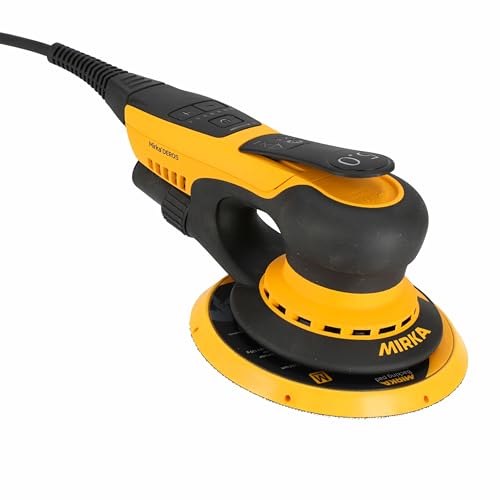
Mirka DEROS 5650CV Random Orbital Sander
The Mirka DEROS 5650CV is a 6 inch random orbital sander with a 5 mm orbit and brushless motor. It is known for its exceptional dust extraction when paired with a vacuum. Its compact body and low vibration make it a favorite among finishers.
Pros
- Outstanding dust control
- Very smooth operation
- Durable brushless motor
Cons
- Pricey
- Requires separate vacuum for best results

Bosch 1278DVS Belt Sander
The Bosch 1278DVS is a professional belt sander with a 120 volt motor and variable speed control. It uses 3 inch by 21 inch belts. Craftsmen value its power and the ability to adjust speed for different materials.
Pros
- High power for fast stock removal
- Variable speed for controlled work
- Includes dust bag
Cons
- Heavy and bulky
- Not for fine finishing

3M Xtract 6 in. Random Orbital Sander
The 3M Xtract 6 inch random orbital sander features a 5 mm orbit and a built-in dust extraction system that captures dust directly at the pad. It works with a vacuum or the optional 3M dust extractor. Drywall finishers report minimal dust escape.
Pros
- Excellent dust capture for drywall
- Lightweight
- Easy to connect to vacuum
Cons
- Pad replacement is costly
- Not as powerful as some for heavy sanding
Side by side
| # | Model | Orbit | Best for | Score | Price |
|---|---|---|---|---|---|
| 1 | Festool ETS EC 150/5 EQ Random Orbital Sander | 5 mm | Fine finishing on wood and paint | 9.6 | Check price |
| 2 | Bosch GET65-5N Random Orbital Sander | 5 mm | Heavy stock removal and finishing | 9.2 | Check price |
| 3 | DeWalt DWE6423K Random Orbital Sander | 5 mm | General purpose sanding with low vibration | 8.9 | Check price |
| 4 | Makita BO5041K Random Orbital Sander | 5 mm | Professional finishing on wood | 9.0 | Check price |
| 5 | Mirka DEROS 5650CV Random Orbital Sander | 5 mm | Furniture and automotive refinishing | 9.5 | Check price |
| 6 | Bosch 1278DVS Belt Sander | 3 x 21 inches | Aggressive stock removal | 8.7 | Check price |
| 7 | 3M Xtract 6 in. Random Orbital Sander | 5 mm | Drywall sanding and paint removal | 8.4 | Check price |
Good to know
What is the best sander for professional woodworking?
The Festool ETS EC 150/5 EQ is widely preferred for its finish quality and dust control. However, budget-conscious professionals may opt for the Makita BO5041K or Bosch GET65-5N, which also deliver excellent results.
What is the difference between a 5 mm and 6 mm orbit sander?
A 5 mm orbit is versatile, providing a good balance between material removal and finish. A 6 mm orbit removes material faster but may leave more noticeable swirl marks. For fine finishing, a 3 mm orbit is better.
Do I need a dust extractor for a professional sander?
Yes, a dust extractor or a vacuum with HEPA filter is highly recommended. It keeps the air clean and prevents dust from clogging the sandpaper. Many sanders have ports for connecting to a vacuum.
Can I use a random orbital sander for drywall sanding?
Yes, but it may create more dust than a pole sander. Models like the 3M Xtract are designed for dust extraction and work well with a vacuum. For large areas, consider a drywall sander with a pole.
What is a brushless motor and why is it better?
A brushless motor has no brushes to wear out, making it more durable and efficient. It also provides more torque and longer runtime, which is beneficial for heavy professional use.
How often should I replace the sanding pad on my sander?
It depends on usage. Inspect the pad for wear, such as cracking or losing hook-and-loop grip. Frequent users may replace it every few months. Always use the correct pad size and type for your sander.
Can I use any sandpaper discs with any sander?
Most random orbital sanders use hook-and-loop discs and have a standard hole pattern for dust extraction. Check the pad size and hole configuration. Some brands like Festool have proprietary systems, but adapters are available.
What safety gear should I use when sanding?
Always wear a dust mask or respirator, safety glasses, and hearing protection. Even with dust extraction, fine particles can become airborne. Also, follow the manufacturer’s safety instructions.
The bottom line
If you need the finest finish and have the budget, choose the Festool ETS EC 150/5 EQ. For a more affordable yet versatile professional sander, the Bosch GET65-5N is the best value. For belt sanding, the Bosch 1278DVS is the reliable choice.