Ski Goggles That Handle Race Speed and Backcountry Light
Smith I/O MAG ranks first for skiers who want fast magnetic lens swaps paired with a spherical ChromaPop lens. Oakley Flight Deck L offers the widest field of view for aggressive terrain. Anon M4 Toric adds face mask integration, making it the pick for high-altitude days.
Smith I/O MAG wins this comparison for skiers who split time between resort laps and backcountry tours. Its spherical ChromaPop lens sharpens contrast, and rare-earth magnets swap tints in seconds. Riders chasing the widest possible sightline may prefer a toric or oversized frame instead.
We compared lens shape, VLT range and swap mechanism across manufacturer spec sheets, then checked owner reviews for fogging and OTG fit before ranking these seven models for serious skiers and snowboarders.
The top picks, ranked

Smith I/O MAG
Smith builds the I/O MAG around a spherical ChromaPop lens held by rare-earth magnets at eight points. Swapping lenses takes seconds, with no hinge or exposed screw involved. Dual-layer face foam and a floating frame spread pressure evenly under a helmet.
Pros
- Fastest lens swap in this lineup
- ChromaPop lens sharpens contrast in flat light
- Fits most Smith helmets without a forehead gap
Cons
- Replacement lenses cost more than cylindrical options
- Frame runs large on narrower faces

Oakley Flight Deck L
Oakley extends its largest goggle frame on the Flight Deck L, pairing it with a single spherical Prizm lens. Peripheral coverage stretches further than most helmet-integrated designs manage. A Switchlock hinge locks the lens without magnets, and triple-layer foam manages moisture on long lift lines.
Pros
- Widest sightline in this lineup
- Prizm lens tunes contrast for specific light
- Fits most full-shell helmets
Cons
- Switchlock swap runs slower than magnetic systems
- Oversized fit crowds smaller faces
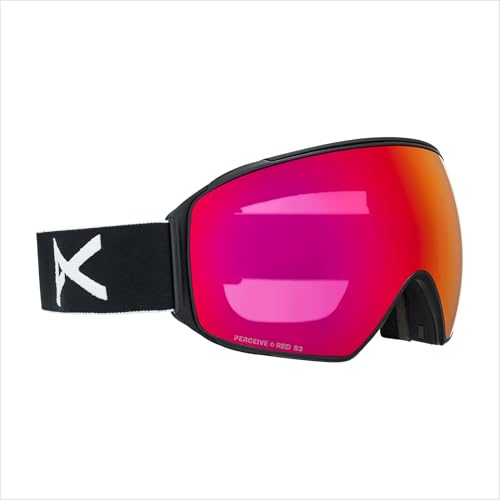
Anon M4 Toric
Anon curves the M4 lens more on the horizontal axis than the vertical, a toric shape that cuts distortion versus flat cylindrical shields. Magnetic Facemask Integration clips an Anon MFI mask straight onto the frame. A second magnetic lens swaps in without lifting the goggle off the face.
Pros
- Toric shape reduces distortion at the lens edges
- Magnetic mask attachment suits extreme cold
- Most kits include a low-light spare lens
Cons
- Heavier than single-lens spherical models
- MFI mask sold separately on some bundles

Dragon PXV
Dragon fits the PXV with a panoramic spherical lens and Lumalens optics tuned for whiteout and flat light. One side lever releases the lens without tools. Frame vents channel air across the lens face to limit fogging during exertion.
Pros
- Lumalens variants target specific light conditions
- Side-lever release speeds up lens changes
- Wide bottom sightline for checking bindings
Cons
- Bulkier profile than the I/O MAG
- Fewer tint options than Smith or Oakley

Julbo Aerospace
Julbo skips a battery fan on the Aerospace and relies on an adjustable vent lever instead. Its Reactiv photochromic lens darkens and lightens as light shifts on a skin track. That combination suits uphill efforts, where fogging poses the bigger risk.
Pros
- Photochromic lens adapts without swapping shields
- Adjustable vents limit fogging on climbs
- Lighter frame than fan-equipped goggles
Cons
- No magnetic quick-change lens system
- Photochromic range narrower than swappable lenses

Giro Axis
Giro sells the Axis with a cylindrical lens standard and a spherical EXV upgrade, both on the same magnetic frame. EXV shape extends the field of view lower than typical cylindrical goggles. Fit matches several Giro helmet lines closely.
Pros
- Costs less than premium spherical-only models
- Magnetic swap despite the entry price
- Two lens shapes available on one frame
Cons
- Cylindrical lens option shows more edge distortion
- Foam padding thinner than Smith or Anon
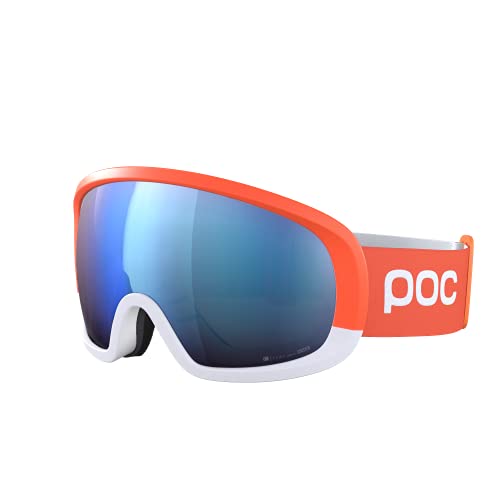
POC Fovea Clarity Comp
POC trims the Fovea Clarity Comp to a low, race-cut frame that sits close to the face for less wind drag at speed. Anti-fog and anti-scratch coatings on the Clarity lens hold up through gate training. A single spherical lens keeps distortion low across a wide field.
Pros
- Low-profile frame cuts drag at race speed
- Anti-fog coating holds up through repeated runs
- Wide spherical lens limits edge distortion
Cons
- Fewer tint choices than touring-oriented models
- Foam runs narrower than all-mountain goggles for long wear
How they stack up
| # | Model | Lens Shape | Best for | Score | Price |
|---|---|---|---|---|---|
| 1 | Smith I/O MAG | Spherical | Best Overall | 9.4 | Check price |
| 2 | Oakley Flight Deck L | Spherical, oversized fit | Best for Wide Field of View | 9.2 | Check price |
| 3 | Anon M4 Toric | Toric | Best for Interchangeable Lenses and Face Mask Integration | 9.0 | Check price |
| 4 | Dragon PXV | Spherical, panoramic single-lens | Best for Low Light and Flat Conditions | 8.7 | Check price |
| 5 | Julbo Aerospace | Reactiv photochromic | Best for Backcountry and High-Altitude Touring | 8.5 | Check price |
| 6 | Giro Axis | Cylindrical or spherical (EXV) | Best Value | 8.2 | Check price |
| 7 | POC Fovea Clarity Comp | Spherical | Best for Racing and Downhill | 8.0 | Check price |
What to look for
What Separates Professional-Grade Goggles From Entry-Level Pairs Spherical lenses curve on two axes, cutting glare more than flat cylindrical shields do. Cylindrical shapes cost less but curve on a single axis, so edge distortion increases. Anti-fog coatings and dual-layer foam matter once exertion raises body heat inside the frame. VLT percentage measures how much light passes through a lens, and lower numbers suit bright days while higher numbers suit flat light.
Picking a Lens for Changing Mountain Light Magnetic systems, like those on the Smith I/O MAG and Anon M4 Toric, let riders switch tint without touching the strap. Julbo’s Reactiv lens takes a different approach, adjusting automatically as clouds roll in. Skiers riding one mountain through changing weather gain the most from a swap system or a photochromic lens instead of a fixed tint.
Getting the Right Fit With Helmets, OTG and Face Masks Helmet-goggle gap causes more discomfort than either product does alone, so frame height should meet the helmet brim without a forehead gap. Eyeglass wearers need OTG-rated frames with extra internal room and vents placed away from the lenses. Anon’s MFI system solves a separate problem, clipping a magnetic face mask onto the goggle frame for exposed skin in deep cold.
Backcountry and High-Altitude Considerations Uphill effort raises body heat and fogging risk faster than lift-served skiing does, which is why the Julbo Aerospace favors open vents over a sealed frame. Altitude increases UV exposure, so full UV400 coverage matters more on glaciers than at low-elevation resorts. Weight counts too on multi-hour tours, favoring light frames over bulkier race-cut designs.
Frequently asked questions
What is the difference between spherical and cylindrical ski goggle lenses?
Spherical lenses curve on both axes, matching the eye’s curve and cutting glare and distortion. Cylindrical lenses curve on one axis, which lowers cost but narrows the field of view slightly at the edges.
What VLT rating is best for ski goggles?
Lower VLT, roughly 5% to 20%, suits bright days on snow. Higher VLT, roughly 50% to 90%, suits flat light, overcast skies and night skiing. Photochromic or magnetic swap lenses cover both ends without buying a second goggle.
Are magnetic lens-swap goggles worth it for advanced skiers?
Owners report faster changes and fewer scratched lenses than hinge-based systems, since magnets avoid direct handling of the lens edge. Replacement lenses cost more on models like the Smith I/O MAG and Anon M4 Toric though.
Can ski goggles fit over glasses?
Goggles labeled OTG carry extra interior depth and vent placement designed to clear standard eyeglass frames. Not every model here is OTG-rated, so glasses wearers should check frame depth specs before buying.
Do ski goggles need to match the helmet brand?
Frame height and helmet brim shape affect how well the gap between goggle and helmet seals against wind and snow. Giro Axis and Smith I/O MAG align closely with their own helmet lines, though most goggles fit helmets across brands.
What causes ski goggles to fog up?
Fogging happens when warm, moist air from the face meets a colder lens surface faster than venting can clear it. Anti-fog coatings, dual-layer lenses and open vents, like the adjustable system on the Julbo Aerospace, cut fogging during high-exertion touring or racing.
Are pricier ski goggles actually better for racing?
Race-cut frames like the POC Fovea Clarity Comp sit lower and tighter to the face, cutting wind drag at speed better than recreational all-mountain goggles. Casual skiers who skip racing gain little from that cut and may prefer a wider field of view instead.
What is the best ski goggle lens for backcountry touring?
Photochromic lenses that shift tint automatically, such as Julbo’s Reactiv on the Aerospace, suit tours where light changes repeatedly between treeline and open alpine terrain. Adjustable venting without a battery fan also matters more on multi-hour climbs than on lift-served days.
How should ski goggles fit on your face?
A properly fitted goggle rests evenly on the face with no gaps at the nose or temples, and the strap sits flat across the helmet without slipping. Foam should compress slightly without pinching, and models like the Oakley Flight Deck L run large enough to crowd narrower faces.
The verdict
Smith I/O MAG remains the top all-around pick, pairing a spherical ChromaPop lens with the fastest magnetic swap in this group for riders who move between resort runs and backcountry laps. Racers get more from the POC Fovea Clarity Comp, since its low-profile frame cuts drag at speed. Anyone climbing for hours should choose the Julbo Aerospace instead, because its adjustable venting and photochromic lens handle fogging and shifting light better than a fixed tint.


