Quiet Generators That Won’t Wake the Whole Campsite
For most campers, the Honda EU2200i balances low noise with dependable wattage among current Amazon listings. The WEN 56203i offers similar quiet operation at a lower cost, making it the strongest value pick. The Champion 200988 dual fuel model adds fuel flexibility for a budget price.
Thin tent walls and campground quiet hours make generator noise the deciding factor for most buyers. Honda’s EU2200i, the WEN 56203i, and Champion’s 200988 dual fuel model each solve that problem differently, from ultra-low decibel ratings to fuel flexibility for longer trips. Wattage needs shift depending on whether you run a CPAP, a mini-fridge, or a small air conditioner.
Noise rating, wattage, and weight often trade off against each other, which makes picking one generator tricky. We compared listed decibel ratings, rated and surge wattage, fuel type, weight, and outlet configuration across current Amazon listings. Grouping came from real use case rather than price alone.
Before you buy
How much wattage do you actually need for camping? A CPAP machine typically draws 40 to 60 continuous watts, well within reach of any inverter generator. Phone and laptop charging adds under 100 watts combined for most setups. Camping mini-fridges pull 100 to 200 running watts but can spike near 600 watts on startup. Small window air conditioners need 1000 to 1800 watts just to start, so match rated wattage, not surge wattage, to your heaviest appliance.
What decibel rating counts as quiet at a campsite? Most US campgrounds enforce quiet hours around 60 dB after 10pm. Inverter generators rated between 48 and 57 dB blend into typical forest ambient noise. Standard open-frame generators often exceed 70 dB, loud enough to draw complaints from neighboring sites. Distance also matters, since perceived volume drops roughly in half every 10 feet from the source.
Gas vs propane vs dual fuel vs battery: which fuel fits your trip? Gasoline offers the widest availability and generally the lowest generator cost. Propane resists the varnish buildup that ruins stored gasoline between camping seasons. Dual fuel models let campers switch based on what’s available at a given site. Battery power stations skip fuel entirely, recharging instead from a wall outlet, vehicle, or solar panel between trips.
Backpacking vs car camping vs RV: matching weight and portability Car campers can accept the 40 to 50 lb range of most inverter generators since a trunk carries the load. Backpackers need a battery station under 25 lbs or may skip a generator entirely. RV owners often parallel two units together to cover air conditioning loads that a single generator cannot handle alone.
Our top picks

Honda EU2200i
At 48 dB on low load, the Honda EU2200i stays under 57 dB even at full output. A 0.95 gallon tank delivers up to 8.1 hours of runtime at quarter load. Two units can sync through Honda’s parallel cable for double the wattage.
Pros
- Consistent quiet operation across load ranges
- Parallel capable for added wattage
- Strong resale value and parts availability
Cons
- Higher cost than most competitors
- Rated wattage limits larger appliances
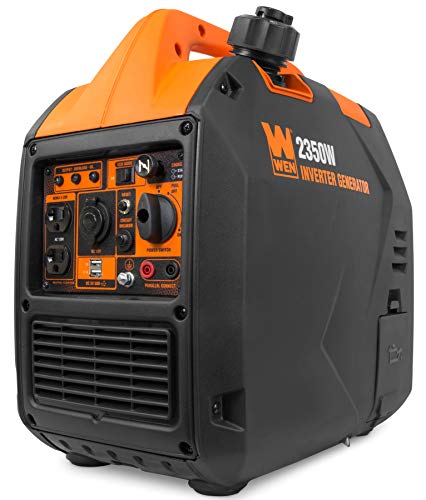
WEN 56203i
Quiet enough for most campground quiet hours, the WEN 56203i produces 51 dB at rated load. A 1 gallon tank powers it for roughly 6 hours at half load. Eco-mode throttling adjusts engine speed to match the connected appliance.
Pros
- Lower price than comparable inverter models
- Eco-mode extends fuel efficiency
- Compact enough for car camping storage
Cons
- No parallel port for combining units
- Recoil start only, no electric start option

Champion 200988
Switching between gasoline and propane takes no tools on the Champion 200988. Propane use trims runtime but avoids stale fuel issues between camping trips. At 59 dB it runs louder than pure inverter competitors, though still below most quiet-hour thresholds.
Pros
- Dual fuel flexibility for longer storage
- Lower price point than single-fuel inverters
- Electric start reduces pull-cord effort
Cons
- Noisier than Honda and WEN models
- Propane tank adds extra gear to pack

Westinghouse iGen2200
Pure sine wave output on the Westinghouse iGen2200 is rated safe for CPAP machines and other sensitive medical electronics. Two outlets, a 12V DC port, and dual USB ports cover typical campsite needs. Parallel cording links two units for higher combined wattage.
Pros
- Pure sine wave output safe for CPAP use
- Multiple outlet types including USB
- Three-year warranty on the unit
Cons
- Heavier than WEN and Champion models
- Fuel gauge sits in a hard to read spot

Yamaha EF2200iS
Owners cite long service life for the Yamaha EF2200iS, built around the same engine platform used in Yamaha’s outdoor power equipment line. Smart Throttle adjusts RPM to cut noise under light loads. Resale value tends to track closely with Honda’s comparable models.
Pros
- Reputation for long-term engine durability
- Smart Throttle lowers noise under light loads
- Holds resale value well
Cons
- Runs louder than Honda at full load
- Limited dealer network for parts in some regions

Jackery Explorer 1000 v2
Fuel disappears entirely with the Jackery Explorer 1000 v2, which runs on a lithium battery pack rechargeable from a wall outlet, car port, or optional solar panel. Zero exhaust and no engine noise make it usable inside a tent vestibule. Total capacity covers a mini-fridge or CPAP for several hours before recharging is needed.
Pros
- Completely silent with no exhaust fumes
- Safe to run near or inside a tent
- Recharges from solar panels off grid
Cons
- Runtime is limited compared to fuel-powered generators
- Recharging from empty takes several hours without solar

Generac GP2200i
A parallel port lets the Generac GP2200i pair with a second unit to power a small RV air conditioner or larger camp setup. Rated at 53 dB, it sits between the WEN and Champion models on the noise scale. A 1.2 gallon tank extends runtime for multi-day trips without refueling.
Pros
- Parallel ready for RV-level power needs
- Larger fuel tank than most 2200-class rivals
- Lower price than Honda and Yamaha
Cons
- Heavier than comparable inverter models
- Fewer accessory outlets than Westinghouse
How they compare
| # | Model | Rated Wattage | Best for | Score | Price |
|---|---|---|---|---|---|
| 1 | Honda EU2200i | 1800W | Best overall | 9.4 | Check price |
| 2 | WEN 56203i | 1700W | Best value | 9.1 | Check price |
| 3 | Champion 200988 | 1850W | Best budget dual fuel | 8.8 | Check price |
| 4 | Westinghouse iGen2200 | 1800W | Best for CPAP and medical devices | 8.6 | Check price |
| 5 | Yamaha EF2200iS | 1800W | Best for reliability and resale | 8.4 | Check price |
| 6 | Jackery Explorer 1000 v2 | 1000W, 2000W surge | Best silent battery alternative | 8.2 | Check price |
| 7 | Generac GP2200i | 1700W | Best for RV and expandable power | 8.0 | Check price |
Questions worth asking
How many watts do I need to run a mini fridge while camping?
Most camping mini-fridges draw 100 to 200 running watts but spike near 600 watts on startup. A generator rated above 700 watts surge covers typical models with room to spare.
What is considered a quiet generator in decibels?
Inverter generators rated between 48 and 57 dB are generally considered quiet enough for campground use. Anything above 65 dB tends to violate typical quiet hour rules after 10pm.
Can I run a CPAP machine on a portable generator?
Yes, as long as the generator produces pure sine wave output like the Westinghouse iGen2200 or Honda EU2200i. Modified sine wave output from cheaper models can interfere with sensitive medical electronics.
Are dual fuel generators as quiet as gas-only inverter models?
Dual fuel units like the Champion 200988 typically run a few decibels louder than pure inverter models such as the WEN 56203i. The tradeoff buys fuel flexibility between gasoline and propane.
Is a battery power station quieter than a gas generator?
Battery stations like the Jackery Explorer 1000 v2 produce no engine noise at all since they store power instead of burning fuel. They trade that silence for a limited runtime before recharging is needed.
Can two inverter generators be connected for more power?
Models with a parallel port, including the Honda EU2200i, Westinghouse iGen2200, and Generac GP2200i, link with a compatible cable. Combining two units roughly doubles available wattage for larger appliances.
How long does a quiet camping generator run on one tank?
Runtime varies by load and tank size, typically 6 to 8 hours at quarter to half load on a 1 gallon tank. Propane-fueled dual fuel models often run shorter than gasoline on an equivalent tank.
What size generator is best for backpacking?
Backpackers generally skip fuel generators altogether in favor of a compact battery station under 25 lbs. A 2200-watt gas inverter generator suits car camping better, where trunk space is not a concern.
Which quiet generator is best for an RV air conditioner?
Parallel-ready models like the Generac GP2200i or Honda EU2200i can link two units together to cover the startup wattage an RV air conditioner needs.
The bottom line
Quiet operation, wattage, and portability pull in different directions, so no single generator wins every category. The Honda EU2200i suits campers who want the quietest reliable option, while the Jackery Explorer 1000 v2 fits anyone chasing zero engine noise. Match the pick to your appliance load and trip length rather than chasing the highest wattage rating.

